
HVAC License Requirements by State 2026: The Complete Guide
March 27, 2026 - 26 min read


March 27, 2026 - 26 min read

Table of Contents
| TL; DR: Every HVAC tech who handles refrigerants needs EPA Section 608 certification; no exceptions, it’s federal law. About 32 states require a state-level HVAC license; the rest leave it to cities and counties, so you’re not necessarily off the hook. The typical path from zero to licensed takes 1–5 years and costs $2,000–$18,000, depending on your education route and state. This guide covers all 50 states, costs, reciprocity, renewal, and the exact steps to get your license. |
The Bureau of Labor Statistics projects roughly 40,000 HVAC job openings every year through the end of the decade. That’s a massive opportunity, but you can’t touch a refrigerant line, pull a permit, or legally bid on most jobs without the right credentials.
Here’s what makes HVAC licensing confusing: there’s no single national license. Instead, you’re dealing with a patchwork of federal requirements (EPA Section 608, mandatory for everyone), state licensing boards (each with its own rules), and local city or county regulations that can override everything above.
Whether you’re a career-changer exploring the HVAC industry, an apprentice planning your next move, or a contractor looking to start an HVAC business, this guide breaks down exactly what you need, state by state, dollar by dollar, step by step.
This guide covers all 50 states, exams, costs, and timelines. If you want a quick answer for your specific state and situation, let AI pull out exactly what applies to you.
KEY HIGHLIGHTS
HVAC License Requirements
Short answer: almost always yes. But the type of license and who issues it depends on where you work and what kind of work you do.
Federal requirement, EPA Section 608 (non-negotiable)
If you handle, recover, or dispose of refrigerants, which covers the vast majority of HVAC work, you must hold EPA Section 608 certification. This is a federal mandate under the Clean Air Act.
No state can waive it.
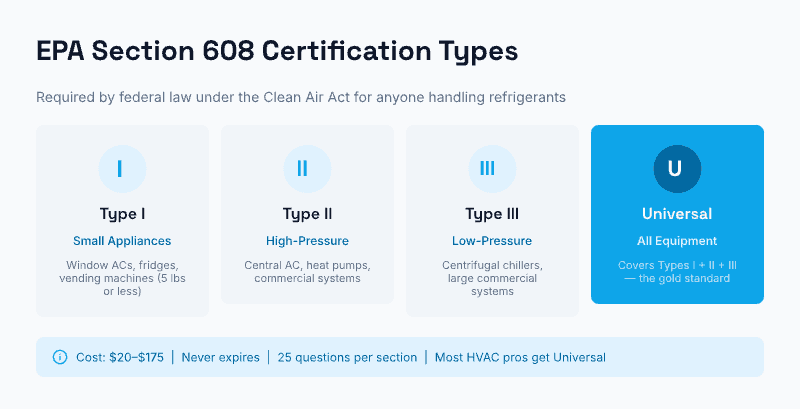
There are four types: Type I (small appliances under 5 lbs of refrigerant), Type II (high-pressure systems, most residential and commercial AC, heat pumps), Type III (low-pressure systems, chillers), and Universal (all of the above; this is what most technicians get).
State requirements (~32 states)
About 32 states require some form of state-level HVAC license. These typically fall into tiers: apprentice, journeyman, master, and contractor, each with escalating experience and exam requirements.
Some states only license contractors (not individual technicians), while others license everyone who touches HVAC equipment.
Local wildcards
Even if your state doesn’t require a state license, your city or county probably does. This is the part that catches people off guard.
For example, Colorado has no state HVAC license, but Denver requires a mechanical license for anyone doing HVAC work within city limits.
Technician vs. contractor
Working under a licensed contractor’s supervision is different from holding your own license. In many states, technicians can perform HVAC work under a licensed employer without their own individual license, but they still need EPA 608.
If you want to bid on jobs, pull permits, or run your own operation, you’ll need a contractor license.
These two terms get used interchangeably, but they’re legally different, and confusing them can cost you.
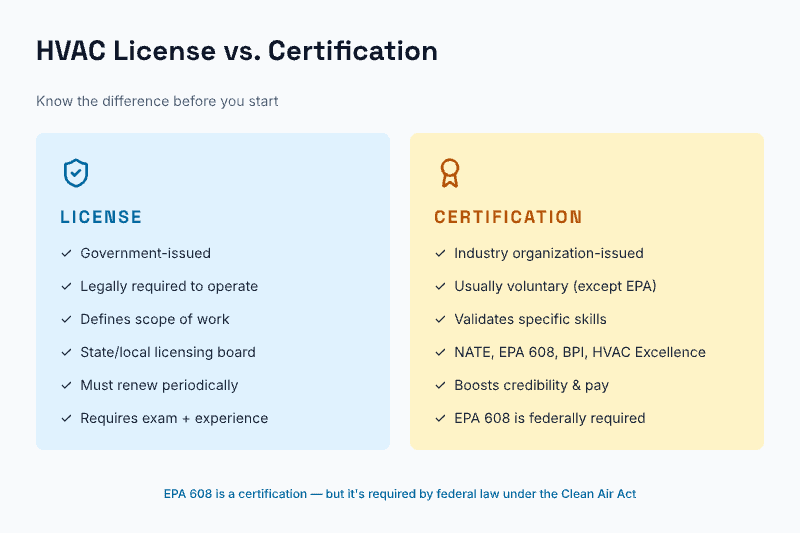
EPA Section 608 is technically a “certification,” but it’s federally required. This trips people up. It’s issued by EPA-approved testing organizations (not state governments), but the Clean Air Act makes it illegal to handle refrigerants without it.
So while it’s called a certification, it functions like a mandatory license.
Voluntary certifications that matter:
NATE (North American Technician Excellence) is the gold standard for HVAC competency. Not legally required, but many employers prefer or require it; NATE-certified techs typically earn 10–15% more.
HVAC Excellence is another respected industry certification program. R-410A certification covers the specific refrigerant that replaces R-22 in most systems; some states require this on top of EPA 608.
BPI (Building Performance Institute) is focused on building science and energy efficiency, useful for techs doing energy audits or whole-home performance work.
Bottom line: You need a license to legally do the work, and certifications to stand out, earn more, and demonstrate expertise to customers.
Most states that license HVAC professionals use a tiered system. Here’s how it typically works.
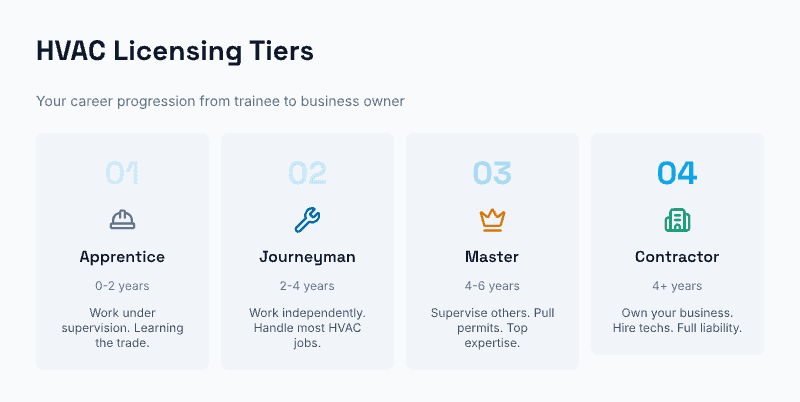
This is your starting point. You work under the direct supervision of a licensed journeyman or master technician. In some states, you need to register as an apprentice; in others, you simply work under a licensed employer.
No experience is required, and the typical duration is 2–5 years. Apprentices cannot work independently or own a business.
The journeyman license is where you gain independence. You’ve completed your apprenticeship (or equivalent education and experience), passed a trade exam, and can now work without direct supervision.
Most states require 2–5 years of documented work under a licensed professional and a proctored trade exam. Journeymen can work independently and can own a business in some states.
The master license represents the highest individual technical credential. Not every state offers this tier, but those that do require 4–8 years total experience and an advanced technical exam.
Master technicians can work independently and own a business in most states.
This is the business license. If you want to pull permits, bid on projects, hire other technicians, and operate your own HVAC company, you typically need a contractor license. This often requires a separate business law exam, proof of insurance, a surety bond, and a registered business entity.
Experience requirements vary; usually 3–7 years of field experience, sometimes a journeyman or master license first.
| Tier | Experience Required | Independent Work? | Own a Business? |
| Apprentice/Trainee | None | No | No |
| Journeyman | 2–5 years | Yes | Some states |
| Master | 4–8 years | Yes | Yes |
| Contractor | 3–7 years + license/exam | Yes | Yes |
If your long-term goal is to start your own HVAC business, plan your career path toward the contractor license from day one. Every hour you log as an apprentice or journeyman counts toward that goal.
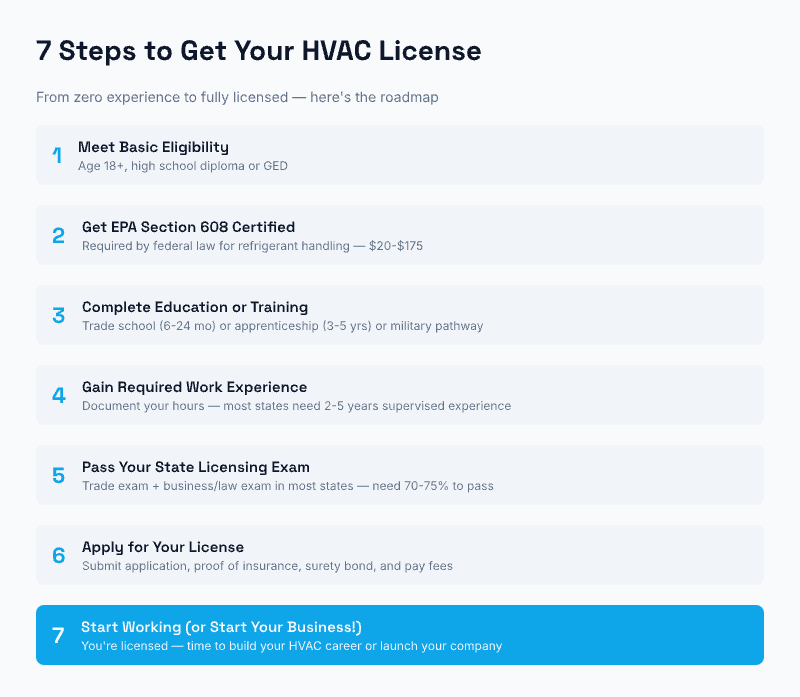
Every state starts with the basics: age 18+ (some states allow apprenticeship registration at 16–17), a high school diploma or GED, a clean criminal record in some states (especially for contractor licenses), and legal work authorization in the U.S.
Don’t skip the background check requirement, as it catches some applicants off guard in states like California and Florida.
Do this early, ideally during or right after your training. You can’t legally work on any system containing refrigerant without it.
The cost ranges from $20–$175 in testing fees. The format is a proctored written exam with a core section plus specialty sections.
Go for the Universal certification (covers Types I, II, and III); it’s the same exam sitting, and there’s no reason to limit yourself. EPA 608 never expires, though if regulations change (like the AIM Act expanding coverage), you may need additional credentials. EPA-approved testing organizations, including ESCO Institute, Mainstream Engineering, and others, offer in-person and online proctored exams.
You have three main paths, and the right one depends on your timeline, budget, and learning style.
Trade school / vocational program (6–24 months) costs $1,200–$15,000 and provides a structured curriculum covering electrical theory, refrigeration, heat transfer, ductwork, controls, and building codes. Many programs include EPA 608 prep. Good for career-changers who want a faster start. Use our HVAC load calculator and HVAC CFM calculator to practice the calculations you’ll encounter in class.
Apprenticeship (3–5 years) lets you earn while you learn, with paid on-the-job training that combines work experience with classroom instruction (usually 144+ hours/year).
Registered apprenticeships through the Department of Labor carry the most weight. Longer timeline, but zero tuition debt and immediate income.
Military pathway, Military HVAC training (HVAC/R MOS programs) counts toward civilian licensing in most states. Some states grant accelerated licensing for veterans with military HVAC experience. Check your state’s veterans licensing reciprocity provisions.
Most states require documented field experience before you can sit for a licensing exam: 2–5 years for a journeyman license, an additional 1–3 years beyond journeyman for master, and 3–7 years total for a contractor license (sometimes requiring a journeyman or master license first).
Document everything. Keep copies of pay stubs, employer verification letters, and hour logs. Some states require your supervising licensee to sign off on your experience hours.
If you can’t prove your hours, they don’t count, no matter how many systems you’ve installed.
Trade school graduates sometimes get 6–12 months of credit toward the experience requirement (varies by state). Apprenticeship hours always count.
Most states that require licensing also require a proctored exam. Expect 80–150 multiple-choice questions over 2–4 hours, with a passing score of 70–75%. Topics covered include refrigeration cycles, electrical theory, load calculations, mechanical codes, safety procedures, and EPA regulations.
Contractor exams often add a business and law component. Costs run $50–$500 per attempt, and most states allow retakes after a 14–90 day waiting period.
Study resources include Modern Refrigeration and Air Conditioning (Althouse), Delmar’s Standard Textbook of Electricity, and online prep platforms. Many local ACCA chapters offer exam prep workshops.
Once you’ve passed the exam, submit a license application to your state’s licensing board. This typically requires proof of EPA 608 certification, exam score verification, experience documentation, proof of general liability insurance (usually $300K–$1M minimum), a surety bond (required in ~20 states, typically $5,000–$25,000), workers’ compensation insurance if you have employees, business registration for contractor licenses, and an application fee of $50–$500.
Processing times vary from 2 weeks to 3 months. California’s Contractors State License Board (CSLB) is notoriously slow; plan for 8–12 weeks.
With your license in hand, you can legally perform HVAC work within your scope and jurisdiction.
If you’re launching a business, you’ll also need to set up your business entity, price your HVAC jobs accurately from day one, get proper HVAC invoicing software, and a free HVAC invoice template.
Build a system for HVAC lead generation, consider HVAC scheduling software to manage your calendar from day one, and estimate HVAC jobs properly using our free HVAC estimate template.
The license gives you legal permission.
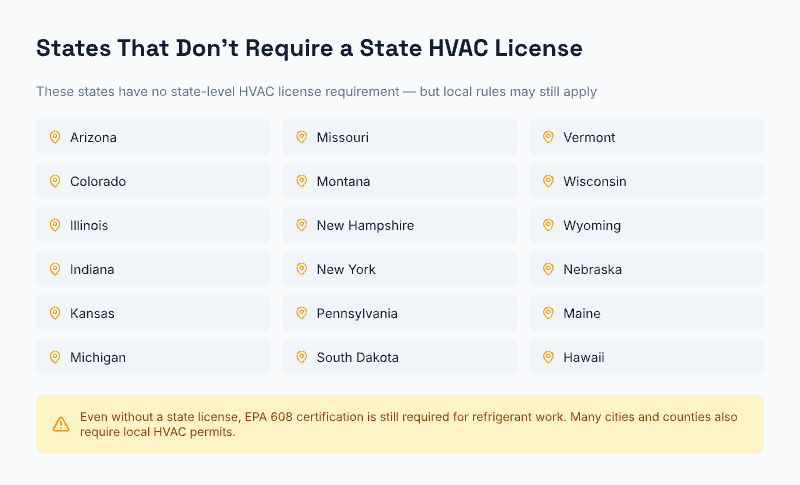
The following states do not require a state-level HVAC license (as of 2026): Colorado, Illinois, Indiana, Kansas, Maine, Massachusetts, Michigan, Minnesota, Missouri, New Hampshire, New York, Ohio, Pennsylvania, South Dakota, Vermont, Wisconsin, and Wyoming.
Before you celebrate, three important warnings:
1. Local requirements still apply. Most of these states push licensing authority down to cities and counties. New York City requires a mechanical license even though New York State does not. Chicago, Denver, Minneapolis, and dozens of other cities have their own HVAC licensing requirements.
Always check with your local building department before starting work.
2. EPA Section 608 is still mandatory. No state exemption overrides federal law. If you’re handling refrigerants, you need EPA 608 regardless of your state’s licensing stance.
3. Getting licensed anyway is smart business. Even where it’s not legally required, holding a license or certification gives you credibility with homeowners who check credentials, better insurance rates, access to jobs that specify “licensed contractors only,” an easier path if you ever move to a state that does require it, and a competitive advantage in growing your HVAC business.
Some of these states are also actively considering statewide licensing legislation, so the list may shrink in the coming years.
| State | License Required? | Experience Needed | Exam? | Reciprocity? | Approx. Cost |
| Alabama | Yes (state) | 4 yrs journeyman, 6 yrs master | Yes | Limited | $100–$300 |
| Alaska | Yes (state, mechanical admin) | 3 yrs journeyman, 6 yrs master | Yes | Limited | $150–$350 |
| Arizona | Yes (state, ROC contractor) | 4 yrs | Yes (trade + business) | Limited | $200–$600 |
| Arkansas | Yes (state) | 4 yrs journeyman | Yes | Limited | $75–$250 |
| California | Yes (state, CSLB C-20) | 4 yrs journeyman-level | Yes (trade + law) | No | $350–$600 |
| Colorado | No (state); local rules vary | N/A | Depends on the city | N/A | Varies locally |
| Connecticut | Yes (state) | 4 yrs | Yes | Limited | $100–$300 |
| Delaware | Yes (state) | 4 yrs | Yes | Limited | $75–$200 |
| Florida | Yes (state, DBPR) | 4 yrs journeyman | Yes (trade + business) | Limited | $200–$500 |
| Georgia | Yes (state, conditioned air contractor) | 4 yrs | Yes | Limited | $150–$350 |
| Hawaii | Yes (state) | 4 yrs | Yes | No | $200–$400 |
| Idaho | Yes (state, HVAC/R) | 4 yrs | Yes | Limited | $75–$200 |
| Illinois | No (state); local rules vary | N/A | Depends on the city | N/A | Varies locally |
| Indiana | No (state); local rules vary | N/A | Depends on the county | N/A | Varies locally |
| Iowa | Yes (state) | 2 yrs | Yes | Limited | $50–$150 |
| Kansas | No (state); local rules vary | N/A | Depends on the city | N/A | Varies locally |
| Kentucky | Yes (state) | 4 yrs journeyman | Yes | Limited | $50–$200 |
| Louisiana | Yes (state) | 4 yrs journeyman | Yes | Limited | $150–$350 |
| Maine | No (state); local rules vary | N/A | Depends on the municipality | N/A | Varies locally |
| Maryland | Yes (state, DLLR) | 4 yrs journeyman, 7 yrs master | Yes | Limited | $100–$300 |
| Massachusetts | No (state); local rules vary | N/A | Depends on the city/town | N/A | Varies locally |
| Michigan | No (state); local rules vary | N/A | Depends on the municipality | N/A | Varies locally |
| Minnesota | No (state); local rules vary | N/A | Depends on the city | N/A | Varies locally |
| Mississippi | Yes (state) | 3 yrs | Yes | Limited | $100–$250 |
| Missouri | No (state); local rules vary | N/A | Depends on the city | N/A | Varies locally |
| Montana | Yes (state) | 4 yrs | Yes | Limited | $75–$200 |
| Nebraska | Yes (state) | 2 yrs | Yes | Yes | $50–$150 |
| Nevada | Yes (state) | 4 yrs | Yes (trade + law) | Limited | $200–$500 |
| New Hampshire | No (state); local rules vary | N/A | Depends on the municipality | N/A | Varies locally |
| New Jersey | Yes (state, mechanical contractor) | 5 yrs | Yes | Limited | $150–$350 |
| New Mexico | Yes (state) | 4 yrs journeyman | Yes | Limited | $100–$300 |
| New York | No (state); local rules vary | N/A | NYC requires a license | N/A | Varies locally |
| North Carolina | Yes (state, NCBEEC) | 3 yrs | Yes | Limited | $100–$350 |
| North Dakota | Yes (state) | 4 yrs | Yes | Yes | $75–$200 |
| Ohio | No (state); local rules vary | N/A | Depends on the city/county | N/A | Varies locally |
| Oklahoma | Yes (state, mechanical) | 4 yrs | Yes | No | $100–$300 |
| Oregon | Yes (state) | 4 yrs | Yes | Limited | $100–$300 |
| Pennsylvania | No (state); local rules vary | N/A | Depends on the municipality | N/A | Varies locally |
| Rhode Island | Yes (state) | 4 yrs | Yes | Limited | $50–$200 |
| South Carolina | Yes (state, mechanical contractor) | 4 yrs | Yes | Limited | $100–$350 |
| South Dakota | No (state); local rules vary | N/A | Depends on the municipality | N/A | Varies locally |
| Tennessee | Yes (state, contractor) | 3 yrs | Yes | Limited | $100–$300 |
| Texas | Yes (state, TDLR ACR license) | 2 yrs technician, 4 yrs contractor | Yes | Limited | $100–$350 |
| Utah | Yes (state, DOPL) | 4 yrs journeyman | Yes | Limited | $100–$250 |
| Vermont | No (state); local rules vary | N/A | Depends on the municipality | N/A | Varies locally |
| Virginia | Yes (state, DPOR) | 4 yrs journeyman | Yes | Limited | $150–$350 |
| Washington | Yes (state, L&I) | 4 yrs journeyman | Yes | Limited | $100–$300 |
| West Virginia | Yes (state) | 4 yrs | Yes | Limited | $50–$200 |
| Wisconsin | No (state); local rules vary | N/A | Depends on the municipality | N/A | Varies locally |
| Wyoming | No (state); local rules vary | N/A | Depends on the municipality | N/A | Varies locally |
| Washington, D.C. | Yes | 4 yrs | Yes | Limited | $150–$350 |
Notes on specific states:
California: One of the strictest states. Requires the C-20 (Warm-Air Heating, Ventilating, and Air-Conditioning) license from the CSLB.
Separate C-38 license for refrigeration. No reciprocity with any other state. Expect 8–12 weeks processing time.
Texas: The TDLR issues ACR (Air Conditioning and Refrigeration) licenses at technician and contractor levels. Texas also requires a separate municipal license in some cities.
Florida: The DBPR requires both a trade exam and a business exam for contractors. Class A (unlimited) and Class B (limited) contractor designations exist.
North Carolina: The NCBEEC oversees HVAC licensing. H-1, H-2, and H-3 classifications cover different scopes of work.
New York: No state license, but NYC has its own rigorous mechanical licensing through the Department of Buildings. If you work in NYC, you need it.
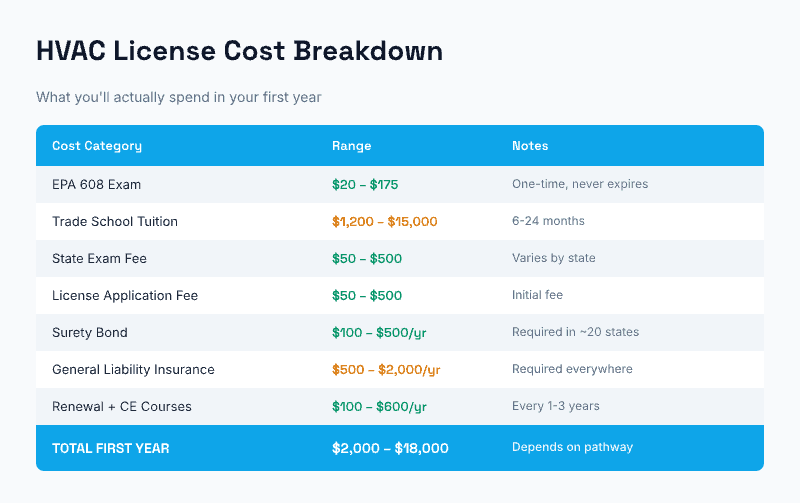
The biggest variable is education. If you go the apprenticeship route, you avoid tuition entirely and earn a paycheck from day one. Trade school gets you in the field faster but costs more upfront. After your initial investment, annual costs settle to roughly $700–$3,000/year for insurance, renewal fees, CE courses, and bond premiums.
Use our profit margin calculator to see how licensing costs factor into your overall HVAC profit margins. Our service price calculator can help you bake these costs into your pricing.
License reciprocity means one state recognizes another state’s HVAC license, allowing you to work there without starting the licensing process from scratch. In practice, it usually means a simplified application with no re-examination, reduced experience documentation, and sometimes just a fee and a background check.
Approximately 34 states offer some form of reciprocity or credential recognition, but the details vary enormously.
Some states have formal reciprocity agreements with specific states; others accept out-of-state licenses on a case-by-case basis; a few require that your original state’s standards meet or exceed theirs.
States with no reciprocity: California, Hawaii, Oklahoma, and a handful of others that evaluate case-by-case but rarely accept.
How to transfer your license: Contact the destination state’s licensing board, request their reciprocity application, provide your current license verification, submit experience documentation if required, pay the application fee, and wait for approval (2–8 weeks typically).
Always verify current requirements directly with the destination state. Reciprocity agreements change, and what worked last year may not apply today.
This is especially important for HVAC contractors managing teams across state lines; see our HVAC dispatching tips for managing multi-state operations effectively.
Most states require renewal every 1–3 years. Annual renewal is required in Texas, Virginia, North Carolina, and other states. Biennial renewal (every 2 years) applies in Florida, Georgia, Maryland, and other states.
Triennial renewal (every 3 years) applies in California, Arizona, and other states.
Continuing education (CE) requirements: Most states require 4–8 CE hours per cycle, with stricter states like Florida requiring 12–16 hours. CE courses cover code updates, new refrigerant regulations (AIM Act compliance), safety standards, and business law changes.
Many are available online, though some states require in-person instruction for certain topics.
What happens if your license lapses: Some states offer a 30–90 day grace period to renew late with a penalty fee. With an expired license, you cannot legally perform HVAC work.
If your license has expired for 1+ years, many states require you to retake the licensing exam.
Pro tip: Set calendar reminders 90 days before your renewal date. If you manage a team, this is exactly the kind of administrative detail that HVAC software handles for you, tracking every technician’s license and certification expiration dates automatically.
Financial penalties: Fines range from $500 to $10,000+ per violation, depending on the state. Repeat offenses increase penalties exponentially. Some states impose per-day fines for ongoing unlicensed operation.
Criminal charges: In several states (Florida, California, Texas, among others), operating without a license is a misdemeanor on the first offense. Repeat offenses can escalate to felony charges in some jurisdictions. Criminal convictions can permanently disqualify you from future licensing.
Insurance and liability: Your general liability insurance may void coverage for work performed without proper licensing. If something goes wrong (fire, property damage, injury), you’re personally liable, with no insurance safety net. Homeowner’s insurance may deny claims for work done by unlicensed contractors.
Business consequences: You cannot pull building permits, meaning your installations can’t pass inspection. Contracts with customers may be legally void, meaning you can’t collect payment through the courts. Government and commercial jobs are completely off-limits. Your reputation takes a permanent hit if violations become public record.
Bottom line: The cost of getting licensed is far cheaper than the cost of getting caught without one.
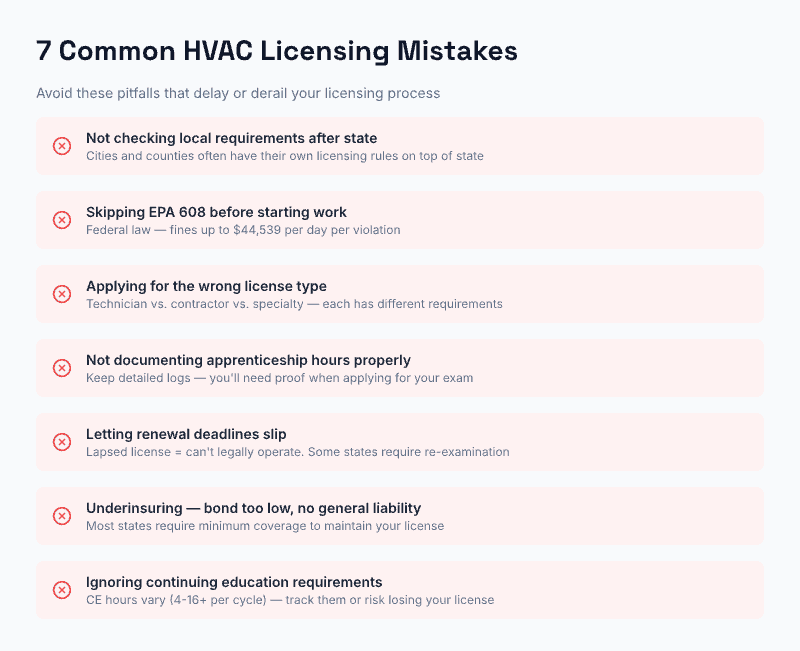
1. Not checking local requirements after state requirements. You confirmed your state doesn’t require a license, so you’re good, right? Wrong. Your city, county, or municipality may have its own licensing requirements.
Always check both levels. Call your local building department; a 5-minute phone call can save you from fines.
2. Skipping EPA 608 before starting work. Some apprentices start working on systems before getting EPA 608 certified, thinking they’ll “get around to it.”
This is a federal violation. Get it done before you touch your first refrigerant line; it’s a straightforward exam, and you only need to do it once.
3. Applying for the wrong license type. A journeyman license doesn’t let you pull permits or run a business in most states. Know the difference between tiers before you invest time and money in the wrong path.
4. Not documenting apprenticeship hours properly. Your supervising licensee needs to sign off on your hours. Keep a running log: dates, job types, hours worked, supervisor name, and license number.
If your employer goes out of business or your supervisor retires, recovering those records becomes nearly impossible.
5. Letting renewal deadlines slip. An expired license means you can’t legally work. In some states, lapsing for more than a year requires re-examination.
Set reminders, mark your calendar, and treat your renewal date as a business-critical deadline.
6. Underinsuring, or skipping insurance entirely. Some states require specific minimum coverage amounts. Even where minimums are low, carrying inadequate insurance is a business risk that can wipe you out with a single claim. Talk to an insurance broker who specialises in contractor coverage.
7. Ignoring continuing education requirements. CE hours keep you current on code changes, new refrigerant regulations, and evolving best practices. Falling behind on CE can result in license suspension at renewal time.
Once you’re past the solo-operator stage and growing your HVAC business, license management becomes exponentially more complex. Every technician on your team has their own set of credentials with different expiration dates, CE requirements, and scope limitations.
The challenge: multiple technicians, each with different license tiers and renewal dates; EPA 608 certifications to track; NATE certifications that recertify every 2 years; state licenses that renew on different cycles; CE completion records for each team member; and insurance and bonding that must stay current.
What happens when something falls through the cracks: A technician’s license expires without anyone noticing; your company is liable for any work they performed after expiration.
A missed CE requirement means a license is suspended at renewal. No EPA 608 on file means an instant violation during any inspection or audit.
How to stay on top of it: Maintain a centralised digital record of every team member’s credentials. Set automated reminders 90, 60, and 30 days before any expiration. Assign one person as the compliance owner. Require new hires to provide credential documentation before their first day on the job.
This is where HVAC software becomes genuinely useful, not for flashy features but for the unglamorous work of keeping your team compliant.
FieldCamp lets you store technician credentials, set expiration alerts, and keep everything in one place so nothing slips. Combined with AI job scheduling and AI dispatch scheduling, you can even assign jobs based on which technicians hold the right credentials for specific work types.
If you’re evaluating HVAC business tools, our guides on the best HVAC apps, the best HVAC CRM, and HVAC dispatch software can help you find the right fit.
Getting your HVAC license isn’t a one-afternoon task; it’s a multi-year investment in your career. But it’s an investment that pays off in higher earning potential, legal protection, customer trust, and the ability to build something of your own.
Your action plan: get EPA 608 certified first (it’s fast, and you need it no matter what); check your state’s requirements using the table above; choose your education path (trade school, apprenticeship, or a combination); document everything as you accumulate experience hours; pass your exam and apply; then keep your license current with timely renewals.
The HVAC industry isn’t slowing down. With heat pump adoption accelerating, energy efficiency regulations tightening, and an aging workforce creating opportunities for new professionals, there’s never been a better time to get licensed.
A License Gets You in the Door. The Right Software Keeps You Profitable.
FieldCamp stores your team’s certifications, assigns jobs only to qualified techs, and handles scheduling, invoicing, and follow-ups, so you can focus on the work, not the admin.
It depends on your path. The fastest route, trade school plus a state with a 2-year experience requirement, can get you licensed in about 2.5–3 years total. The apprenticeship route typically takes 4–5 years. If your state requires a master or contractor license, add 1–3 more years beyond journeyman. EPA 608 certification can be earned in a single day of studying and testing.
You can complete some components online, including EPA 608 prep courses, CE hours, and some state application forms. However, most state licensing exams must be taken in person at a proctored testing centre. Some states moved to online proctored exams during COVID and have kept that option. Check with your state’s licensing board for current testing format options.
In most cases, yes. Mini-split systems contain refrigerant, which means EPA 608 certification is federally required. Beyond that, your state and local requirements apply the same as they would for any HVAC installation. Some states have limited exemptions for ductless systems installed by homeowners on their own property, but these are rare and narrow. If you’re doing it for a customer, you need proper licensing.
HVAC stands for Heating, Ventilation, and Air Conditioning. HVAC-R adds Refrigeration, covering commercial refrigeration systems (walk-in coolers, cold storage, supermarket cases). Some states license HVAC and refrigeration separately, while others combine them. If you plan to work on commercial refrigeration, check whether your state requires a separate refrigeration license or classification.
The numbers say yes. The Bureau of Labor Statistics reports a median annual wage of $57,300 for HVAC technicians, with the top 10% earning over $80,000. HVAC industry trends show continued growth driven by new construction, energy efficiency mandates, heat pump adoption, and the ongoing refrigerant transition (R-410A to R-454B). Job growth is projected at 6% through 2032, faster than the national average. For more on the financial side, check our guide on HVAC profit margins.
According to BLS data: entry-level/apprentice earns $30,000–$40,000/year; journeyman earns $45,000–$65,000/year; master technician earns $60,000–$80,000/year; contractor/business owner earns $75,000–$150,000+ (highly variable based on market and business size). NATE-certified technicians earn roughly 10–15% more than non-certified peers in the same role. HVAC techs in high-cost metro areas earn 20–40% above the national median.
This varies by state. Some states only license work that involves refrigerant circuits (which would exempt pure ductwork). Others license all mechanical work, including ventilation and sheet metal. Even if ductwork is exempt from HVAC licensing, you may still need a general contractor license or a sheet metal license depending on your jurisdiction.
Most state licensing boards offer an online license lookup tool. Search by the contractor’s name or license number to verify current status, license type, expiration date, and any disciplinary actions. This is also a good practice for HVAC business owners; verify that any subcontractors you work with are properly licensed to protect your own liability. — *This guide is for informational purposes only and does not constitute legal advice. HVAC licensing requirements change frequently. Always verify current requirements directly with your state’s licensing board and local building department before starting work.*