
How to Estimate HVAC Jobs in 2026: The Complete Step-by-Step Guide
March 26, 2026 - 22 min read


March 26, 2026 - 22 min read

Table of Contents
| TL; DR: A professional HVAC estimate starts with a qualifying phone call, moves through a detailed site survey and Manual J load calculation, then layers materials + fully burdened labor + overhead + profit margin into a Good-Better-Best proposal. Most contractors lose money by using base wages instead of burdened rates ($51+/hr vs. $26/hr), skipping load calculations, and presenting a single option instead of three tiers. This guide gives you the exact formulas, real 2026 cost tables, and step-by-step process to price every job accurately and close more of the estimates you send out. |
The HVAC industry is one of the few trades where a single bad estimate can quietly erase an entire week’s profit.
Bid too high, and the homeowner picks your competitor. Bid too low, and you win the job, but watch your margin disappear once the real costs hit: the corroded line set nobody spotted, the panel upgrades nobody budgeted for, the extra four hours of labor nobody accounted for.
What separates the contractors pulling 20%+ net margins from those scraping by at 5%? It’s rarely a marketing or sales skill.
It’s estimating accuracy, knowing exactly what a job costs, adding the right markup, and presenting it in a way that makes the customer choose your Better or Best tier instead of shopping three more quotes.
Whether you’re a new HVAC business owner building your first pricebook or a seasoned contractor tightening up a process that’s been running on gut feel, this guide walks you through every step, from the qualifying phone call to the signed proposal, with real 2026 pricing, actual formulas, and templates you can put to work today.
Need an estimate template right now? Grab our free HVAC Estimate Template, it includes all the line items covered in this guide.
This guide is packed with formulas, cost tables, and worked examples. If you’d rather get a quick breakdown tailored to your specific job type and crew size, let AI help you.
KEY HIGHLIGHTS
How to Estimate HVAC Jobs
Before we get into the step-by-step, here’s what a complete, professional HVAC estimate contains. Missing any of these creates confusion, disputes, or margin leaks.
| Section | What to Include | Why It Matters |
| Company info | Business name, logo, license #, insurance, contact | Establishes credibility and legal compliance |
| Customer info | Name, service address, phone, email | Ensures accurate job assignment and follow-up |
| Estimate number | Unique sequential number | Tracking, reference, and accounting |
| Scope of work | Detailed description of what you’ll do (and what you won’t) | Prevents scope creep and “I thought that was included” disputes |
| Equipment details | Brand, model, size (tonnage), efficiency (SEER2), warranty | Homeowners need this for comparison shopping and rebate applications |
| Material line items | Each material with quantity and price | Transparency builds trust and reduces negotiation |
| Labor | Hours or flat-rate price for installation/service | Can be itemized or bundled depending on your pricing model |
| Permits & inspections | Cost and who pulls them (you or the homeowner) | Many jurisdictions require permits for HVAC installations |
| Taxes | Sales tax on equipment and materials | Varies by state, some exempt labor, some don’t |
| Total price | Clear, prominent total | No ambiguity about what the customer is agreeing to pay |
| Payment terms | Deposit amount, balance due date, accepted methods | Sets expectations before work begins |
| Validity period | How long the estimate is good for (typically 30 days) | Protects you from material price changes |
| Exclusions | What’s NOT included (electrical upgrades, drywall repair, asbestos removal) | Your biggest legal and financial protection |
| Warranty info | Differentiator: Most competitors skip this | Differentiator, most competitors skip this |
A good estimate covers the basics above. A great estimate also includes photos from the site survey showing current equipment condition, a load calculation summary proving the equipment is properly sized, Good-Better-Best options, financing options for jobs over $3,000, a maintenance agreement offer bundled with installation, a timeline showing when you’ll start and how long it will take, and your license and insurance certificates as attachments.
Not every lead deserves an on-site estimate. An estimated visit costs you $50–$150 in technician time, drive time, and opportunity cost. Before scheduling, qualify by phone.
Questions to ask: What system do you currently have? What’s the problem? What’s your timeline? Have you gotten other estimates? What’s your budget range? Is the homeowner available for the estimate visit?
Bid/no-bid criteria:
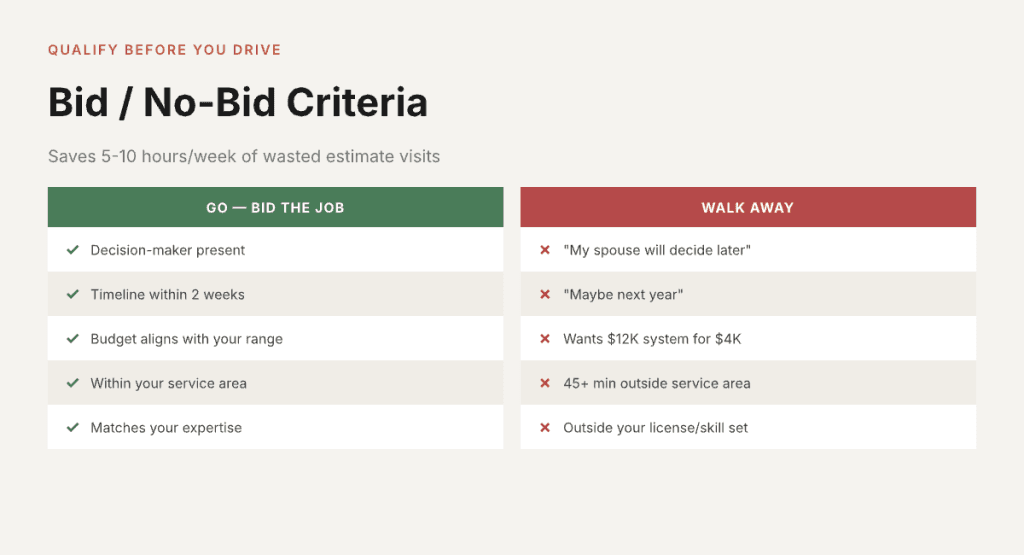
Qualifying saves you 5–10 hours per week of wasted estimate visits. That time goes to jobs you’ll actually win.
This is where most estimating errors happen. Rushing through the site survey or skipping it entirely is how you end up eating $2,000 on a job because you didn’t notice the 6-inch crawl space or the panel that needs an upgrade.
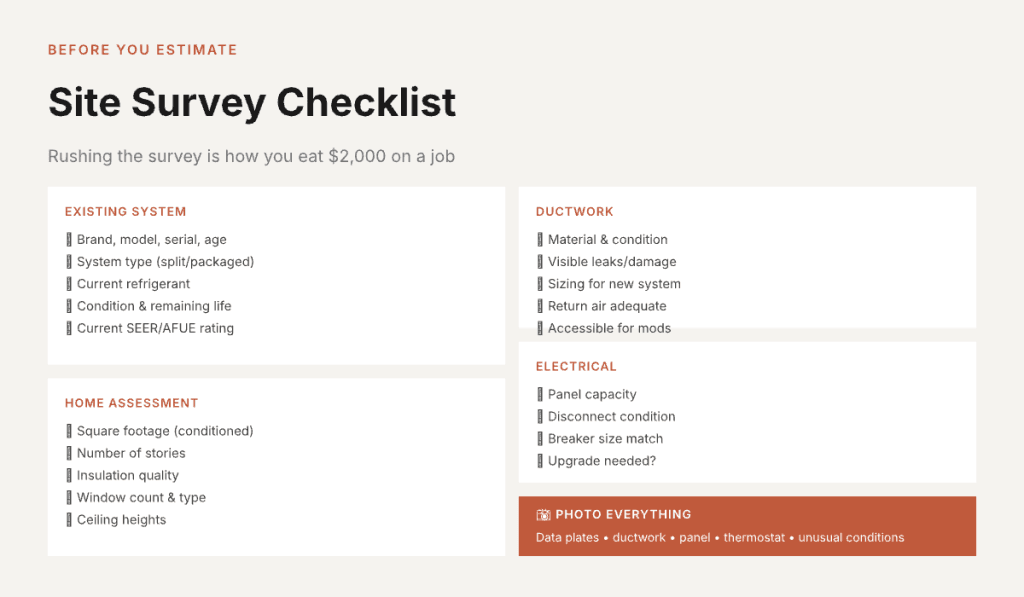
Take photos of everything. Equipment data plates, ductwork connections, electrical panel, thermostat, and any unusual conditions.
These photos protect you if the customer disputes the scope later, and they help your team prepare for installation day.
Never size equipment based on “what was there before” or “1 ton per 500 square feet.” Those rules of thumb lead to oversized or undersized systems that cause comfort complaints, efficiency losses, and warranty issues.
Run a proper Manual J load calculation for every installation estimate. This accounts for square footage and building envelope, insulation R-values, window area and orientation, occupancy and internal heat gains, climate zone and design temperatures, and ductwork losses.
Tools for load calculations: FieldCamp’s HVAC Load Calculator (free, web-based, covers residential), HVAC CFM Calculator for airflow verification, Wrightsoft for detailed Manual J/S/D, and CoolCalc for free basic residential.
Why this matters for your estimate: A properly sized 3-ton system costs $3,500–$5,500 wholesale. An oversized 5-ton system costs $5,000–$8,000. Getting the size wrong doesn’t just waste the customer’s money; it wastes yours if you quoted based on incorrect tonnage.
Once you know the system size, build your material list. Here’s what a typical residential AC replacement includes:
Equipment & Material Cost Breakdown: 3-Ton AC Replacement
| Item | Estimated Cost (Your Cost) | Notes |
| Condenser (3-ton, 16 SEER2) | $1,800–$2,800 | R-454B ready for 2026 |
| Evaporator coil | $400–$800 | Matched to the condenser |
| Thermostat | $50–$250 | Basic to smart (Ecobee, Nest) |
| Refrigerant (R-454B) | $150–$300 | New standard replacing R-410A |
| Line set (30 ft) | $80–$150 | Pre-charged or field-charged |
| Disconnect box | $30–$60 | If existing needs replacement |
| Concrete pad | $40–$80 | If the existing is cracked/settled |
| Drain line materials | $20–$40 | PVC, trap, fittings |
| Electrical materials | $50–$100 | Wire, breaker, whips |
| Miscellaneous (tape, mastic, supports) | $40–$80 | Always budget this |
| Total Materials | $2,660–$4,660 |
Get current pricing from your distributor the same day you survey the job and build your estimate within 24 hours while pricing is current. Never pull prices from memory or last month’s catalog.
2026 pricing note: The industry transition from R-410A to R-454B refrigerant is increasing equipment costs by 10–15% across most manufacturers. Factoring this into your estimates, using last year’s pricing will destroy your margins.
Labor is typically 35–55% of total job cost. Getting this wrong is the fastest way to blow your margins.
The Fully Burdened Labor Rate Formula:
Fully Burdened Rate = (Annual Wages + Payroll Taxes + Benefits + Insurance + Training) ÷ Annual Billable Hours
| Component | Annual Cost |
| Technician’s base salary | $55,000 |
| Payroll taxes (7.65% FICA + SUTA/FUTA) | $5,500 |
| Health insurance | $6,000 |
| Workers’ compensation | $4,400 |
| Paid time off (2 weeks) | $2,115 |
| Training and certifications | $1,500 |
| Total annual labor cost | $74,515 |
| Annual billable hours (2,080 × 70% utilization) | 1,456 hours |
| Fully burdened rate | $51.18/hour |
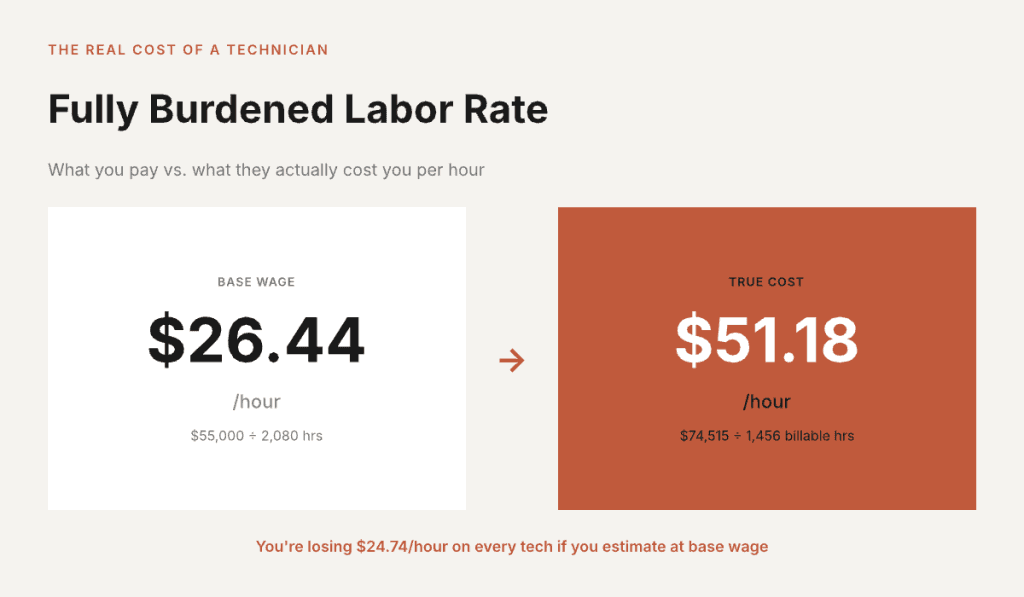
Your tech’s W-2 says $55,000, but they actually cost you $74,515. If you’re estimating labor at $55K ÷ 2,080 hours = $26.44/hour, you’re losing $24.74 on every single hour they work.
Use our Labor Cost Calculator to get your exact burdened rate.
Labor hours by common HVAC job type:
| Job Type | Typical Labor Hours | Crew Size |
| AC replacement (split system) | 6–10 hours | 2 techs |
| Furnace replacement | 4–8 hours | 2 techs |
| Full system (AC + furnace) | 8–14 hours | 2 techs |
| Heat pump installation | 6–12 hours | 2 techs |
| Mini-split (single zone) | 4–6 hours | 1–2 techs |
| Mini-split (multi-zone, 3–4 heads) | 10–16 hours | 2 techs |
| Ductwork replacement (full house) | 16–24 hours | 2–3 techs |
| Service/repair call | 0.5–3 hours | 1 tech |
| Maintenance tune-up | 0.5–1 hour | 1 tech |
Labor cost for our 3-ton AC replacement example: 2 techs × 8 hours × $51.18/hour = $819 total labor cost
This is where most HVAC contractors underestimate, and where profit margins get destroyed.
| Overhead Category | Typical Monthly Cost | Annual |
| Vehicle payment + insurance (per truck) | $800–$1,200 | $9,600–$14,400 |
| Fuel (per truck) | $400–$700 | $4,800–$8,400 |
| Shop/office rent | $1,000–$3,000 | $12,000–$36,000 |
| Office staff salary | $3,300–$4,500 | $40,000–$55,000 |
| General liability insurance | $300–$800 | $3,600–$9,600 |
| Marketing & advertising | $500–$2,000 | $6,000–$24,000 |
| Software (CRM, accounting) | $100–$500 | $1,200–$6,000 |
| Phone, internet, supplies | $200–$400 | $2,400–$4,800 |
| Total overhead (5-tech company) | $6,600–$13,100 | $79,600–$158,200 |
Overhead allocation per billable hour: Using a 5-tech company with $120,000/year overhead and 7,280 annual billable hours (5 techs × 1,456 hours): $120,000 ÷ 7,280 = $16.48/hour
Overhead for our 3-ton AC replacement: 16 total labor hours × $16.48 = $263.68
Now add your target profit margin. Industry standard for residential installation is 15–25% net margin. Using 20%:
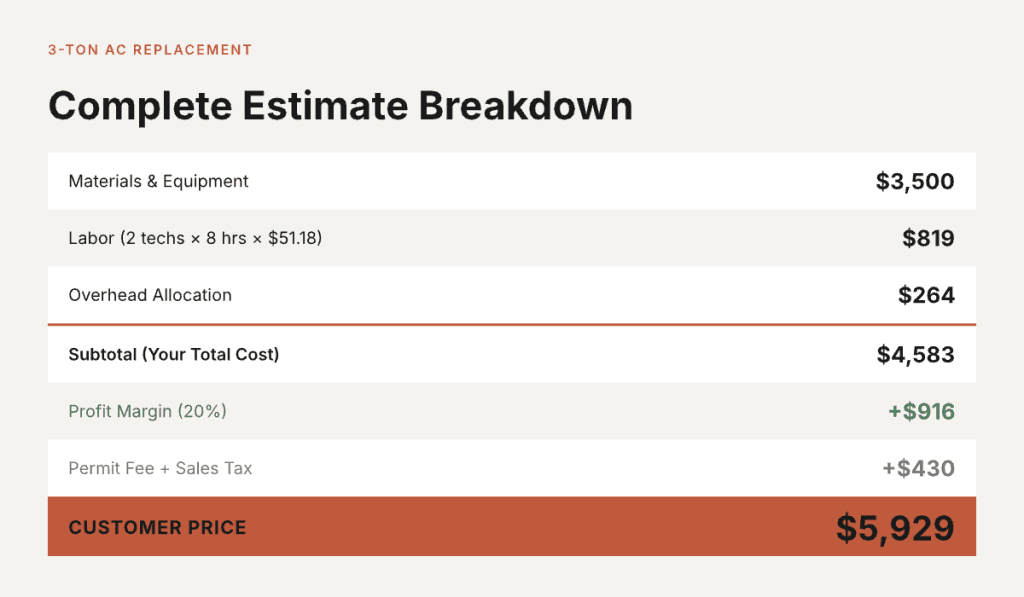
Every HVAC estimate you write should follow this exact structure: materials + labor + overhead + profit + fees + tax.
If you’re skipping any component, you’re undercharging. For pricing strategy beyond this mechanical calculation, see our complete HVAC pricing guide.
Here’s where you turn a $5,929 estimate into a $7,500–$9,000 sale. Never present a single option. Always present three.
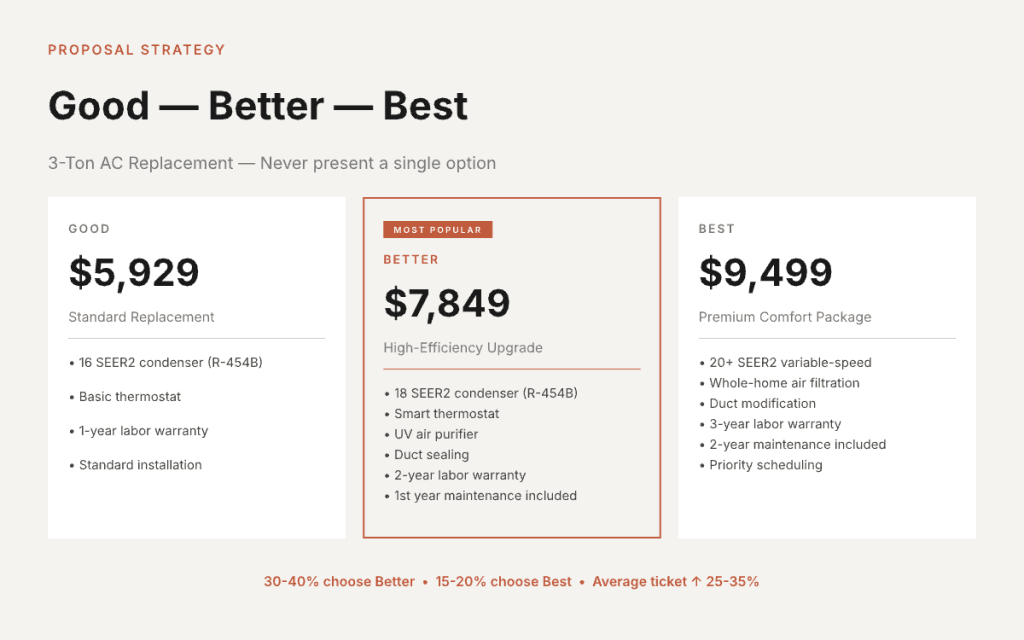
Good: Standard Replacement — $5,929
Better: High-Efficiency Upgrade — $7,849
Everything in Good, PLUS:
Customer savings: Higher SEER2 saves approximately $200–$350/year on energy bills. System pays for the upgrade in 5–6 years.
Best: Premium Comfort Package — $9,499
Everything is better, PLUS:
Why Good-Better-Best works: 30–40% of customers choose the middle tier, and 15–20% choose the premium tier. Average ticket increases 25–35% compared to single-option estimates.
The “Good” option anchors low, making “Better” feel reasonable. The “Best” option makes “Better” look like a smart compromise.
Build these tiers directly into your estimate templates so every tech presents them consistently. Inconsistent presentations across your team cost you thousands in lost upsells.
During the Presentation:
Start with the problem, not the price. Show photos from the site survey. Explain what you found, what it means, and what happens if they do nothing: “Your compressor is showing early signs of failure. This unit is 14 years old with a 15-year expected lifespan. Repair is possible, but you’d be investing $800 in a system that may fail within a year.”
Present all three options, walk through Good, Better, Best, and let the customer self-select. Explain value, not just features: “The 18 SEER2 unit in the Better package saves roughly $300/year on your electric bill; it pays for itself in under six years.”
Address financing proactively: “If the total feels like a lot right now, we offer financing starting at $159/month with approved credit.”
Include a deadline: “This estimate is valid for 30 days. Equipment pricing changes quarterly, and I can’t guarantee these numbers after that.”
After the Presentation:
| Timeframe | Action |
| Same day | Send the written estimate via email (use estimating software for instant delivery) |
| Day 2 | Text message: “Hi [name], just checking if you had any questions about the options we discussed.” |
| Day 5 | Phone call: “Wanted to follow up on the estimate. Any questions I can answer?” |
| Day 10 | Email with seasonal urgency: “Scheduling is filling up for [month] — wanted to make sure you have a spot if you’d like to move forward.” |
| Day 21 | Final follow-up: “Your estimate expires in 9 days. Happy to answer any last questions.” |
Automate this. Use your CRM’s workflow automation to trigger these follow-ups automatically. Manual follow-up doesn’t scale; you’ll forget by day 3 when 10 new leads come in.
Close rate benchmarks: Average HVAC close rate is 30–40%. Top performers hit 50–65%. If you’re below 25%, your pricing is too high, or your presentation needs work. If you’re above 70%, you’re probably priced too low.
Here are complete cost breakdowns for the most common HVAC jobs in 2026. Your costs will vary by region, but the structure applies everywhere.
| Component | Cost Range |
| Condenser (16–20 SEER2, R-454B) | $1,800–$4,500 |
| Evaporator coil | $400–$800 |
| Thermostat | $50–$250 |
| Refrigerant, line set, electrical, misc. | $350–$700 |
| Labor (2 techs × 6–10 hrs) | $600–$1,050 |
| Overhead allocation | $200–$350 |
| Permit | $100–$250 |
| Your total cost | $3,500–$7,900 |
| Customer price (20% margin) | $4,625–$10,000 |
| Component | Cost Range |
| Furnace (80K BTU, 96% AFUE) | $1,200–$3,000 |
| Flue/venting modifications | $100–$500 |
| Thermostat | $50–$250 |
| Gas line, electrical, misc. | $150–$400 |
| Labor (2 techs × 4–8 hrs) | $400–$850 |
| Overhead allocation | $130–$280 |
| Permit | $75–$200 |
| Your total cost | $2,105–$5,480 |
| Customer price (20% margin) | $2,780–$7,225 |
| Component | Cost Range |
| Condenser + coil + furnace (matched system) | $3,500–$8,000 |
| Thermostat | $50–$250 |
| All materials (line set, electrical, flue, misc.) | $400–$900 |
| Labor (2 techs × 8–14 hrs) | $800–$1,450 |
| Overhead allocation | $260–$480 |
| Permit | $150–$300 |
| Your total cost | $5,160–$11,380 |
| Customer price (20% margin) | $6,825–$15,000 |
| Component | Cost Range |
| Heat pump (3-ton, 16–20 SEER2) | $2,500–$5,500 |
| Air handler or coil | $500–$1,200 |
| Thermostat (heat pump compatible) | $100–$300 |
| Refrigerant, line set, electrical, misc. | $400–$800 |
| Labor (2 techs × 6–12 hrs) | $600–$1,250 |
| Overhead allocation | $200–$400 |
| Permit | $100–$250 |
| Your total cost | $4,400–$9,700 |
| Customer price (20% margin) | $5,825–$12,800 |
| Component | Cost Range |
| Mini-split unit (12K BTU) | $800–$2,000 |
| Line set and mounting bracket | $100–$250 |
| Electrical | $100–$300 |
| Labor (1–2 techs × 4–6 hrs) | $200–$625 |
| Overhead allocation | $130–$210 |
| Your total cost | $1,330–$3,385 |
| Customer price (20% margin) | $1,760–$4,470 |
| Component | Cost Range |
| Diagnostic/truck roll fee | $75–$150 |
| Common parts (capacitor, contactor, fan motor) | $15–$300 (your cost) |
| Labor (1 tech × 0.5–2 hrs) | $25–$105 |
| Overhead allocation | $8–$35 |
| Your total cost | $123–$590 |
| Customer price (flat rate from pricebook) | $250–$1,200 |
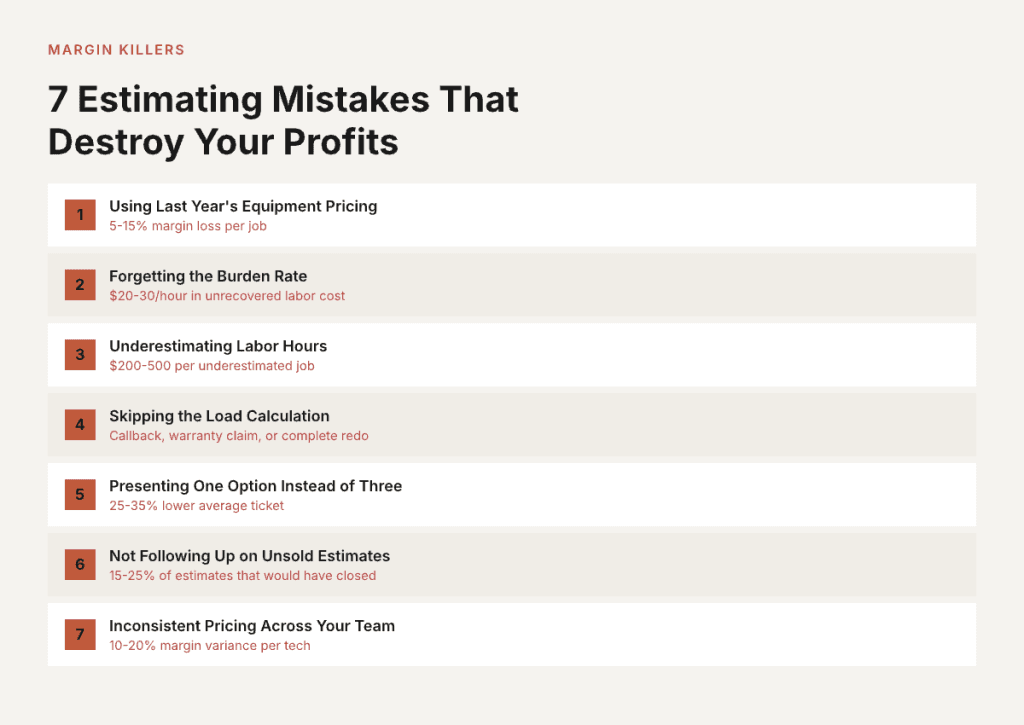
Cost impact: 5–15% margin loss per job
Equipment prices change quarterly. The R-410A to R-454B refrigerant transition is adding 10–15% to condenser costs in 2026. Always get fresh distributor quotes within 48 hours of creating an estimate. Never pull prices from memory or last month’s catalog.
Cost impact: $20–30/hour in unrecovered labor cost
If you’re calculating labor at base wage ($26/hour) instead of a fully burdened rate ($50+/hour), you’re losing on every job. The burden rate includes payroll taxes, insurance, benefits, PTO, and training. Use our labor cost calculator to get your real number.
Cost impact: $200–$500 per underestimated job
A “standard” AC replacement that should take 8 hours takes 12 because the existing line set was corroded, the pad was cracked, and the disconnect needed replacement. Build 15–20% buffer into labor estimates for residential work. Track actual vs. estimated hours for every job.
After 90 days, you’ll have reliable averages.
Cost impact: Callback, warranty claim, or complete redo
Oversizing wastes the customer’s money (bigger unit = higher cost, short-cycling, humidity problems). Undersizing leads to comfort complaints and callbacks.
Either way, you’re spending time and money fixing a problem that a 20-minute load calculation would have prevented.
Cost impact: 25–35% lower average ticket
When you present one price, the customer decides yes or no. When you present Good-Better-Best, they decide which one. This psychological shift alone increases your average ticket by 25–35% with zero additional marketing spend.
Cost impact: 15–25% of your estimates that would have closed
The average homeowner needs 5–7 days to decide on an HVAC purchase over $3,000. If you don’t follow up, they either forget, call someone who does follow up, or the urgency fades.
Automate your follow-up sequence, day 2 text, day 5 call, day 10 email, day 21 final notice.
Cost impact: 10–20% margin variance per tech
If every tech builds estimates differently, different markups, different labor estimates, different option tiers, your pricing is random. Build a standardized pricebook, train every tech on it, and use estimate software that enforces consistent pricing.
Your profit margins depend on consistency, not individual guesswork.
The EPA’s phase-down of R-410A means new equipment in 2026 uses R-454B (or similar A2L refrigerants). Equipment costs are 10–15% higher than comparable R-410A units. Installation requires additional safety measures, leak detection, proper ventilation, and technician A2L certification.
Existing R-410A systems can still be serviced, but new installs must use a compliant refrigerant. Communicate this to customers, explaining that the regulatory change makes the higher cost feel justified, not arbitrary.
SEER2 replaced SEER as the efficiency metric. Northern states require a 14 SEER2 minimum for split systems; Southern states (DOE South region) require 15 SEER2 minimum. Don’t quote equipment that doesn’t meet your region’s minimum; a failed inspection means a return trip at your cost.
HVAC technician salaries have increased 8–12% over the past two years due to labor shortages. If your estimates still use 2023 or 2024 labor rates, you’re undercharging on every job. Recalculate your fully burdened rate quarterly.
Copper, steel, and aluminum prices remain elevated. Equipment manufacturers have passed these costs through. If your pricebook hasn’t been updated in 6+ months, you’re losing margin on every installation.
Paper estimates and spreadsheet quotes are slow, error-prone, and impossible to track. Here’s how the most efficient HVAC companies handle the estimate-to-revenue pipeline.
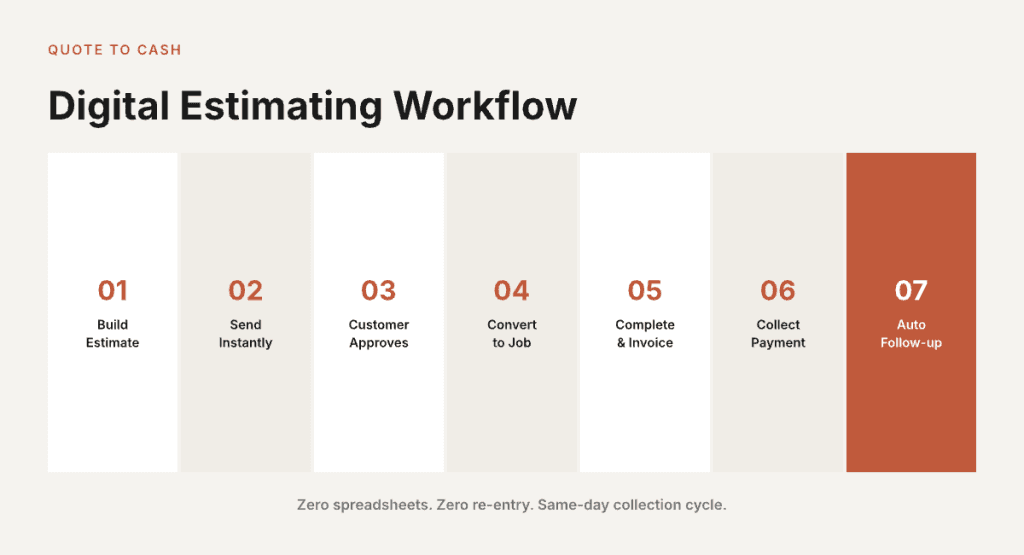
Build the estimate in your estimating software using your pricebook, line items, markups, and taxes, which are calculated automatically.
Send instantly from the field before you leave their driveway, a customer who receives a professional estimate within an hour of the survey is 3× more likely to buy than one who waits 3 days.
Customer approves online, they click “Approve” from their phone, select their option tier, and sign digitally.
Estimate converts to a job, and one click turns the approved estimate into a scheduled job with all details already attached.
Invoice generates automatically, and the invoicing system pulls approved line items from the estimate with no re-entry.
Payment collected in the field via card or ACH, reconciled automatically with QuickBooks.
Follow-up triggers: your CRM automatically sends a review request, schedules the first maintenance visit, and adds the customer to your renewal pipeline.
This entire flow, from estimate to collected payment to maintenance agreement, happens without a single spreadsheet, filing cabinet, or “I’ll send that invoice Monday” delay.
Accurate estimating isn’t a nice-to-have; it’s the difference between 5% margins and 20% margins. Every underpriced job, missed upsell, and forgotten follow-up is money you earned but didn’t keep.
Calculate your real numbers, use our labor cost calculator and profit margin calculator to know your true burdened rate and overhead allocation.
Build a pricebook: Document every job type with materials, labor hours, overhead, and target margin, and update it quarterly.
Use Good-Better-Best on every estimate, and build the tiers into your estimate templates so techs present them consistently.
Go digital: Switch from paper/spreadsheet estimates to estimating software that sends instantly, tracks approval, and converts to jobs automatically.
Follow up relentlessly, automate your follow-up sequence so the estimate that sits unfollowed doesn’t become the one your competitor closes.
The tools, templates, and formulas are all in this guide. The only thing left is to use them.
A service/repair estimate should take 15–30 minutes (diagnostic + quote from pricebook). A residential installation estimate takes 45–90 minutes, including the site survey, load calculation, equipment selection, and proposal creation. Commercial estimates can take 4–20+ hours depending on project complexity. Estimating software with a pre-built pricebook reduces residential estimates to 30 minutes.
For service calls, yes. Charge a diagnostic fee ($75–$150) that’s waived if the customer approves the repair. For installation estimates, most residential HVAC companies offer free estimates because the competitive market expects it. However, if you’re consistently losing 60%+ of estimated visits, consider charging a $50–$100 “design fee” credited toward the installation. This filters out tire-kickers.
An estimate is a detailed quote for a specific customer at a specific property, usually residential. A bid is a formal proposal submitted in response to a commercial project’s specifications, often competing against other contractors. Bids follow stricter formatting requirements (AIA documents, performance bonds) and typically have lower margins (5–15% vs. 15–25% for residential estimates).
Ductwork estimating requires measuring each run (supply and return), calculating the CFM requirements per room, sizing ducts accordingly, and pricing materials per linear foot. Sheet metal duct costs $15–$30/linear foot installed; flex duct costs $8–$15/linear foot installed. A full-house ductwork replacement (1,500–2,000 sq ft) typically runs $3,000–$7,000 in materials and 16–24 hours of labor. Always add a 10–15% material buffer for fittings, transitions, and waste.
Target within 5–10% of the actual job cost. Track estimated vs. actual costs for every job. After 90 days of data, you’ll see patterns. If you’re consistently 15%+ over or under on a specific job type, adjust your pricebook. Consistent, slightly conservative estimates that protect your margins are the goal, not perfection.
Industry standard equipment markup is 15–35% for major equipment (condensers, furnaces, heat pumps), 50–150% for mid-range parts (motors, boards, coils), and 150–300% for small parts (capacitors, contactors, fuses). Your specific markup depends on your overhead structure; companies with higher overhead need a higher markup to maintain target margins. Use our service pricing calculator to dial in your numbers.
Include a validity period on every estimate (30 days is standard). When a customer calls back after expiration, pull a fresh distributor quote and reissue. If the increase is significant, explain the market change (material costs, refrigerant transition). For estimates that expired less than a week ago, honoring the original price as a goodwill gesture often closes the deal and earns loyalty.
Yes, for any estimate over $3,000. Offering financing increases the average ticket by 30–50% because customers can afford the premium option when spread over monthly payments. Partner with GreenSky, Synchrony, or Service Finance for consumer lending. The dealer fee (5–15%) is offset by the higher ticket and immediate payment. Include the monthly payment amount on your Better and Best tiers: “As low as $159/month with approved credit.”