
HVAC Lead Generation: 15 Proven Strategies That Actually Work in 2026
March 14, 2026 - 30 min read


March 14, 2026 - 30 min read

Table of Contents
| TL;DR: The average HVAC lead costs $50–$150, but most contractors waste half of them by responding too slowly and having no follow-up system. The 15 strategies below cover every channel: Google Business Profile, LSAs, SEO, Facebook Ads, referral programs, maintenance agreements, energy rebates, and more, with real cost benchmarks, conversion data, and the exact steps to build a lead generation system that works year-round. |
Your phone should be ringing off the hook. Instead, it’s quiet, while the HVAC company across town is booked two weeks out and turning away work.
Here’s the thing most contractors get wrong about HVAC lead generation: they think it’s about spending more on ads. It’s not. It’s about building a system where leads come in from multiple channels, get followed up on instantly, and actually convert into booked jobs.
The average HVAC lead costs somewhere between $50 and $150, depending on the channel. But with the right marketing strategies for HVAC lead generation, you can bring that number way down, and more importantly, stop wasting the leads you’re already getting.
This guide covers 15 strategies that HVAC companies are actually using to generate leads in 2026. No fluff, no agency pitch. Just what works, what it costs, and how to make it happen. We’ll also cover HVAC lead costs by channel, how to track your ROI, and the biggest mistakes that silently kill your pipeline.
If you’re also looking for a broader HVAC marketing playbook beyond just lead gen, check out our full guide on HVAC marketing strategies.
KEY HIGHLIGHTS
HVAC Lead Generation
An HVAC lead is any homeowner or business that needs heating, cooling, or ventilation work and has raised their hand, called, filled out a form, sent a message, or requested a quote.
Not all leads are equal, though:
Here’s what matters more than lead volume: speed. A study from MIT and InsideSales.com found that your odds of reaching a lead drop 100x if you wait 30 minutes versus responding in 5 minutes.
Most HVAC companies respond in 24–48 hours. That’s not lead generation, that’s lead donation to your competitors.
Getting HVAC leads is half the battle. Converting them is the other half.
Before you invest in any channel, you need to know what leads cost actually. Here’s a breakdown based on current industry data:
| Lead Source | Avg. Cost Per Lead | Lead Quality | Best For |
| Google Local Services Ads | $45–$85 | Very high intent | Fast, verified leads |
| Google Ads (PPC) | $75–$150 | High intent | Emergency and seasonal keywords |
| SEO / Organic Search | $0–$30 (ongoing) | High intent | Long-term, compounding returns |
| Facebook Ads | $20–$60 | Medium intent | Demand generation, tune-ups |
| Angi / HomeAdvisor | $50–$150 (shared) | Medium | New companies building volume |
| Thumbtack | $15–$75 | Medium | Specific services, budget control |
| Referral Programs | $0–$50 (incentive) | Very high | Loyal customer base |
| Exclusive Lead Services | $100–$250 | High | Companies willing to pay for quality |
These are national averages. Your actual cost per lead depends on your city, competition level, and time of year. A lead in Phoenix during July costs a lot more than one in Portland during March.
The cheapest lead isn’t always the best deal. An exclusive lead at $150 that converts at 40% is worth far more than a shared lead at $30 that converts at 5%.
Industry benchmarks suggest spending 5–10% of annual revenue on marketing. For a company doing $500K/year, that’s $25K–$50K in total marketing spend.
Your Google Business Profile is the single most valuable free lead source for a local HVAC company.
It powers the Map Pack, those three listings that appear above organic search results when someone searches “AC repair near me” or “HVAC companies in [city].” And 46% of all Google searches have local intent.
Here’s how to make it work harder:
The HVAC-specific advantage here: you can post seasonal content that naturally rotates. Spring AC tune-up promos in March, “don’t get left in the cold” furnace messaging in September.
Most businesses can’t do this; you can. If you need help getting your GBP photos and reviews flowing, our list of the best HVAC apps includes tools that automate review requests and photo uploads.
Local SEO puts your website in front of homeowners searching for HVAC services in your area. When someone types “furnace repair in Denver” or “emergency AC repair near me,” you want to be the result they click.
Quick wins that move the needle:
Here’s why this matters: SEO leads close at a 14.6% rate versus 1.7% for traditional outbound marketing. SEO takes 3–6 months to show results, but once it kicks in, it compounds. Eventually, it becomes your lowest cost-per-lead channel.
If you want to learn more about building your online presence from scratch, our guide on how to start an HVAC business covers the foundational steps.
Google Local Services Ads (LSAs) sit at the very top of search results, above regular Google Ads, above organic results. You see them with the green “Google Guaranteed” checkmark.
What makes LSAs different from regular PPC:
Getting started:
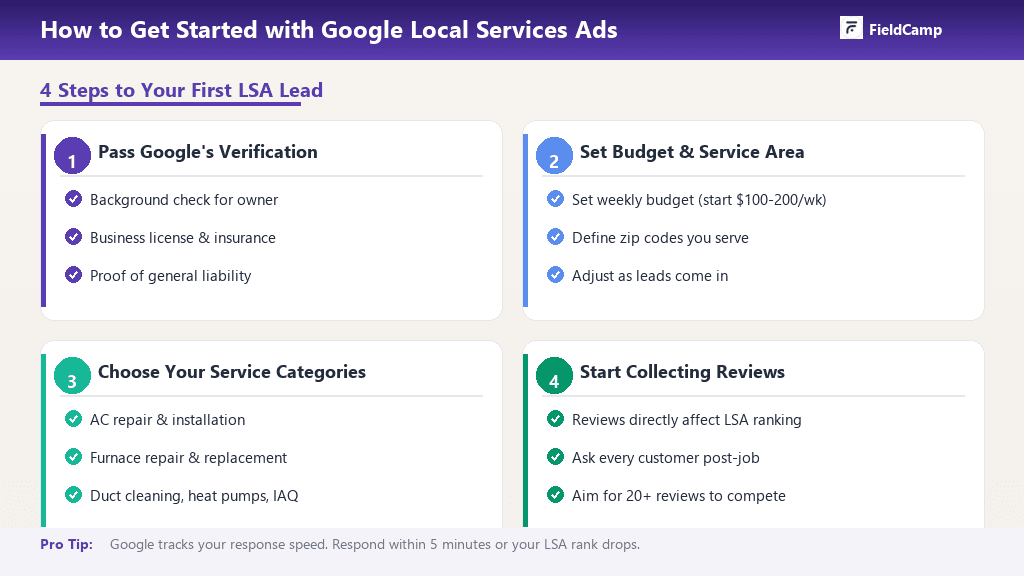
The ranking formula is straightforward: reviews + responsiveness + proximity. More 5-star Google reviews, faster response times, and proximity to the searcher. If a lead is bad (wrong number, out of area, spam), dispute it, and Google will credit you back.
One thing most HVAC contractors don’t realize: Google tracks how fast you respond to LSA leads. Answer quickly, or your ad rank drops. Using AI-powered job scheduling can help you respond to and book LSA leads faster than doing it manually.
When a homeowner searches “emergency AC repair near me” at 2 AM during a July heat wave, they’re not browsing; they’re buying. Google Ads puts you in front of them at that exact moment.
What to target:
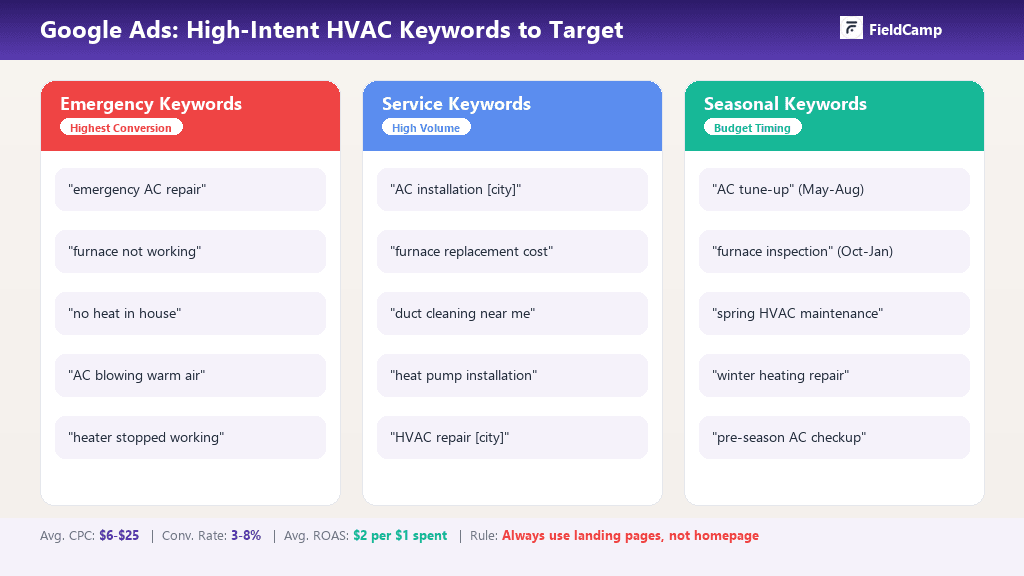
Critical rule: send ad traffic to a dedicated landing page, not your homepage. A landing page with one clear CTA (“Call Now” or “Request a Free Estimate”) converts 2–5x better than a homepage with a dozen distractions. And use call-only ads on mobile, HVAC customers overwhelmingly prefer to pick up the phone.
Need help quoting jobs that come through ads? FieldCamp’s quoting feature lets you build and send professional estimates in minutes, so you can respond before your competitors even pick up the phone.
Your website is your 24/7 salesperson. But if it’s slow, outdated, or confusing, it’s actively losing you leads you already paid for through ads and SEO.
Here’s the checklist for an HVAC website that generates leads:
If you want to set up online booking to capture leads around the clock, here’s how to set up an online booking system. It walks through the full setup process.
Platforms like Angi, Thumbtack, and Yelp can supplement your lead flow, especially when you’re new or building your pipeline. But go in with realistic expectations.
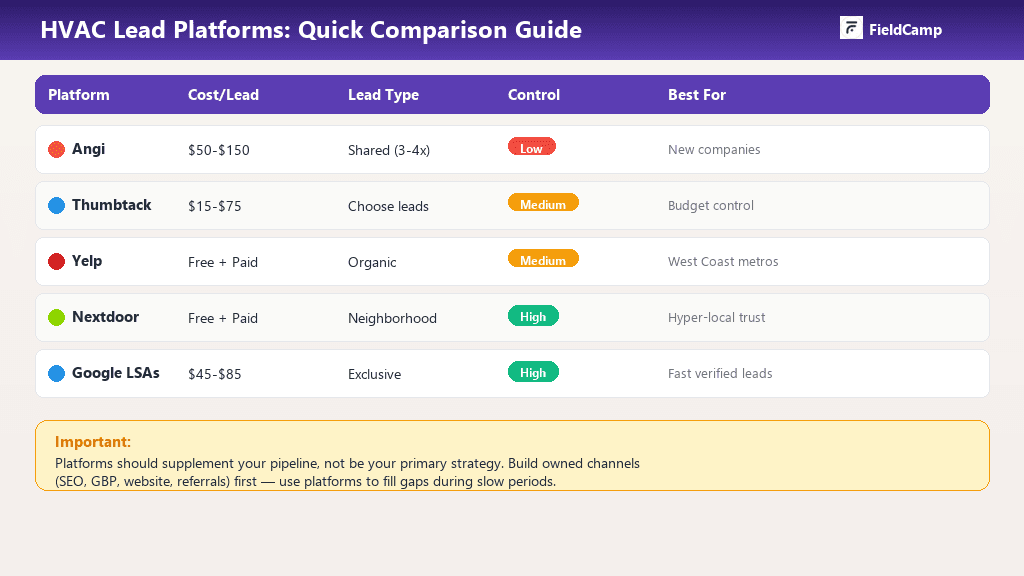
Angi / HomeAdvisor (now Angi Leads) Shared leads at $50–$150 each. You’re competing against 3–4 other contractors for the same homeowner. Best for newer HVAC companies that need volume.
The trade-off: lead quality is inconsistent, and some leads ghost you entirely.
Thumbtack: You set your own budget and choose which leads to respond to ($15–$75 per lead). More control than Angi.
Works well for specific, high-margin services like AC installation or duct cleaning.
Yelp Free listing plus a paid advertising option. Reviews are king on Yelp; businesses with strong ratings dominate.
Best for residential HVAC in markets where Yelp usage is high (major metros, especially the West Coast).
Nextdoor Neighborhood-based social platform. Free business page plus paid “local deals.” Great for building hyper-local trust, your neighbors recommending you to their neighbors.
Here’s the honest take: these platforms should be a supplement, not your primary strategy. If Angi changes its pricing model or Thumbtack raises rates, which happens, you don’t want your entire pipeline depending on a platform you don’t control.
Build your own channels (SEO, GBP, website, referrals) and use platforms to fill gaps.
Referred customers convert 4x more often and have a 16% higher lifetime value than customers acquired through other channels. And they cost almost nothing.
How to structure an HVAC referral program:
Partner with referral sources outside your customer base, too. Real estate agents, property managers, and home inspectors constantly need HVAC recommendations. Offer them priority scheduling or a referral fee. These warm introductions close at significantly higher rates than any ad.
Track every referral in your CRM, so you know which customers and partners are your top advocates. If you’re using FieldCamp, you can tag lead sources and set follow-up reminders automatically.
Reviews aren’t optional anymore. They’re your first impression. According to BrightLocal’s 2024 Local Consumer Review Survey, 98% of consumers read online reviews for local businesses. And businesses that move from a 3-star to a 5-star rating get significantly more clicks from Google Maps.
Where to focus: Google first (it directly impacts your Map Pack and LSA ranking), then Yelp, Facebook, Angi, and the BBB.
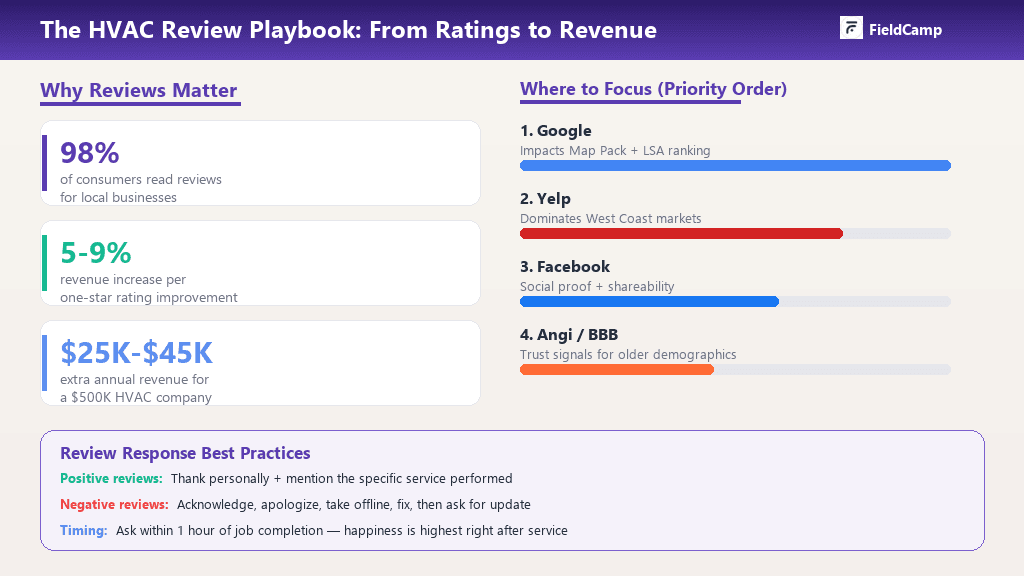
How to get more reviews consistently:
Use your best reviews as marketing assets. Pull quotes for your website, share them on social media, and include them in your Google Ads. Social proof is one of the most powerful conversion tools you have.
A Harvard Business School study found that a one-star increase in a business’s rating led to a 5–9% increase in revenue.
For an HVAC company doing $500K a year, that’s an extra $25K–$45K, just from better reviews. If you’re looking for ways to use AI to handle customer communications and review follow-ups, check out our guide on ChatGPT for HVAC customer support.
Social media ads work differently from Google Ads. Google captures existing demand (someone is already searching for “AC repair”).
Facebook and Instagram generate demand (someone who doesn’t know they need a tune-up yet).
Facebook Ads for HVAC:
Instagram: Visual platform, perfect for before-and-after transformations, equipment photos, and team culture content. Use Stories and Reels. Same ad manager as Facebook, so you can run campaigns on both simultaneously.
When to use Facebook over Google: For proactive campaigns, maintenance tune-ups, seasonal specials, system upgrades, and indoor air quality promotions. These are things homeowners need but aren’t actively searching for.
Retargeting is where it gets powerful. Someone visits your website but doesn’t call? Show them a Facebook ad the next day. Retargeted visitors are 70% more likely to convert because they already know who you are.
Want to automate what happens after they convert? Set up an instant lead response workflow, so every Facebook lead gets a follow-up within minutes.
This is a strategy most HVAC lead generation guides completely ignore, and it’s one of the most powerful ones.
A maintenance agreement (also called a service contract or maintenance plan) locks a customer into 1–2 tune-up visits per year.
But here’s what makes it a lead generation engine: every maintenance visit is an opportunity to find and sell additional work.
How it works as a lead pipeline:
How to market maintenance agreements:
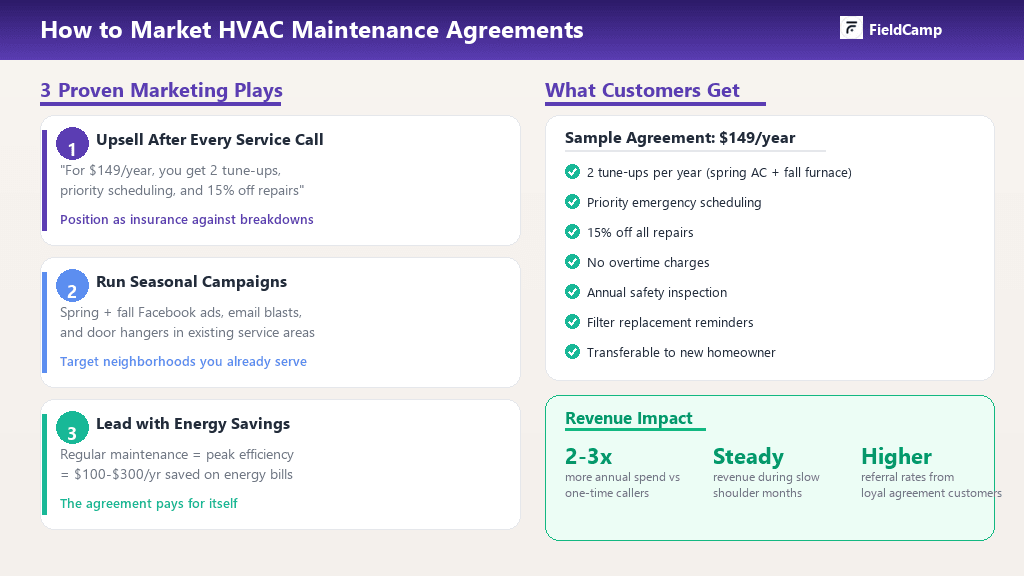
Maintenance agreements also reduce seasonal revenue swings; they keep your technicians busy during shoulder months when emergency calls slow down.
For accurate pricing on these jobs, check out our detailed HVAC pricing guide.
Here’s an HVAC lead generation strategy almost nobody talks about: federal and state rebates as a marketing hook.
The Inflation Reduction Act (IRA) offers homeowners up to $2,000 in tax credits for qualifying heat pump installations, plus additional state-level utility rebates in most markets.
The problem? Most homeowners have no idea these exist. You can be the one who tells them and captures the lead.
How to turn rebates into leads:
This positions you as an advisor, not just a contractor trying to close a sale. That trust difference matters. Use FieldCamp’s HVAC estimate template to build professional quotes that include rebate breakdowns, so homeowners see the savings before they decide.
Your service trucks are driving through your service area every single day. A professionally designed vehicle wrap turns each one into a mobile billboard, generating 30,000–70,000 impressions per day.
These methods build long-term brand recognition in the neighborhoods you serve. They work especially well in tight-knit suburban and rural communities where people notice who’s working on their neighbors’ homes.
Pair them with route optimization to make sure your branded trucks are spending more time in high-value neighborhoods and less time stuck in traffic.
HVAC is one of the most seasonal industries in existence. Your marketing strategy should reflect that, not just by running ads during peak season, but by being strategic about when and how you ramp up.
Seasonal campaign calendar for HVAC:
| Season | Campaign Focus | Messaging |
| Spring (Mar–May) | AC tune-ups, early-bird installation | “Beat the summer rush, schedule your AC tune-up now” |
| Summer (Jun–Aug) | Emergency AC repair, indoor air quality | “AC broken? Same-day emergency repair, 24/7” |
| Fall (Sep–Nov) | Furnace tune-ups, heating inspections | “Don’t get left in the cold, schedule your furnace checkup” |
| Winter (Dec–Feb) | Emergency heating, new furnace installs | “No heat? We’re available 24/7 for emergency repair” |
The off-season play: When your competitors stop advertising (and they always do during shoulder months), that’s your opportunity. CPCs drop, competition thins out, and you can acquire leads for a fraction of the peak-season cost.
Run maintenance agreement campaigns. Promote pre-season specials. The HVAC companies that market year-round are the ones that stay fully booked.
Start seasonal campaigns 4–6 weeks before peak season. By the time it hits 95°F and every HVAC company in town is running ads, the smart ones already have their summer schedules filled.
For tips on managing seasonal dispatching efficiently, see our HVAC dispatching tips guide.
Some of the highest-converting HVAC leads don’t come from ads at all. They come from warm introductions through trusted partners.
Strategic partnerships that consistently send HVAC leads:
How to structure the partnership: Offer a referral fee ($50–$100 per booked job), priority scheduling for their clients, or simple reciprocal referrals. These leads convert exceptionally well because they arrive with a trusted recommendation already attached.
Need a professional invoice to send after those partner-referred jobs? Grab our free HVAC invoice template.
Every strategy above is pointless if your leads fall through the cracks. And for most HVAC companies, that’s exactly what happens.
The numbers tell the story:
This is where a CRM changes everything for HVAC lead generation. Here’s what it does:
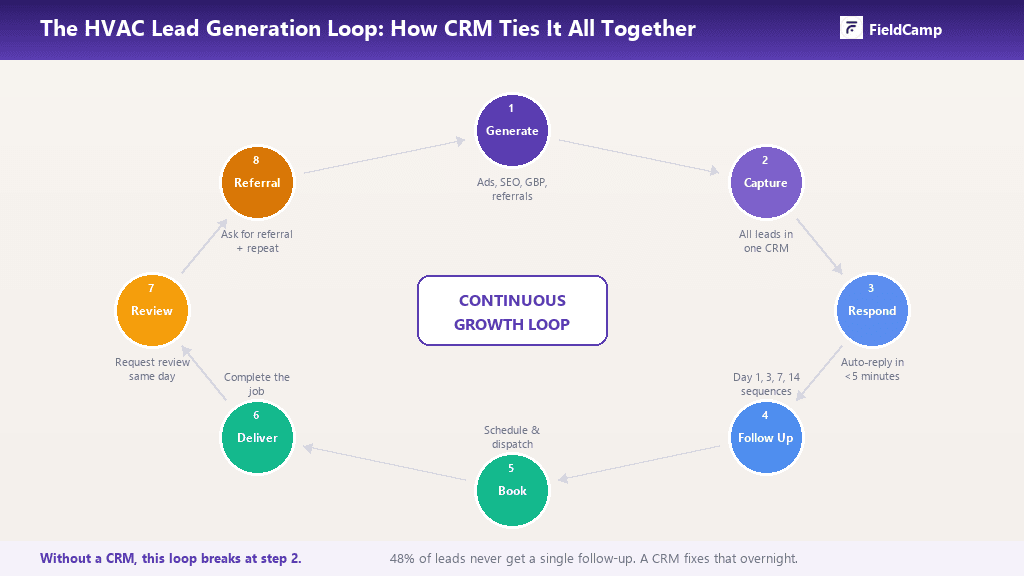
FieldCamp’s AI-powered CRM was built for exactly this workflow. It captures leads automatically, sends instant follow-ups, dispatches technicians with smart scheduling, and tracks every job from estimate to invoice. If you’re serious about not losing another lead, it’s worth a look.
You can’t improve what you don’t measure. Track these metrics monthly:
How to actually track this:
Benchmark: If your customer acquisition cost is less than 10% of your average customer lifetime value, your lead generation is healthy. If it’s higher, you’re either overspending on low-quality channels or not converting enough leads into jobs.
FieldCamp’s reporting dashboard can track lead sources, conversion rates, and revenue per channel automatically, so you’re not guessing.
| Free Lead Generation | Paid Lead Generation | |
| Examples | SEO, Google Business Profile, reviews, referrals, content, maintenance agreements | Google Ads, LSAs, Facebook Ads, Angi, Thumbtack |
| Time to Results | 3–6 months | Days to weeks |
| Ongoing Cost | Time and effort | Ad spend + management |
| Scalability | Slow, compounds over time | Fast, limited by budget |
| Lead Quality | High (earned trust) | Varies by channel |
| Sustainability | Long-term asset you own | Stops when you stop paying |
| Best For | Reducing CAC, long-term growth | Quick wins, peak season, scaling fast |
The answer isn’t one or the other, it’s both.
For established HVAC companies: Aim for 40% organic (SEO, GBP, referrals, reviews, maintenance agreements) and 60% paid (Google Ads, LSAs, Facebook). As your organic channels grow, shift budget from paid channels to profit.
For new HVAC companies: Flip it – 20% organic, 80% paid. You need leads NOW while your organic presence builds. LSAs and Google Ads deliver the fastest.
HVAC lead generation isn’t about finding one magic channel; it’s about building a system. The contractors booking out weeks in advance aren’t doing one thing right.
They’re doing five or six things consistently: showing up in Google Maps, running targeted ads during peak season, asking for referrals after every install, selling maintenance agreements that feed their pipeline year-round, and following up on every single lead within minutes, not hours.
The biggest takeaway from every strategy in this guide comes down to two things: diversify your lead sources and don’t waste the leads you already have. Most HVAC companies don’t need more leads; they need to stop losing the ones that are already coming in.
Start with what’s free (Google Business Profile, reviews, referrals). Layer in paid channels as your budget allows (LSAs, Google Ads, Facebook).
And tie it all together with a CRM that captures, tracks, and follows up automatically, so nothing falls through the cracks.
The HVAC companies that build this system now will be the ones turning away work next summer. The ones that don’t will still be wondering why the phone isn’t ringing.
HVAC companies generate leads through a combination of digital marketing (Google Business Profile, local SEO, Google Ads, Facebook Ads), lead platforms (Angi, Thumbtack, Yelp), referral programs, and traditional marketing (vehicle wraps, door hangers, community partnerships). The most effective companies combine 3–5 channels rather than depending on any single source. Top-performing HVAC businesses generate 60–70% of leads from their own marketing efforts (website, SEO, ads) and use platforms and referrals to supplement.
The average HVAC lead costs between $50 and $150, depending on the channel and your market. Google Local Services Ads average $45–$85 per lead. Google Ads run $75–$150. Facebook Ads come in at $20–$60. Referrals are essentially free. Exclusive leads from lead generation services cost $100–$250 but convert at significantly higher rates than shared leads.
The best approach is a combination: optimize your Google Business Profile (free, high impact), invest in local SEO (compounding returns over time), and run Google Local Services Ads (fast, pay-per-lead). This covers free, organic, and paid channels. Add a referral program and maintenance agreement marketing, and you have a lead generation system that works in both peak and off-seasons.
Buying leads from platforms like Angi, Thumbtack, or exclusive lead services can be worthwhile if you track ROI carefully. Exclusive leads ($100–$250) are generally worth the premium because you’re the only contractor competing. Shared leads ($15–$75) work but have lower conversion rates since you’re up against 3–4 competitors. The most important factor is speed: respond within 5 minutes, and your close rate improves dramatically.
Free HVAC leads come from a fully optimized Google Business Profile, local SEO rankings, online reviews, customer referral programs, social media content, maintenance agreement upsells, and energy rebate awareness campaigns. These channels require time and consistency rather than ad spend, but they produce some of the highest-quality leads because customers find and trust you organically.
A good lead-to-booked-job conversion rate is 15–25%. Top-performing HVAC companies hit 30%+ by combining fast response times (under 5 minutes), automated follow-up sequences, and a clean estimate-to-booking process.
The Air Conditioning Contractors of America (ACCA) recommends 5–10% of annual revenue. For a company doing $500,000/year, that’s $25,000–$50,000 annually, roughly $2,000–$4,000 per month. Newer companies or those in highly competitive markets may need to invest closer to 10–15% initially. The key is tracking ROI by channel and continually shifting spend toward what delivers.
Absolutely. SEO is one of the highest-ROI marketing channels for HVAC companies. Organic leads close at 14.6% versus 1.7% for outbound marketing, and once you rank, leads come without paying per click. The catch is patience; SEO typically takes 3–6 months to produce results. But after that initial investment, your cost per lead drops significantly and the returns compound year over year. Most HVAC companies that commit to SEO see it become their top lead source within 12–18 months.