
HVAC Marketing: 15 Strategies to Grow Your Business in 2026
March 4, 2026 - 23 min read


March 4, 2026 - 23 min read

Table of Contents
| TL;DR: HVAC marketing works best when you combine local SEO, Google Ads, review generation, and automated follow-ups. The 15 strategies below cover digital and traditional channels that HVAC businesses of every size can implement right now to generate more leads and close more jobs. |
You got into HVAC because you’re good with your hands, not because you dreamed of running Facebook ads or obsessing over Google rankings. But here’s what nobody tells you when you start your own shop: the companies that grow aren’t always the best at the work. They’re the ones people can actually find.
That’s the frustrating part. You know you do better work than half the contractors in your area, but they’re booked solid, and you’re waiting for the phone to ring. The difference almost always comes down to marketing. Not the flashy, expensive kind.
Just a handful of the right strategies, done consistently, that put you in front of homeowners at the exact moment their AC dies, or their furnace starts acting up.
This guide breaks down 15 HVAC marketing strategies that actually work, ranked by ROI, so you know where to start. Some are free. Some take a budget.
All of them have helped real HVAC businesses fill their schedules and grow their revenue. Whether you’re a one-truck operation or managing a team of 20, there’s something here you can put to work this week.
If you prefer listening over reading – check out the podcast above!
KEY HIGHLIGHTS
15 HVAC Marketing Strategies
HVAC marketing isn’t optional anymore if you want to grow. The U.S. HVAC market is projected to reach $54 billion by 2033, and over 114,000 HVAC businesses are competing for those dollars right now. Without a structured HVAC marketing plan, you’re leaving jobs on the table.
Here’s the reality most HVAC business owners face: you’re a skilled technician who’s also trying to run marketing, handle scheduling, manage invoices, and keep customers happy. A 2025 HVAC industry survey found that small HVAC owners spend 15-20 hours per week on non-technical tasks, including marketing and lead follow-up.
That’s time you could spend on billable work.
The good news? The 15 HVAC marketing strategies below are ranked by ROI and difficulty. Start with the first five (they’re free or low-cost) and layer in the rest as your budget grows.
Optimizing your Google Business Profile is the fastest, free way to generate HVAC leads. A complete GBP with photos, reviews, and updated services appears in the Local Pack above all organic results, putting your business in front of customers actively searching for HVAC help.
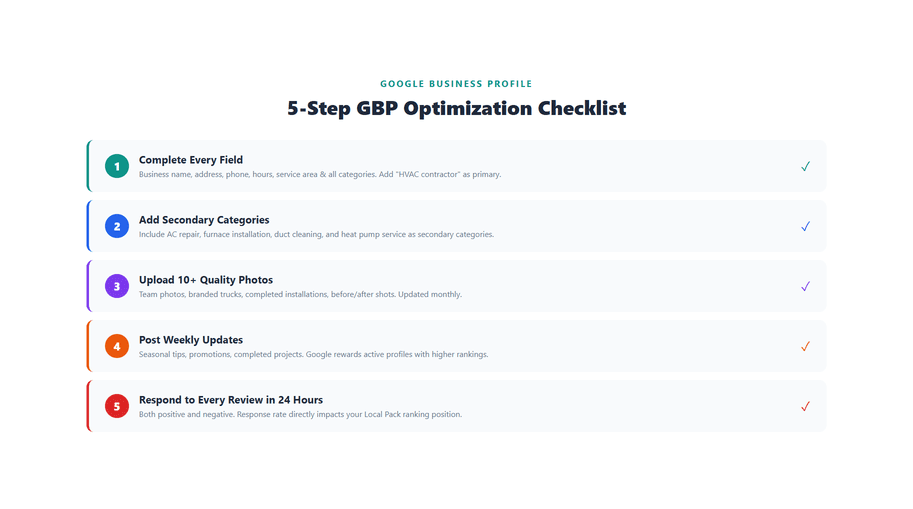
Your GBP is the single most important free HVAC marketing asset you have. When someone searches “HVAC repair near me,” the Local Pack (the map with three business listings) appears above all organic results. If you’re not in that pack, you’re invisible.
How to optimize your GBP:
Pro Tip: Add your services with detailed descriptions and pricing ranges directly to your GBP. Google uses this data to match you with relevant searches, and it gives potential customers pricing confidence before they call.
Your HVAC website should convert visitors into phone calls and booked jobs, not just look professional. Most contractor websites fail because they lack click-to-call buttons, online booking, and service-area pages that rank for local searches.
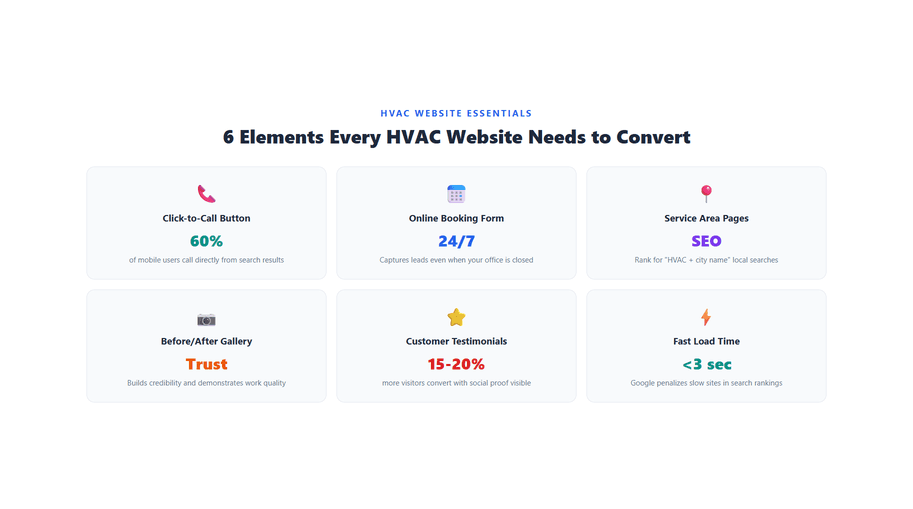
A professional website is your 24/7 salesperson. Most HVAC companies have a website, but few have one that actually converts visitors into calls and booked appointments.
Essential website elements for HVAC marketing:
| Element | Why It Matters |
| Click-to-call button | 60% of mobile users call directly from search results |
| Online booking form | Captures leads even when your office is closed |
| Service area pages | Helps you rank for “HVAC + city name” searches |
| Before/after gallery | Builds trust and demonstrates quality |
| Testimonials | Social proof converts 15-20% more visitors |
| Fast load time (<3 sec) | Google penalizes slow sites in rankings |
Make sure your website includes individual pages for every service you offer (AC repair, furnace installation, duct cleaning, heat pump service) and every city you serve. These pages act as landing pages for local searches.
If you offer HVAC estimates, make sure the process is easy for customers to request one online.
Local SEO gets your HVAC business in front of people searching for heating and cooling services in your area, without paying for every click. Once you rank, the traffic is free and compounds over time, making it the highest long-term ROI channel for HVAC marketing.
Unlike paid ads, local SEO traffic doesn’t stop when you turn off the budget.
HVAC local SEO checklist:
The best part of local SEO for HVAC marketing? It compounds. A page you publish today can generate leads for years with minimal ongoing cost. For more on pricing your services competitively, check out our guide on how to price HVAC jobs.
Key Takeaway: HVAC companies that invest $500-$1,500/month in local SEO typically see 3-5x ROI within 6-12 months, according to BrightLocal’s 2025 local search report.
Google Local Service Ads put your HVAC company at the very top of search results with a “Google Guaranteed” badge, and you only pay when a customer actually contacts you. For most HVAC companies, LSAs deliver the lowest cost per lead of any paid channel.
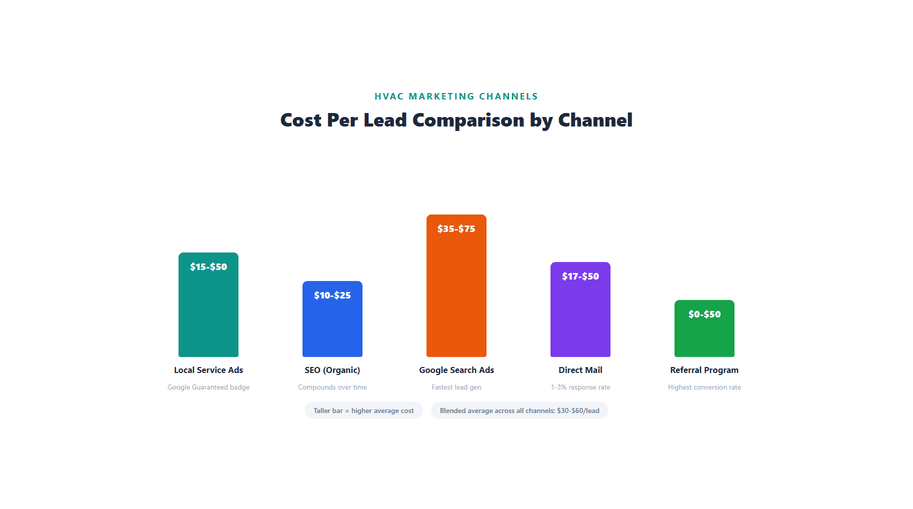
LSAs are one of the most cost-effective HVAC marketing channels available right now.
LSA basics for HVAC companies:
LSA optimization tips:
Google Search Ads let you bid on high-intent HVAC keywords and show ads at the top of search results the same day you launch. Unlike SEO, which takes months to build, PPC delivers leads immediately and gives you full control over budget, targeting, and timing.
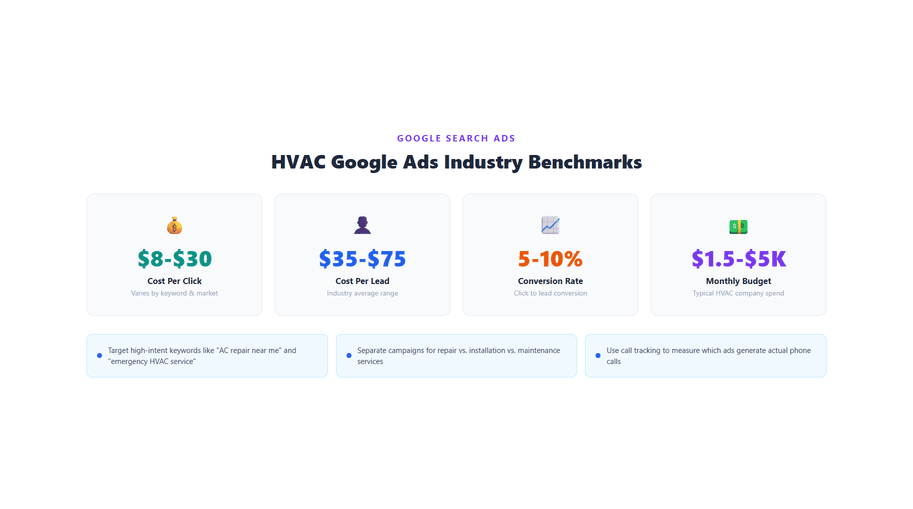
PPC is your fastest path to new HVAC leads.
HVAC Google Ads benchmarks:
| Metric | Industry Average |
| Cost per click | $8-$30 |
| Cost per lead | $35-$75 |
| Conversion rate | 5-10% |
| Average monthly budget | $1,500-$5,000 |
HVAC Google Ads best practices:
Warning: Don’t set up Google Ads and walk away. Without weekly optimization, you’ll bleed money on irrelevant clicks. If you don’t have time to manage ads, hire a PPC specialist or local agency that specializes in home services.
Online reviews are the modern version of word-of-mouth, and for HVAC marketing, they’re non-negotiable. Build a system that automatically asks every customer for a review after service, and you’ll outrank competitors who rely on organic reviews alone.
A BrightLocal survey found that 87% of consumers read online reviews for local businesses, and HVAC companies with more reviews rank higher in local search.
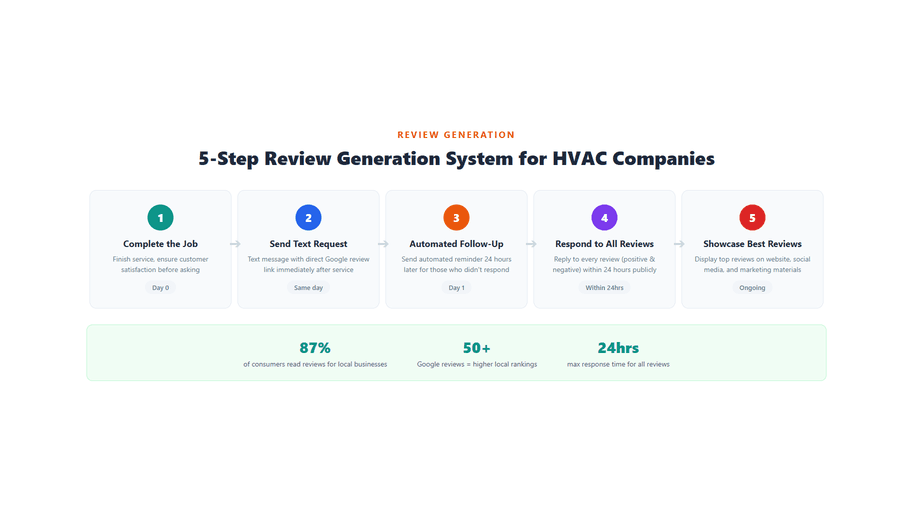
Review generation system:
How to handle negative reviews:
Automating your review requests saves hours and increases your review count significantly. Tools like FieldCamp’s customer communication features make this seamless.
Social media won’t be your top HVAC lead generator, but it builds the brand awareness, trust, and community presence that makes every other marketing channel work better. The key is consistency over volume.
Don’t overthink this one. Post 3-5 times per week and focus on what’s real: your work, your team, your results.
Best platforms for HVAC digital marketing:
Content ideas that work for HVAC companies:
If you’re just getting started and still building your brand identity, check out our HVAC company names guide for ideas that work on social and beyond.
Email marketing delivers the highest ROI of any HVAC marketing channel when targeting your existing customer base. For every $1 spent, HVAC companies typically see $36-$42 in return because you’re reaching people who already trust you.
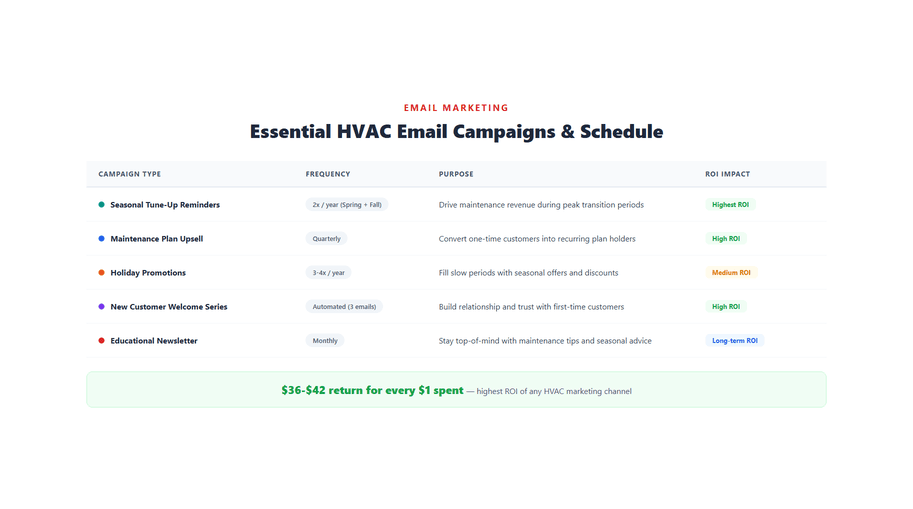
The secret isn’t a fancy design. It’s timing and relevance.
Essential HVAC email campaigns:
| Campaign Type | Frequency | Purpose |
| Seasonal tune-up reminders | 2x/year (spring + fall) | Drive maintenance revenue |
| Maintenance plan upsell | Quarterly | Convert one-time customers to recurring |
| Holiday promotions | 3-4x/year | Fill slow periods |
| New customer welcome series | Automated (3 emails) | Build a relationship and trust |
| Educational newsletter | Monthly | Stay top-of-mind |
Email marketing tips for HVAC businesses:
Managing customer communication and follow-ups is easier with a centralized CRM that tracks every interaction.
Referrals are the cheapest, highest-converting leads for any HVAC business. A referred customer has a 37% higher retention rate and a 16% higher lifetime value than a non-referred customer.
Simple HVAC referral program structure:
The best referral programs are easy to understand and easy to use. Don’t make customers fill out forms or remember codes. A simple “mention your name” system works for most HVAC shops.
Publishing helpful HVAC content on your website positions your company as the local expert and drives free organic traffic for years. When homeowners search “how often should I change my HVAC filter” or “what size AC do I need,” your content answers their question and introduces your brand.
This is the HVAC marketing strategy that compounds the most over time.
High-performing HVAC content topics:
Each piece of content acts as a long-term lead magnet. Blog posts about HVAC topics can rank on Google for years, bringing in steady organic traffic. You can even create tools like an HVAC load calculator to attract visitors who need your services.
Pro Tip: Write one pillar article per quarter (2,000+ words on a core topic) and support it with 5-10 shorter posts that link back to it. This topic cluster strategy signals authority to Google.
Direct mail isn’t dead. For HVAC marketing, it’s actually making a comeback because mailbox competition has dropped dramatically while digital inboxes overflow. A well-timed HVAC postcard in a sparse mailbox gets noticed.
Here’s why it still works: homeowners keep physical mail longer than they keep emails.
Direct mail strategies that work:
Average ROI: 1-3% response rate. On a 5,000-piece mailer costing $2,500, that’s 50-150 leads at $17-$50 per lead. Competitive with digital channels, especially in suburban markets.
Strategic local partnerships put your HVAC business in front of qualified leads without spending a dollar on ads. Real estate agents, home inspectors, plumbers, and property managers all work with customers who need HVAC services, and cross-referrals benefit everyone.
This is the most underused HVAC marketing strategy for small businesses.
High-value HVAC partnership opportunities:
Offer a referral fee or a reciprocal referral agreement. Even a simple agreement to keep each other’s business cards on your counter generates leads.
HVAC maintenance plans create predictable recurring revenue, improve customer retention, and give you a built-in reason to market to existing customers year-round. They’re both a revenue strategy and an HVAC marketing strategy in one.
Plan holders spend 2-3x more annually and are 6x more likely to choose you for a major replacement.
Typical HVAC maintenance plan structure:
| Tier | Annual Price | Includes |
| Basic | $149-$199 | 2 tune-ups/year, priority scheduling |
| Standard | $249-$349 | 2 tune-ups, 15% parts discount, no overtime fees |
| Premium | $399-$499 | 2 tune-ups, 20% discount, free diagnostics, priority emergency |
Why maintenance plans are marketing gold:
Track maintenance plan renewals, scheduling, and billing with an all-in-one platform like FieldCamp’s invoicing tools to keep everything organized. Need help creating professional invoices? Download a free HVAC invoice template.
Your service vehicles are mobile billboards that drive through your target market every single day. A fully wrapped HVAC van generates 30,000-70,000 impressions per day, according to the Outdoor Advertising Association of America.
Vehicle wrap essentials:
Yard sign strategy:
These are one-time marketing investments that keep generating impressions for years.
HVAC marketing automation uses software to handle follow-ups, review requests, appointment reminders, and customer communication automatically, so you can focus on actual HVAC work instead of chasing leads manually. This is the strategy that makes the other 14 work.
Most HVAC owners don’t have a marketing problem.
They have a follow-through problem. Automation fixes that.
What HVAC marketing automation looks like:
This is where most HVAC business owners fall behind. They’re so busy running calls that marketing follow-up falls through the cracks. Automating these touchpoints with the right scheduling software recovers leads you’re already paying for.
Key Takeaway: The HVAC companies growing fastest in 2026 aren’t spending more on marketing. They’re spending smarter by automating the follow-up, tracking what works, and doubling down on their top channels.
The Small Business Administration recommends spending 7-8% of gross revenue on marketing. For HVAC companies specifically, here’s what that looks like:
| Annual Revenue | Marketing Budget (7-8%) | Recommended Allocation |
| $250,000 | $17,500-$20,000 | SEO + GBP + reviews + referrals |
| $500,000 | $35,000-$40,000 | Add Google Ads + LSA + email marketing |
| $1,000,000 | $70,000-$80,000 | Add content marketing + social + direct mail |
| $2,000,000+ | $140,000-$160,000 | Full-channel HVAC marketing plan with agency support |
Budget allocation for a typical HVAC marketing plan:
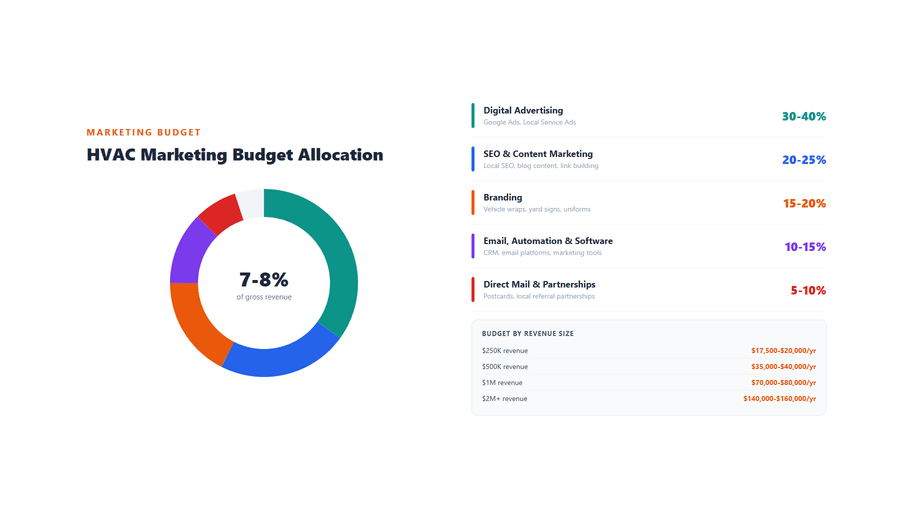
Start with the free and low-cost strategies first (GBP optimization, reviews, referrals, social media). Layer in paid channels as revenue grows.
Most HVAC marketing strategies fail not because of the strategy itself, but because busy owners can’t keep up with the follow-through. That’s where the right field service management platform makes the difference.
Here’s the thing about HVAC marketing: generating leads is only half the equation. If a customer calls and you can’t schedule them quickly, they call your competitor. If a technician shows up without knowing the equipment history, the customer notices. Every operational gap undermines your marketing investment.
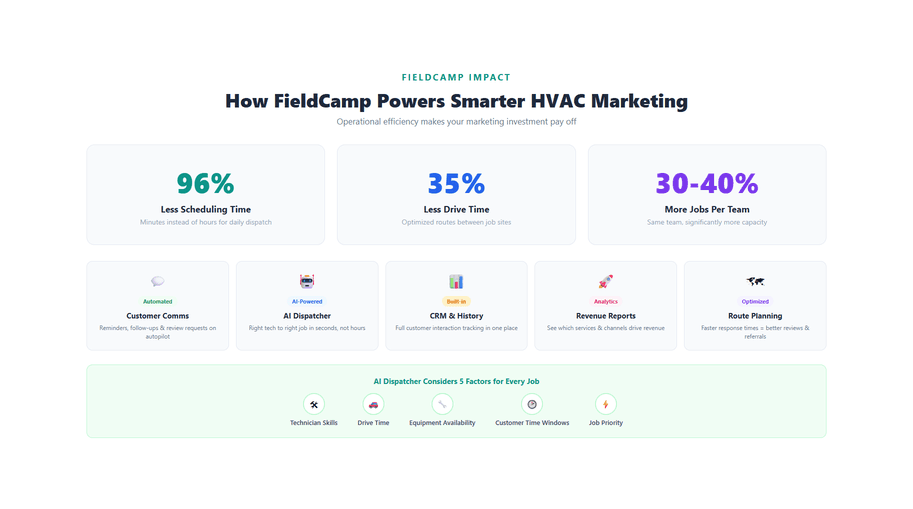
FieldCamp helps HVAC businesses close that gap:
The numbers: FieldCamp users report 96% less time spent on scheduling, 35% less drive time, and the capacity to handle 30-40% more jobs with the same team.
That’s the operational foundation that makes your HVAC marketing investment actually pay off.
The HVAC companies winning in 2026 aren’t spending more on marketing. They’re combining smart HVAC marketing strategies with operational efficiency. Generate the leads, deliver exceptional service, and the referrals take care of the rest.
Growing an HVAC business in 2026 requires more than just being a great technician. It requires a structured HVAC marketing plan that combines free channels (Google Business Profile, reviews, referrals) with paid channels (Google Ads, LSAs) and long-term investments (SEO, content marketing).
Start with the first five strategies in this guide. They cost little to nothing and deliver the fastest results. Then layer in the remaining 10 as your budget and team grow.
The HVAC companies scaling fastest right now aren’t marketing experts. They’re skilled contractors who built simple, repeatable systems for generating and converting leads, and they use software to automate the follow-through.
Your next step: pick one strategy from this list that you’re not doing today and implement it this week. One new channel, consistently executed, can transform your lead flow within 90 days.
You’re Paying for Leads That Your Competitors Are Closing
You’re spending thousands on Google Ads, SEO, and mailers, but without automated follow-ups and instant dispatch, 40-60% of those leads go cold
before anyone picks up the phone. The HVAC companies scaling fastest in 2026 aren’t spending more on marketing. They’re converting more of what they already
have.
The best HVAC marketing strategy for small companies is optimizing your Google Business Profile, generating customer reviews, and running Google Local Service Ads. These three channels cost little to nothing and deliver the highest ROI for local HVAC businesses. Pair them with a referral program, and your lead flow compounds over time without increasing your ad spend.
HVAC companies get more customers by combining local SEO, paid advertising, review generation, and referral programs. The most effective approach is ranking in Google’s Local Pack for “[service] near me” searches while earning 50+ Google reviews. Consistency across multiple channels builds compounding visibility over time.
The Small Business Administration recommends 7-8% of gross revenue. For a $500,000 HVAC company, that’s $35,000-$40,000 per year. Start with free channels (Google Business Profile, reviews, referrals) and add paid advertising as revenue grows. Track your cost per lead across every channel to know what’s working.
Social media works for HVAC businesses as a brand awareness and trust-building tool, but it isn’t a primary lead generator. Facebook and YouTube deliver the best results. Post 3-5 times per week with before/after photos, maintenance tips, and customer testimonials. Use social media to support your SEO and reputation efforts, not replace them.
HVAC cost per lead varies by channel: Google Local Service Ads average $15-$50, Google Search Ads average $35-$75, SEO delivers leads at $10-$25 once you rank, and referrals cost $0-$50 per lead. The blended average across all channels is $30-$60 per lead for most HVAC companies.
During slow seasons, focus on maintenance plan sales, email campaigns to existing customers, and educational content that builds long-term SEO value. Offer seasonal promotions (indoor air quality assessments, duct cleaning specials) and run direct mail campaigns to fill the schedule. Use slow periods to build the marketing foundation that drives busy-season leads.