
HVAC Seasonal Maintenance Checklist (Spring AC + Fall Heating + Slow Season Playbook)
April 9, 2026 - 19 min read

April 9, 2026 - 19 min read

Table of Contents
| TL;DR: This guide gives you two things: the professional-grade maintenance checklists your techs use in the field (15+ inspection points for spring AC and fall heating), and the slow season survival playbook to keep trucks rolling year-round. Regular maintenance extends HVAC system life by 5–10 years and catches 75% of no-heat/no-cool failures before they happen. But here’s the business angle most guides miss: HVAC companies see 30–50% revenue drops in shoulder seasons, and the ones that survive have a plan. This is that plan. |
Three years into running his HVAC business, a contractor we’ll call Mike had a slow season that nearly put him out of business. October hit, the phones stopped ringing, and he had four techs sitting in the shop playing cards by 11 AM.
The wages kept coming, the truck insurance kept coming, the rent kept coming, but the revenue had fallen off a cliff. The math on a napkin was brutal: $675 per day, per idle truck, in overhead alone. Four trucks, 40 slow days. That’s $108,000 in overhead with nothing to show for it.
That was the year Mike got serious about two things: HVAC maintenance checklists (because proper tune-ups are how you sell maintenance agreements) and a slow season strategy (because hope is not a business plan).
Three years later, his shop runs 400+ maintenance agreements, generating $90,000 in predictable annual revenue. His techs carry comprehensive 25-point inspections that catch problems before they become emergencies, converting 35% of tune-up visits into additional repair revenue.
And the slow season? It’s now the busiest maintenance season on the calendar. The phone doesn’t need to ring because the work is already booked.
This guide covers the exact checklists his techs carry in the field, and the playbook that turned a cash hemorrhage into a profit center.
KEY HIGHLIGHTS
HVAC Seasonal Maintenance Checklist
Spring is when you prepare cooling systems for the heavy-lifting months ahead. A thorough spring tune-up prevents mid-summer breakdowns (your customer’s worst nightmare) and catches problems while parts are available, and you have schedule capacity to fix them.
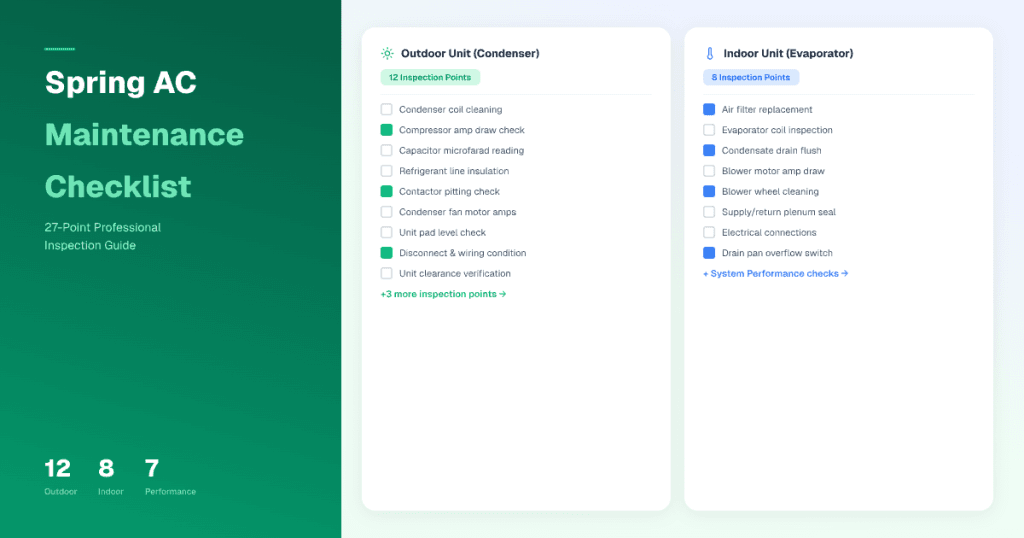
This is the professional technician checklist, not the “change your filter” homeowner version. These are the inspection points that separate a $79 quick-check from a $200 comprehensive tune-up.
For help pricing these visits profitably, see our HVAC pricing guide.
| # | Inspection Point | What to Check | Pass/Fail Criteria |
| 1 | Visual inspection | Physical condition, rust, damage, debris | No structural damage, housing intact |
| 2 | Condenser coil | Vegetation, fencing, and stored items around the unit | Clean with coil cleaner; straighten fins if >10% bent |
| 3 | Unit clearance | Dirt, debris, bent fins, and biological growth | Minimum 24″ clearance on all sides, 60″ above |
| 4 | Condenser fan motor | Rotation, noise, wobble, amp draw | Smooth operation, amps within nameplate rating |
| 5 | Condenser fan blade | Cracks, chips, balance | No visible damage, no vibration |
| 6 | Compressor | Visual condition, oil stains, noise | No oil leaks, no unusual sounds at startup |
| 7 | Compressor amp draw | Running amps vs nameplate RLA | Vegetation, fencing, and stored items around unit |
| 8 | Contactor | Pitting, arcing, chatter | Contacts clean, no visible pitting >50% |
| 9 | Capacitor(s) | Bulging, leaking, microfarad reading | Within ±5% of rated capacitance |
| 10 | Disconnect and wiring | Corrosion, loose connections, and wire condition | All connections tight, no damaged insulation |
| 11 | Unit pad/mounting | Level, sinking, settling | Level within 1″, not sinking or tilting |
| 12 | Refrigerant line insulation | Suction line insulation condition | Within 10% of the nameplate RLA |
| # | Inspection Point | What to Check | Pass/Fail Criteria |
| 13 | Air filter | Condition, size, type, MERV rating | Replace if dirty; verify correct size |
| 14 | Evaporator coil | Dirt, ice formation, and biological growth | Clean if accessible; no frost/ice during operation |
| 15 | Condensate drain line | Flow, blockage, algae growth | Flush with solution; verify drain flows freely |
| 16 | Condensate drain pan | Standing water, rust, cracks, overflow switch | No standing water, float switch operational |
| 17 | Blower motor | Amp draw, noise, operation | Amps within rating, no grinding or squealing |
| 18 | Blower wheel | Dirt buildup, balance, set screw | Clean if >1/8″ buildup, set screw tight |
| 19 | Supply/return plenum | Air leaks, insulation condition | Sealed, no visible air leaks |
| 20 | Electrical connections | Tightness, corrosion, and wire condition | All connections torqued, no corrosion |
| # | Inspection Point | What to Check | Pass/Fail Criteria |
| 21 | Thermostat calibration | Set temp vs actual room temp | Within 2°F of set point |
| 22 | Thermostat operation | Heat/cool/auto/fan modes, programming | All modes functional, schedule programmed |
| 23 | Refrigerant charge | Superheat and/or subcooling | Per manufacturer specs (typically 10–15°F superheat, 8–12°F subcooling for TXV) |
| 24 | Temperature split | Supply vs return air temperature | 15–22°F split across evaporator coil |
| 25 | Airflow | Static pressure at supply and return | Total external static pressure per manufacturer specs (typically 0.5″ WC or less) |
| 26 | Ductwork (visible) | Leaks, disconnections, damaged insulation | No visible leaks at accessible joints |
| 27 | Safety controls | High-pressure switch, low-pressure switch | Functional per manufacturer specs |
Post-Inspection Actions:
Fall inspections are about safety as much as performance. Furnaces deal with combustion gases, natural gas, and carbon monoxide, things that can hurt people. A thorough fall inspection protects your customers and protects your company from liability.
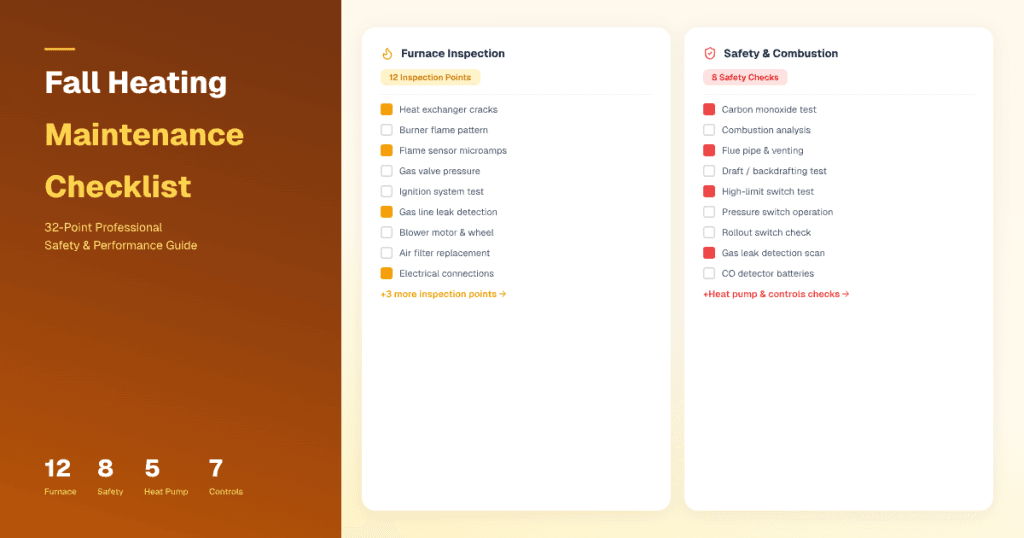
| # | Inspection Point | What to Check | Pass/Fail Criteria |
| 1 | Visual inspection | Physical condition, rust, soot, scorch marks | No visible damage, no soot deposits |
| 2 | Heat exchanger | Cracks, rust, corrosion, separation | No visible cracks or corrosion; flame pattern steady |
| 3 | Burners | Alignment, corrosion, dirt, flame pattern | Burners clean, flame blue with slight yellow tips |
| 4 | Ignition system | Igniter/pilot condition, operation | Ignites within 3–5 seconds, clean and undamaged |
| 5 | Flame sensor | Microamp reading, cleanliness | 2–6 microamps (varies by manufacturer); clean with fine abrasive |
| 6 | Gas valve | Operation, gas pressure (manifold) | Manifold pressure per nameplate specs (typically 3.5″ WC for natural gas) |
| 7 | Gas line | Leaks, condition, drip leg | No leaks (soap bubble test), drip leg present |
| 8 | Blower motor | Amp draw, noise, speed settings | Amps within rating, correct speed for heating |
| 9 | Blower wheel | Dirt buildup, balance | Clean if necessary, balanced |
| 10 | Air filter | Condition, size, type | Replace; verify correct size and MERV rating |
| 11 | Electrical connections | Tightness, condition, wire integrity | All connections torqued to spec |
| 12 | Capacitor (if applicable) | Microfarad reading | Within ±5% of rated capacitance |
| # | Inspection Point | What to Check | Pass/Fail Criteria |
| 13 | Carbon monoxide test | All gas connections, valve, and manifold | 0 ppm at register; under 100 ppm in undiluted flue gas (ACCA Standard 12) |
| 14 | Combustion analysis | O2, CO, CO2, stack temperature | Efficiency within manufacturer specs; CO under 100 ppm |
| 15 | Flue pipe/vent | Condition, pitch, connections, clearance | Proper upward pitch (1/4″ per foot minimum), all joints secured |
| 16 | Draft/venting | Natural draft or induced draft operation | Proper draft established; no spillage or backdrafting |
| 17 | High-limit switch | Operation test | Trips at rated temperature, resets properly |
| 18 | Pressure switches | Operation test (induced draft units) | Closes within specs, no sticking |
| 19 | Rollout switches | Visual and operational check | Not tripped, properly positioned |
| 20 | Gas leak detection | All gas connections, valve, manifold | No leaks detected (electronic leak detector or soap solution) |
| # | Inspection Point | What to Check | Pass/Fail Criteria |
| 21 | Reversing valve | Switchover from cooling to heating mode | Smooth transition, no sticking, proper pressure change |
| 22 | Defrost cycle | Initiation and termination | Defrost board initiates at set point, terminates properly |
| 23 | Auxiliary/emergency heat | Strip heat operation, sequencer function | All stages energize in sequence |
| 24 | Balance point | Outdoor temp where heat pump needs aux heat | Set per manufacturer recommendations and local climate |
| 25 | Outdoor coil (heating mode) | Condition, airflow, ice pattern | No abnormal ice buildup during steady-state operation |
| # | Inspection Point | What to Check | Pass/Fail Criteria |
| 26 | Thermostat calibration | Set temp vs actual room temp in heat mode | Within 2°F of set point |
| 27 | Emergency heat mode | Manual switchover, operation | Engages properly, heats to set point |
| 28 | Temperature rise | Supply air temp minus return air temp | Within the manufacturer’s rated range (typically 30–60°F rise) |
| # | Inspection Point | What to Check | Pass/Fail Criteria |
| 29 | Supply/return ducts | Leaks, disconnections, insulation | No visible leaks at accessible joints |
| 30 | CO detectors | Customer’s CO detectors — batteries and age | Functioning, batteries fresh, unit under 7 years old |
| 31 | Humidifier (if present) | Pad condition, water flow, operation | Replace pad if mineral-crusted; water flows freely |
| 32 | Air purifier/UV light (if present) | Bulb condition, operation | Replace UV bulb annually (12-month lifespan typical) |
Post-Inspection Actions:
Here’s the part most maintenance guides skip: what to do when the maintenance visits are done, and the phones still aren’t ringing.
It depends on where you are.
| Climate Zone | Slow Season | Why |
| Hot climates (Sun Belt — TX, FL, AZ, GA) | October–February | Between AC season and mild winter heating demand |
| Cold climates (Northeast, Midwest — NY, IL, MN) | April–May, September–October | Shoulder months between heating and cooling |
| Moderate climates (Pacific NW, Mid-Atlantic) | Spring and fall shoulder months | Neither hot enough nor cold enough for emergency calls |
Key insight: Your slow season isn’t just about weather, it’s about whether you’ve built systems to generate revenue independent of emergency demand. Understanding current HVAC industry trends can help you identify new service lines that generate revenue year-round, not just when the thermostat spikes.
Let’s quantify what an unmanaged slow season actually costs you. Assuming 5 service trucks at ~$84.40/hr cost to roll (ACCA), each idle truck day costs ~$675 in overhead (truck payment, insurance, tech salary).
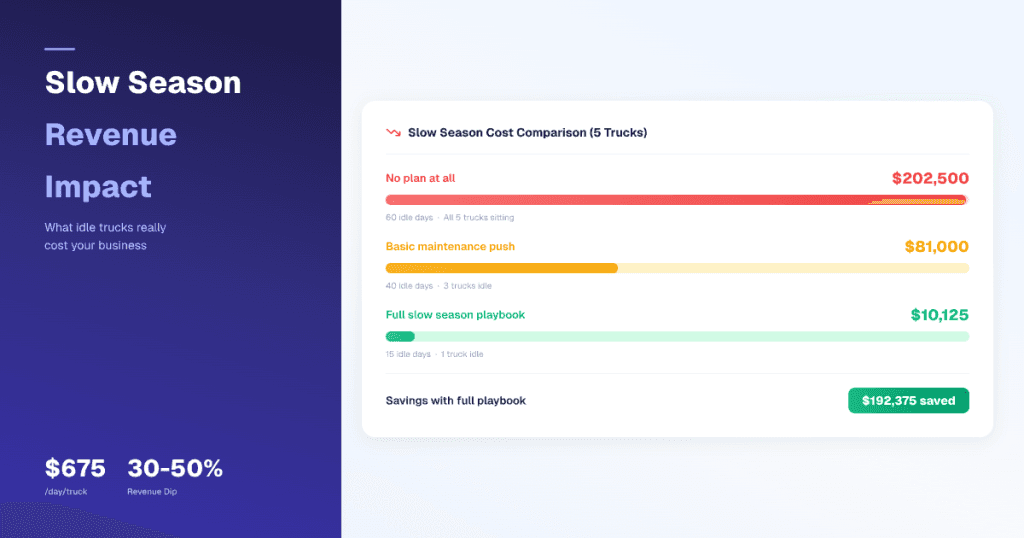
| Scenario | Slow Days | Daily Idle Cost (5 trucks) | Total Slow Season Cost |
| No plan at all | 60 days | $3,375/day | $202,500 |
| Basic maintenance push | 40 days | $2,025/day (3 trucks idle) | $81,000 |
| Full slow season playbook | 15 days | $675/day (1 truck idle) | $10,125 |
The difference between “no plan” and “full playbook” is $192,375 in recovered overhead and revenue. That’s not a nice-to-have; that’s your annual profit margin.
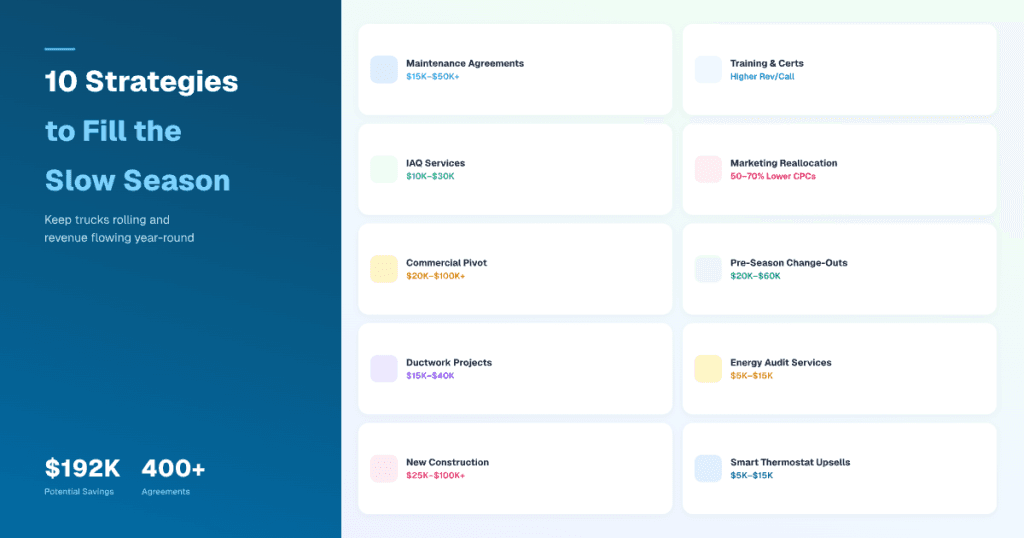
Revenue potential: $15,000–$50,000+
This is your #1 slow season weapon. If you have 200 maintenance agreements, your slow season IS maintenance season — that’s 200 tune-ups to schedule across your shoulder months.
How to execute:
The math: 2,000 customers × 4% conversion × $250/year = $20,000 in new annual recurring revenue.
Revenue potential: $10,000–$30,000
IAQ is a $15+ billion market growing 7–8% annually, and most HVAC companies aren’t touching it. The slow season is perfect for selling and installing:
How to execute: Train techs to recommend IAQ products during every maintenance visit. Use your HVAC CRM to pull a targeted list of customers whose inspection records show relevant findings. And also explore a reliable air changes calculator for more accuracy.
Revenue potential: $20,000–$100,000+
If you’re residential-only, the slow season is the time to start building commercial relationships.
How to execute: Identify 20 local commercial prospects. Send a personalized introduction letter. Offer a free energy audit as a door-opener. Commercial maintenance contracts often run $500–$2,000/year per location.
Revenue potential: $15,000–$40,000
Ductwork projects are ideal slow-season work; they’re scheduled, not emergency-driven, and they’re large-ticket jobs ($2,000–$8,000 per home). Leaky ductwork reduces system efficiency by 20–30%, a data point that’s easy to show customers using a proper HVAC load calculation.
How to execute: Review your maintenance inspection records for homes flagged with duct issues. Send targeted outreach: “During your tune-up, we noted your ductwork has significant leaks. Here’s what we recommend.”
Revenue potential: $25,000–$100,000+
Builders need HVAC subcontractors year-round. The slow season is when you have the capacity to take on new construction jobs without sacrificing your service to customers.
How to execute: Contact 5–10 local builders and general contractors. Offer competitive install pricing for new homes. Even 3–5 new construction installs at $5,000–$15,000 each fill. significant slow season capacity.
Revenue potential: Indirect (better techs = higher revenue per call)
Slow season is when your techs should be getting better, not sitting idle.
How to execute: Build a training calendar for your slow months. Budget $500–$2,000 per tech per year for certifications and training.
Revenue potential: Positions you for peak season dominance
Most HVAC companies spend heavily on Google Ads during peak season when CPCs are highest ($40–$80/click). Smart companies shift marketing spend to the slow season:
Revenue potential: $20,000–$60,000
Homeowners who need system replacements can be incentivized to schedule during the slow season with:
How to execute: Pull a list of customers with systems 12+ years old from your records. Send a targeted campaign and track responses using your HVAC scheduling software so nothing slips through.
Revenue potential: $5,000–$15,000
Energy audits are a natural extension of HVAC maintenance and position you as a trusted advisor, not just a repair company.
Revenue potential: $5,000–$15,000
The smart thermostat market is growing 15–20% annually. Many of your maintenance customers have older programmable or manual thermostats.
Position it during maintenance visits: “Your thermostat is 8 years old — a smart thermostat will save you 10–15% on energy bills and let you control everything from your phone.”
| Month | Focus | Action |
| September | Fall tune-up push | Email/call all maintenance agreement customers to schedule fall inspections |
| October | IAQ awareness | Campaign around “winterize your home” — duct sealing, humidifiers, air purifiers |
| November | Pre-season replacements | Target customers with aging systems for early bird replacement pricing |
| December | Gift cards/referral push | “Give the gift of comfort” — HVAC gift cards, referral bonus for new customers |
| January | Maintenance agreement drive | New Year = new maintenance plan. Discount first-year agreements. |
| February | Spring tune-up booking | Start scheduling spring AC inspections for March–May |
For channel-by-channel budget guidance, our HVAC advertising guide breaks down cost-per-lead by source and how to shift spend seasonally without wasting money.
Even with a full slow-season playbook, some revenue variability is inevitable. Here’s how to plan for it:
Build a reserve. Set aside 15–20% of peak season revenue in a separate account. This is your slow season operating fund. If you gross $100K in July, put $15K–$20K aside.
Stagger big expenses. Schedule truck purchases, tool upgrades, and software investments for peak season when cash flow is strongest. Don’t buy a $40,000 truck in November.
Negotiate supplier terms. Ask your parts distributors for 60-day or 90-day payment terms during slow months. Most are willing to negotiate for reliable customers.
Use maintenance revenue as a baseline. If you have 300 agreements at $200/year, that’s $60,000 in revenue you can count on regardless of the weather. Build your slow season budget around this floor. Pair that with a clear picture of your HVAC profit margins so you know exactly how much overhead those agreements cover.
Monitor weekly. Track booked revenue vs. overhead weekly during slow months. If you see a gap forming, activate outbound calling and promotional campaigns immediately, don’t wait until you’re already in a hole. Real-time field service reporting gives you truck utilization and revenue-per-tech visibility before problems compound.
Twice per year, once in spring for the cooling system and once in fall for the heating system. This is the industry standard recommended by ENERGY STAR, ACCA, and every major equipment manufacturer. Systems with heat pumps that provide both heating and cooling should still be inspected twice yearly since different components are stressed in each season.
A tune-up includes both inspection AND maintenance actions — cleaning coils, replacing filters, checking refrigerant, tightening connections, lubricating motors. An inspection is observation only — looking at components without servicing them. Most residential maintenance agreements include full tune-ups, not just inspections.
Industry range is $79–$250 depending on your market, comprehensiveness, and whether the customer has a maintenance agreement. Agreement customers typically get tune-ups included in their annual fee ($150–$300/year for residential). Non-agreement customers pay per-visit rates. A thorough 27-point AC tune-up that takes 45–75 minutes should be priced at $150–$200 minimum — your cost to roll the truck is ~$84.40/hr before the tech even picks up a tool (ACCA benchmark).
The key is documenting findings with photos and specific measurements — not just telling the customer “your capacitor looks old.” Show them the bulging capacitor, the dirty evaporator coil, the cracked heat exchanger. Present repair options with written estimates on the spot. Companies that do this convert 30–40% of tune-up visits into additional repair, replacement, or IAQ revenue.
The slow season varies by region. In hot climates (Sun Belt), it’s typically October through February. In cold climates (Northeast, Midwest), it’s the shoulder months of April–May and September–October. In moderate climates, it’s spring and fall. The common thread is the period between peak heating and peak cooling demand when emergency calls drop significantly.
The target is 40–50% of annual revenue from maintenance agreements. For a $1M company, that’s $400K–$500K in maintenance and service agreement revenue. In practical terms, 400–600 residential agreements at $200–$300/year creates enough scheduled work to keep 3–4 trucks busy through the slow months. Start with a goal of 100 agreements in year one and grow from there.
Strategically, yes, but never on your core rates. Discount maintenance agreement enrollment (“15% off your first year”), offer early bird pricing on replacements (“schedule now, save $500”), or bundle IAQ services at a package rate. But don’t discount your hourly labor rate or service call fee — that trains customers to wait for slow season pricing and devalues your work year-round.
Train them to present findings, not pitch products. The difference: “You should buy a UV light” is a sales pitch. “I found biological growth on your evaporator coil, here’s a photo. A UV light prevents this from recurring and improves your air quality. Would you like me to include it in today’s visit?” is a professional recommendation. Give techs a simple script, track their conversion rates, and offer spiffs ($25–$50) for maintenance agreement sign-ups and IAQ add-ons. A good HVAC dispatch software keeps techs on efficient routes during slow months so they have more focused time at each job rather than windshield time.