
HVAC Technician Salary in 2026: Complete Guide by State, Experience & Specialization
March 6, 2026 - 41 min read

March 6, 2026 - 41 min read

Table of Contents
| TL; DR: HVAC technicians earn a median salary of $59,810/year (BLS 2024), with entry-level starting at $34,000–$45,000 and top earners exceeding $91,020. Location matters enormously: Alaska pays $80,940 while Mississippi pays $45,710. Union technicians earn 23% more than non-union technicians ($72,210 vs $58,782). Yes, $100K is achievable through specialization, overtime, or business ownership, but it requires strategic career planning. |
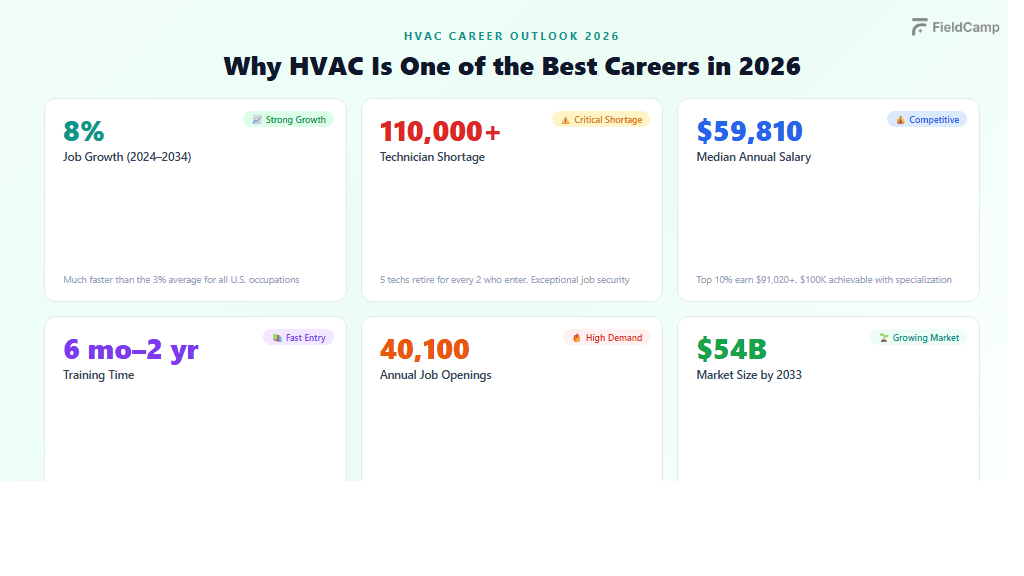
The HVAC industry is one of the fastest-growing skilled trades in America, with the Bureau of Labor Statistics projecting 8% job growth through 2034, much faster than the average for all occupations.
Whether you’re considering a career as an HVAC technician, already working in the field, or thinking about starting your own HVAC business, understanding salary expectations is critical for making smart decisions about your career path.
And if you’re already running an HVAC operation, knowing what fair pay looks like helps you attract and retain top talent in a market where skilled technicians are harder to find every year.
Tools like FieldCamp’s HVAC field service management platform can help you run a more profitable operation, but first, let’s talk numbers.
This guide breaks down HVAC technician salaries by state, experience level, specialization, and employment type.
We’ll explore what really drives earning potential, reveal which HVAC jobs pay the most, and answer the question everyone asks: “Can HVAC technicians actually make $100,000 a year?”
Prefer listening over reading? Check out the podcast above! Don’t forget to follow our channel.
KEY HIGHLIGHTS
What HVAC Technician Salary Data Really Tells You
The average HVAC technician salary varies quite a bit depending on which data source you look at. That’s mostly because each platform collects salary data differently, sample sizes vary, some include overtime while others don’t, and reporting methodologies differ across the board.
Here’s what the major salary platforms report for 2026:
Bureau of Labor Statistics (BLS) – May 2024 Data: The U.S. Bureau of Labor Statistics reports a median annual wage of $59,810 for heating, air conditioning, and refrigeration mechanics and installers. That works out to approximately $28.75 per hour.
Indeed – February 2026 Data: Based on 57,500+ salary reports, Indeed calculates the average HVAC technician salary at $29.94 per hour, with average overtime earnings of $6,750 annually. That puts total annual compensation around $69,000 for technicians working significant overtime.
ZipRecruiter – February 2026 Data: ZipRecruiter reports an average annual salary of $58,782 ($28.26/hour) with a typical range between $46,000 (25th percentile) and $80,000 (90th percentile).
Glassdoor – 2026 Data: Glassdoor shows a higher average of $72,401 per year, ranging between $60,505 and $89,356. Their figures tend to skew higher because they include total compensation — bonuses, profit sharing, and commissions.
PayScale – 2026 Data: PayScale reports a median hourly rate of $24.34, ranging from $17.53 (entry-level) to $35.21 (experienced). Their data shows significant variation based on skills and certifications held.
When you put all these sources together, here’s a realistic salary range for HVAC technicians in 2026:
The median HVAC technician salary of $59,810 sits slightly below the national median for all occupations (~$67,727 in 2026). But here’s what that number doesn’t tell you: HVAC technicians enter the workforce much faster than most professionals.
You’re looking at 6 months to 2 years of training versus 4+ years for a bachelor’s degree, which makes the return on your education investment significantly higher. No student debt, earning while learning, and job security that most desk jobs can’t match.
Most HVAC technicians are paid hourly, though some senior technicians and those in supervisory roles eventually transition to a salary. Here’s how hourly rates break down:
Median Hourly Rates by Source:
Hourly Rate by Percentile (BLS Data):
HVAC technicians frequently work overtime, especially during peak heating and cooling seasons. Standard overtime pay is 1.5x the base hourly rate:
According to Indeed’s data, HVAC technicians average $6,750 in overtime earnings annually. During extreme weather events, heat waves, polar vortexes, and ice storms, over time, opportunities can push that figure to $10,000–$15,000 per year. If you’re willing to work weekends and holidays when systems break down, the earning potential climbs fast.
Understanding how to set your hourly rate properly is especially important for independent contractors who need to cover their own overhead.
Geographic location is one of the single biggest factors affecting HVAC technician pay. Salaries vary by more than 100% between the highest and lowest-paying states, and that’s before you factor in the cost of living.
| State | Annual Salary | Hourly Rate | vs. National Avg |
| Alaska | $80,940 | $38.91 | +35.4% |
| New Hampshire | $77,445 | $37.23 | +29.5% |
| Washington | $76,796 | $36.92 | +28.4% |
| Washington, D.C. | $75,050 | $36.08 | +25.5% |
| Massachusetts | $72,680 | $34.94 | +21.5% |
| New Jersey | $71,230 | $34.25 | +19.1% |
| Connecticut | $70,450 | $33.87 | +17.8% |
| California | $69,560 | $33.44 | +16.3% |
| New York | $68,920 | $33.13 | +15.2% |
| Minnesota | $66,310 | $31.88 | +10.9% |
| Oregon | $65,780 | $31.63 | +10.0% |
| Illinois | $64,920 | $31.21 | +8.5% |
| Hawaii | $64,580 | $31.05 | +8.0% |
| Rhode Island | $63,450 | $30.50 | +6.1% |
| Maryland | $62,890 | $30.23 | +5.2% |
| Nevada | $61,720 | $29.67 | +3.2% |
| Colorado | $61,340 | $29.49 | +2.6% |
| Delaware | $60,880 | $29.27 | +1.8% |
| Vermont | $60,520 | $29.10 | +1.2% |
| Pennsylvania | $59,810 | $28.75 | 0.0% |
| Michigan | $59,340 | $28.53 | -0.8% |
| Wisconsin | $58,970 | $28.35 | -1.4% |
| Virginia | $58,650 | $28.20 | -1.9% |
| Ohio | $57,890 | $27.83 | -3.2% |
| Arizona | $57,420 | $27.61 | -4.0% |
| Texas | $56,980 | $27.39 | -4.7% |
| Florida | $56,450 | $27.14 | -5.6% |
| Georgia | $55,920 | $26.88 | -6.5% |
| North Carolina | $55,680 | $26.77 | -6.9% |
| Tennessee | $54,820 | $26.36 | -8.3% |
| Indiana | $54,390 | $26.15 | -9.1% |
| Missouri | $53,970 | $25.95 | -9.8% |
| South Carolina | $53,210 | $25.58 | -11.0% |
| Kansas | $52,880 | $25.42 | -11.6% |
| Louisiana | $52,450 | $25.22 | -12.3% |
| Alabama | $51,920 | $24.96 | -13.2% |
| Kentucky | $51,680 | $24.85 | -13.6% |
| Oklahoma | $51,230 | $24.63 | -14.3% |
| Iowa | $50,890 | $24.47 | -14.9% |
| Nebraska | $50,560 | $24.31 | -15.5% |
| New Mexico | $50,120 | $24.10 | -16.2% |
| Utah | $49,780 | $23.93 | -16.8% |
| Montana | $49,340 | $23.72 | -17.5% |
| South Dakota | $48,910 | $23.51 | -18.2% |
| North Dakota | $48,570 | $23.35 | -18.8% |
| Wyoming | $47,820 | $22.99 | -20.1% |
| Idaho | $47,450 | $22.81 | -20.7% |
| West Virginia | $46,920 | $22.56 | -21.6% |
| Arkansas | $46,380 | $22.30 | -22.5% |
| Mississippi | $45,710 | $21.98 | -23.6% |
Sources: Bureau of Labor Statistics Occupational Employment and Wage Statistics, May 2024; ZipRecruiter state data, February 2026; World Population Review, 2026
1. Alaska: $80,940/year ($38.91/hour) Alaska pays HVAC technicians 35.4% above the national average. Extreme cold creates year-round demand for heating systems, and the state’s remote location means fewer technicians compete for available work. That said, living expenses run about 27% higher than the U.S. average, which eats into some of the salary advantage.
2. New Hampshire: $77,445/year ($37.23/hour) New Hampshire offers high wages without a state income tax, making your take-home pay even more attractive. Harsh winters and a growing population in southern regions near Boston keep HVAC demand strong year-round.
3. Washington: $76,796/year ($36.92/hour) Washington combines a strong union presence, tech industry growth (data centers need massive HVAC systems), and no state income tax. Seattle’s construction boom creates consistent demand for commercial HVAC work.
4. Washington, D.C.:$75,050/year ($36.08/hour) The nation’s capital has a dense concentration of commercial buildings, government facilities, and data centers. Federal contracts often include prevailing wage requirements that push HVAC rates higher than surrounding areas.
5. Massachusetts: $72,680/year ($34.94/hour) Boston’s historic buildings require specialized HVAC retrofits, and the state has strong union density. Cold winters and humid summers mean technicians stay busy all year.
6. New Jersey: $71,230/year ($34.25/hour) Proximity to New York City, high cost of living, and strong union presence all push wages up. Commercial HVAC work in Newark, Jersey City, and suburban office parks pays particularly well.
7. Connecticut: $70,450/year ($33.87/hour) Affluent residential markets and commercial office centers in Stamford and Hartford support premium wages. Insurance and financial services companies maintain large HVAC-dependent facilities that need constant attention.
8. California: $69,560/year ($33.44/hour) California’s massive population, strict energy efficiency standards (Title 24), and union strength support higher wages. San Francisco, Los Angeles, and San Diego metro areas pay significantly above the state average.
9. New York: $68,920/year ($33.13/hour) New York City’s concentration of skyscrapers, commercial real estate, and residential high-rises creates nonstop HVAC demand. Union wages in NYC are among the highest in the nation for this trade.
10. Minnesota: $66,310/year ($31.88/hour) Extreme temperature swings, from -30°F in winter to 95°F in summer, make HVAC essential year-round. The Twin Cities metro area has strong commercial construction activity, keeping technicians employed.
Why These States Pay More:
Bottom 5 States:
But here’s something important that raw numbers don’t tell you:
While these states pay HVAC technicians 20–24% below the national average, the cost of living is also significantly lower:
That said, even after cost-of-living adjustments, HVAC technicians in high-paying states still come out ahead in absolute earning power. If you’re willing to relocate, the math usually favors a higher-wage state, especially if you can keep your expenses reasonable.
Experience directly correlates with earning potential in the HVAC industry. According to data from ACHR News and the Bureau of Labor Statistics, here’s how salaries progress throughout a typical HVAC career:
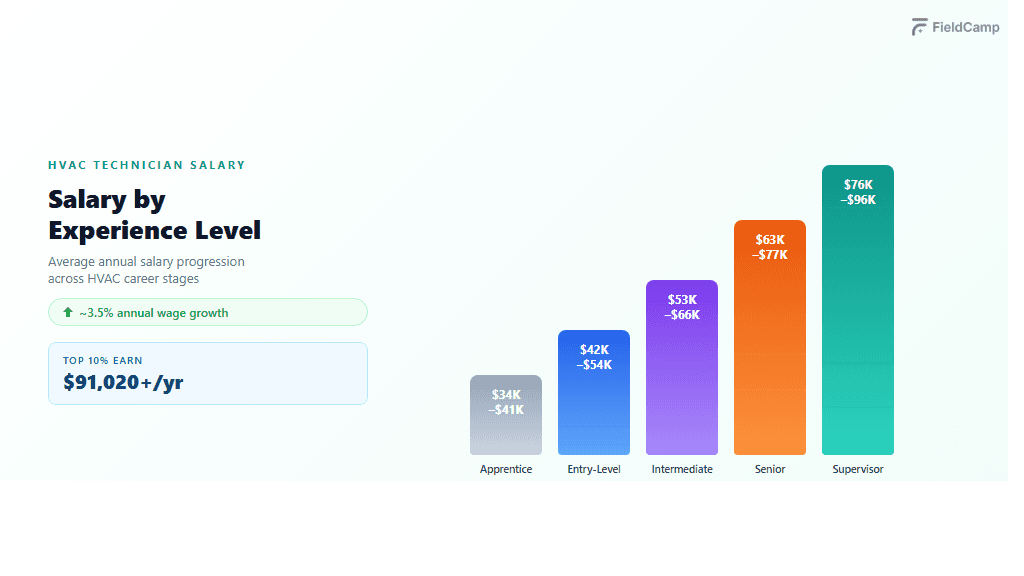
Salary Range: $34,073–$41,187/year Hourly Rate: $16.00–$20.00/hour
Entry-level HVAC helpers assist licensed technicians, learn on the job, and handle basic tasks like carrying tools, fetching materials, and observing system installations. Most states don’t require licensing for helpers, making this the easiest way to get your foot in the door.
What you’ll be doing:
Salary Range: $42,100–$54,100/year Hourly Rate: $20.24–$26.01/hour Wage Growth Rate: 3.44% annually
Entry-level technicians have completed trade school or apprenticeship programs and hold EPA Section 608 certification, which is federally required to handle refrigerants. At this stage, you can perform basic maintenance, diagnose straightforward issues, and work independently on routine service calls.
What you’ll be doing:
This is the stage where setting clear career goals can make the biggest difference in how fast you advance.
Salary Range: $53,100–$65,700/year Hourly Rate: $25.53–$31.59/hour Wage Growth Rate: 3.49% annually
Intermediate technicians handle more complex diagnostics, full system installations, and customer consultations. Many pursue NATE certification at this stage to boost credibility and unlock higher-paying positions.
What you’ll be doing:
Salary Range: $63,400–$77,200/year Hourly Rate: $30.48–$37.12/hour Wage Growth Rate: 3.62% annually
Senior technicians specialize in commercial systems, complex residential installations, or niche areas like refrigeration or geothermal. They often mentor junior technicians and handle the most challenging service calls that nobody else can figure out.
What you’ll be doing:
Salary Range: $76,000–$96,400/year Hourly Rate: $36.54–$46.35/hour Wage Growth Rate: 3.55% annually
Supervisors and lead technicians oversee entire crews, manage projects, and handle administrative responsibilities. This role often transitions from hourly to salaried compensation with performance bonuses on top.
What you’ll be doing:
HVAC technicians experience consistent wage growth of 3.4–3.6% annually across all experience levels. That outpaces general inflation and reflects the industry’s persistent demand for skilled workers.
The longer you stay, the more you earn, especially if you’re intentional about building specializations along the way.
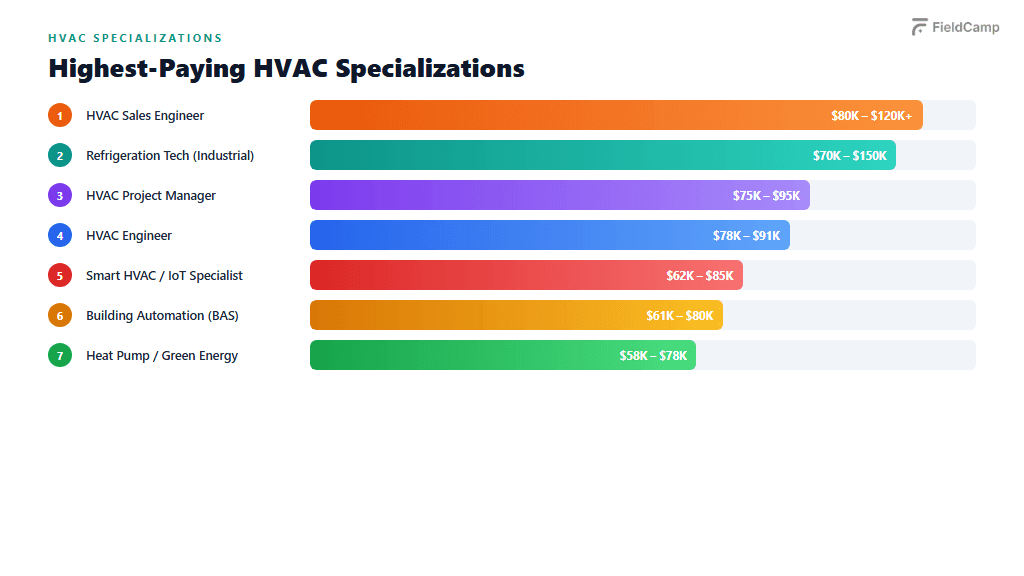
Not all HVAC work pays the same. Your specialization can dramatically change your earning potential, sometimes by $30,000 or more annually.
Residential HVAC Technicians: Average Salary: $54,228/year
Residential technicians work on single-family homes and small multi-family buildings. The work is less complex but more seasonal, peak demand hits in summer (AC) and winter (heating), with slower spring and fall months.
If you don’t mind the seasonal rhythm and enjoy working directly with homeowners, residential can be a great path.
Commercial HVAC Technicians: Average Salary: $55,888–$65,448/year
Commercial technicians work on office buildings, retail centers, hospitals, schools, and industrial facilities.
The systems are larger, more complex, and require advanced knowledge of chillers, boilers, rooftop units, and building automation systems.
Why Commercial Pays More:
1. HVAC Engineer Salary Range: $77,666–$90,684/year
HVAC engineers design systems, perform load calculations, and oversee large commercial installations. This path typically requires an engineering degree or extensive technical training.
Using an HVAC load calculator is just the starting point; engineers handle the full design-to-commissioning process.
2. Refrigeration Technician (Industrial/Commercial) Salary Range: $70,000–$150,000/year
Industrial refrigeration specialists work on massive systems in food processing plants, cold storage warehouses, and supermarkets. Ammonia refrigeration systems command premium pay because of the safety complexity involved.
This is consistently the highest-paying hands-on HVAC specialization.
3. Building Automation/Controls Specialist Salary Range: $60,500–$80,000/year
BAS technicians program and maintain computerized HVAC control systems. You’ll need IT skills, PLC programming knowledge, and solid HVAC fundamentals.
Demand is especially strong in commercial and institutional buildings where energy management matters.
4. HVAC Project Manager Salary Range: $75,000–$95,000/year
Project managers oversee large-scale HVAC installations from bidding through completion. This role requires field experience plus estimating, scheduling, and customer management skills.
It’s the bridge between wrench-turning and business leadership.
5. HVAC Sales Engineer Salary Range: $80,000–$120,000+/year (base + commissions)
Sales engineers sell HVAC equipment and systems to contractors and building owners. This role combines technical knowledge with sales ability.
Top performers regularly clear $150,000+ with commissions.
6. Smart HVAC / IoT Systems Technician Salary Range: $62,000–$85,000/year
An emerging specialization focused on smart thermostats, IoT-connected systems, and predictive maintenance technology. This field is growing rapidly as smart home and smart building adoption accelerates.
7. Green Energy / Heat Pump Specialist Salary Range: $58,000–$78,000/year
With heat pumps outselling gas furnaces and federal incentives driving green HVAC adoption, specialists in heat pump installation, geothermal systems, and energy-efficient retrofits are increasingly hard to find, and well compensated for it.
According to PayScale’s data on skills-based salary premiums, certain technical skills consistently unlock higher hourly rates:
Top-Paying Skills:
Certifications That Increase Pay:
The O*NET database provides additional detail on the knowledge, skills, and abilities that define HVAC career progression.
Within states, metro areas often pay significantly more than rural regions. If you’re willing to deal with city traffic and higher rents, the salary bump can be substantial.
1. New York City, NY Average: $35.57/hour (Indeed) | $75,523/year (Glassdoor)
Union wages in NYC are among the highest in the nation. The dense concentration of commercial real estate and residential high-rises keeps demand constant.
2. San Jose, CA (Silicon Valley) Average: $30.88/hour (PayScale) | $79,623/year (Glassdoor)
Tech industry data centers and commercial office buildings create strong demand for skilled HVAC technicians who can maintain mission-critical cooling systems.
3. Los Angeles, CA Average: $32.66/hour (Indeed) | $76,857/year (Glassdoor)
A massive metro area with year-round cooling demand and strong union presence. Residential and commercial work are both plentiful.
4. San Francisco, CA Average: $30.50/hour (PayScale) | ~$74,200/year
High cost of living and a commercial construction boom support elevated wages. The city’s strict building codes also create demand for specialized HVAC compliance work.
5. Baltimore, MD Average: $32.31/hour (PayScale)
Strong union presence and proximity to Washington, D.C. federal projects drive wages higher than you might expect for a mid-Atlantic city.
6. Boston, MA Average: $30.15/hour (PayScale) | ~$72,800/year
Historic buildings requiring HVAC retrofits and cold winters create consistent, year-round demand. The biotech and university sectors add commercial opportunities.
7. Dallas, TX Average: $31.24/hour (Indeed)
Rapid population growth and extreme summer heat drive cooling demand and commercial construction. No state income tax makes take-home pay more attractive.
8. Seattle, WA Average: $29.85/hour (PayScale) | ~$71,500/year
Tech industry growth and commercial construction support strong wages. No state income tax adds to the appeal, despite the mild climate reducing seasonal peaks.
9. Austin, TX Average: ~$30.12/hour
One of the fastest-growing metros in the country, with extreme summer heat and booming residential and commercial construction fueling demand.
10. Phoenix, AZ Average: ~$29.40/hour
Extreme desert heat makes air conditioning an absolute necessity year-round. Rapid population growth ensures no shortage of work.
These cities pay the highest absolute wages, but the cost of living varies dramatically. A technician earning $75,000 in NYC may have less actual purchasing power than someone earning $60,000 in Dallas, because of the housing, food, and transportation costs in each city.
Always factor in what your dollar actually buys before making a move.
This is one of the biggest salary differentiators in the HVAC industry, and it’s one that most salary guides barely mention.
The pay gap between union and non-union HVAC work is real, consistent, and significant.
Source: ZipRecruiter Union HVAC Technician Salary Data, February 2026
According to HVACR Career Connect NY and union wage scales, here’s how pay typically progresses through a union career:
That journeyman rate of $42+/hour translates to $87,360/year before overtime — and union shops typically pay overtime at 1.5x or even 2x for holidays and weekends.
Union HVAC workers receive comprehensive benefits that significantly boost total compensation:
Pension Plans: Union pensions typically add 20–30% to lifetime compensation. Many union HVAC workers retire with $3,000–$5,000/month in pension income after 30 years of service. That’s a retirement benefit that’s increasingly rare in the private sector.
Health Insurance: Full family health coverage (medical, dental, vision) with little to no employee premium contribution. The estimated value is $15,000–$25,000/year — money that non-union workers often pay out of pocket.
Guaranteed Raises: Union contracts include scheduled wage increases (typically 2–4% annually), protecting workers against wage stagnation. You don’t have to ask, negotiate, or hope — it’s contractual.
Paid Holidays and PTO: Union contracts mandate 10–15 paid holidays plus 2–3 weeks of vacation, compared to 5–10 days offered by many non-union shops.
Training and Apprenticeship: Union apprenticeships provide paid on-the-job training plus classroom education at little to no cost to the worker. You earn while you learn — no student debt required.
Union Pros:
Union Cons:
Non-Union Pros:
Non-Union Cons:
The United Association (UA) is the primary union representing HVAC, plumbing, and pipefitting workers across the U.S. and Canada. Local chapters exist in most major metro areas. To join, contact your local UA chapter and apply for their apprenticeship program. Acceptance typically requires aptitude tests, interviews, and proof of a high school diploma or GED.
If you’re weighing HVAC against other trades, here’s how the numbers actually stack up.
Data sourced from BLS and RSI career comparisons:
| Trade | Entry-Level | Mid-Career | Senior/Supervisor |
| HVAC Technician | $54,100 | $65,700 | $90,800 |
| Electrician | $60,600 | $71,100 | $76,600 |
| Plumber | $53,900 | $70,000 | $75,800 |
| Carpenter | $48,300 | $58,700 | $68,200 |
| Welder | $50,200 | $62,400 | $74,900 |
Key Insights:
Electricians earn more at the entry level ($60,600 vs. $54,100 for HVAC), but here’s the twist: HVAC supervisors out-earn senior electricians by a significant margin ($90,800 vs. $76,600). The long game favors HVAC.
Plumbers and HVAC technicians track closely through mid-career, with HVAC pulling ahead noticeably at the supervisor level. For context on how the plumbing trade is evolving, check out the latest plumbing industry trends and statistics.
All three major trades (HVAC, electrical, plumbing) offer realistic $100K+ potential for those who specialize, work significant overtime, or start their own businesses.
Training Time Comparison:
HVAC offers the fastest entry to the workforce, which means you start earning real money sooner.
Job Growth Comparison (2024–2034):
HVAC leads the skilled trades in projected growth because of aging systems that need replacement, new energy efficiency standards, climate change increasing cooling demand, and the electrification trend driving heat pump adoption.
Understanding what actually moves the needle on your paycheck helps you make strategic decisions about where to work, what to learn, and how to position yourself for maximum earning potential.
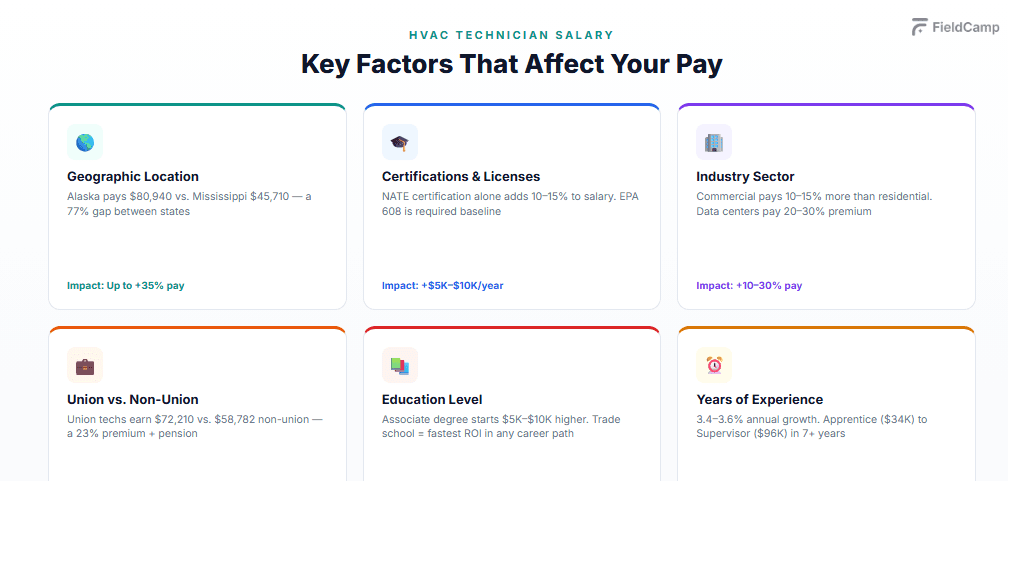
Climate Impact: Extreme climates create year-round demand and push wages higher:
Urban vs. Rural: Metro areas typically pay 15–30% more than rural areas. The reasons are straightforward: higher cost of living, stronger competition for talent, and more commercial work.
Cost-of-Living Adjusted Rankings: When you adjust for actual purchasing power, some lower-wage states look more attractive:
However, even after these adjustments, high-paying states still offer better absolute earnings and wealth-building potential. Higher income means more savings capacity, better retirement contributions, and faster equity building — if you can keep expenses under control.
Knowing how to charge for travel time also matters more in rural areas where drive times between jobs eat into your productive hours.
EPA Section 608 Certification: Federally required to handle refrigerants. This is the baseline, no salary premium, but you literally cannot work legally without it.
NATE Certification (North American Technician Excellence): The industry’s most recognized competency credential. Adds 10–15% to your salary ($5,000–$10,000/year for median earners). Test fees are only $40–$100 each, one of the highest-ROI investments in the trades.
State Licenses: Requirements vary wildly by state. Some states require no state license, while others require contractor licenses for certain types of work. Commercial work almost always requires additional licensing.
Manufacturer Certifications: Carrier, Trane, Lennox, and other manufacturers offer certification programs that can add 5–8% to your earning potential while making you more valuable to your employer.
LEED Green Associate: Positions you for green building and energy-efficient HVAC work. With federal incentives driving demand for sustainable building systems, this certification adds an 8–12% premium.
R-410A / R-32 Refrigerant Certification: As older refrigerants get phased out under EPA regulations, staying current on new refrigerant handling adds real value.
Residential vs. Commercial: We covered this above; commercial pays 10–15% more on average because of system complexity and year-round demand.
Employer Type:
Emerging Sector, Data Centers: Data centers require precise climate control 24/7, 365 days a year. HVAC technicians servicing data centers often earn 20–30% premiums because of the mission-critical nature of the work. A cooling failure in a server farm can cost millions, so they pay well to make sure it doesn’t happen.
High School Diploma / GED: The minimum requirement for most entry-level positions.
Certificate Programs (6–12 months): Trade school certificates like those offered by Lincoln Tech provide faster entry to the field and typically start you at $2–5/hour higher than those without formal training.
Associate Degree (2 years): An associate degree in HVAC technology starts salaries $5,000–$10,000 higher and opens doors to supervisory roles faster than certificate-only credentials.
Apprenticeship Programs: Earn while you learn. Union apprenticeships are paid positions that include classroom instruction at no cost to the student. The combination of no debt plus income from day one makes this an exceptionally strong ROI path.
Education ROI: HVAC education offers exceptional return on investment. A $15,000 trade school program leading to a $60,000/year career means a payback period of just 3–6 months, compared to years or decades for many bachelor’s degree holders paying off student loans.
Short answer: Yes, but it’s not the norm.
The top 10% of HVAC technicians earn over $91,020 according to BLS data, and union HVAC workers in high-cost cities regularly exceed $100,000. Here are the seven proven paths to six-figure HVAC income:
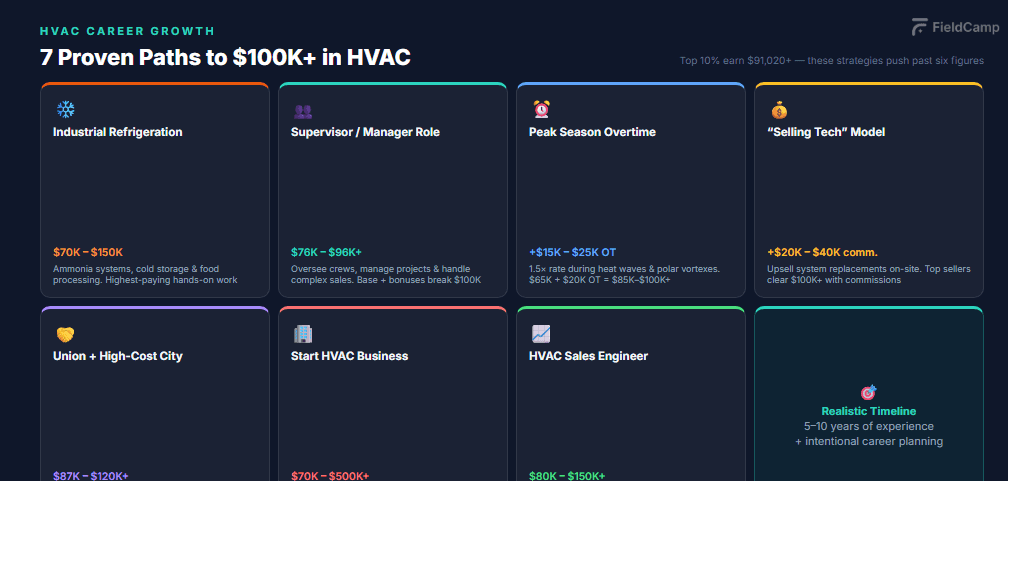
Path 1: Specialize in Commercial/Industrial Refrigeration: Industrial refrigeration technicians working on ammonia systems, cold storage facilities, and food processing plants earn $70,000–$150,000 annually. The work requires specialized training, safety certifications, and carries a higher risk, but pays accordingly.
Path 2: Move Into Supervisory or Management Roles: HVAC supervisors and project managers earn $75,000–$95,000 base salary. With performance bonuses and overtime, total compensation often exceeds $100,000.
Path 3: Work Significant Overtime During Peak Seasons: HVAC technicians working 50–60-hour workweeks during peak summer and winter seasons can add $15,000–$25,000 in overtime pay.
A technician earning $65,000 base plus $20,000 in overtime clears $85,000–$90,000, and those who push harder during extreme weather events can break $100K.
Path 4: Become a “Selling Tech” Service technicians who upsell system replacements and add-on services earns commissions on top of base pay. Top selling techs bring in $20,000–$40,000 in annual commissions, pushing total compensation well over $100K.
Having a solid HVAC pricing guide in your back pocket helps you close deals with confidence.
Path 5: Union HVAC in High-Cost Cities: Union journeyman HVAC technicians in New York City, San Francisco, and Washington D.C. earn $42–$50/hour base ($87,000–$104,000/year) before overtime. Government projects with prevailing wage requirements can push total compensation to $120,000+.
Path 6: Start Your Own HVAC Business: HVAC business owners have the highest earning potential, but also the most risk. Successful multi-crew operations can generate $200,000–$500,000+ in owner income. However, most HVAC business owners take home $70,000–$120,000 annually (more on this below).
Path 7: Combine Technical + Sales Skills: HVAC sales engineers and manufacturer representatives earn $80,000–$150,000 by combining technical expertise with sales ability. This path requires strong communication skills and comfort with consultative selling, but it’s one of the most reliable routes to six figures.
Realistic Timeline to $100K: For most HVAC technicians, reaching $100,000 annual income requires 5–10 years of experience plus one or more of the strategies above. It’s absolutely achievable, but it requires intentional career planning and continuous skill development, not just showing up every day.
Many experienced HVAC technicians dream of starting their own businesses. It’s easy to see the appeal: you’re the boss, you set your own rates, and the income ceiling is theoretically unlimited. But the reality is more nuanced than most people expect.
Here’s the distinction that trips up a lot of new business owners: revenue is NOT the same as owner income.
A $1 million revenue HVAC company doesn’t mean the owner takes home $1 million. After paying technicians, overhead (trucks, insurance, tools, marketing), and business expenses, most residential HVAC businesses net 2.5–5% profit margins.
Realistic math:
Understanding accurate service pricing is essential for maintaining healthy margins as you scale.
Solo Operator (Owner-Technician): $70,000–$120,000 depending on pricing, efficiency, and market. Your income ceiling is limited by the hours you can physically work.
2–3 Technician Shop: $100,000–$180,000. The owner handles sales, dispatching, and still works in the field part-time. Learning how to manage a field service team effectively becomes critical at this stage.
5–10 Technician Company: $150,000–$300,000. The owner focuses primarily on sales, management, and growth. Less field work, more business building.
10+ Technician Operation: $200,000–$500,000+. The owner is essentially a full-time CEO. This level requires strong systems, reliable managers, and efficient operations.
According to industry data, roughly 2% of HVAC business owners consistently earn over $100,000 per year. The majority earn $70,000–$90,000, comparable to senior technician wages, but with significantly more stress, risk, and time investment.
Why Business Ownership Still Makes Sense:
For HVAC business owners looking to maximize efficiency and profitability, having the right tools matters more than you think. Using a free HVAC invoice template and a free HVAC estimate template can streamline your billing from day one, while dedicated field service management software handles the dispatching, scheduling, and routing that eat into your productive hours.
Salary is only part of the picture. When you’re comparing job offers or negotiating compensation, you need to look at the full package, because benefits can add 30–50% on top of your base pay.
Health Insurance Value: $8,000–$20,000/year. Employer-sponsored health plans (medical, dental, vision) add substantial value to your total compensation. Union plans typically cover full family coverage at no employee cost, a benefit worth tens of thousands of dollars annually.
Retirement Plans 401(k) with Employer Match: 3–6% of salary. Many HVAC companies offer 401(k) matching. A technician earning $60,000 with a 4% match receives an additional $2,400/year in free retirement money.
Union Pensions: Union HVAC workers earn pension benefits worth 20–30% of lifetime compensation. After 30 years, many retire with $3,000–$5,000/month pensions — a level of retirement security that’s increasingly rare in the private sector.
Paid Time Off (PTO) Value: $2,000–$5,000/year. 2–4 weeks of paid vacation plus holidays. Union shops typically offer more PTO than non-union employers.
Overtime Pay Average: $5,000–$10,000+/year. According to Indeed, HVAC technicians average $6,750 in overtime annually. During extreme weather, it can easily double.
Performance Bonuses Range: $248–$6,556 (PayScale data). Many HVAC companies offer quarterly or annual performance bonuses based on productivity, customer satisfaction, or company profitability.
Commissions on Sales/Replacements Range: $323–$19,363 (PayScale data). Service technicians who sell system replacements or add-on services earn commissions that can significantly boost income. Top-selling techs add $10,000–$20,000 annually this way.
Profit Sharing Range: $121–$6,000 (PayScale data). Some HVAC companies share profits with employees at year-end, an extra check that rewards company-wide success.
Tool Allowances Value: $500–$2,000/year. Many companies provide tool allowances or reimburse technicians for purchasing specialized equipment. This saves you real money on gear that can be expensive to acquire on your own.
Company Vehicles Value: $3,000–$8,000/year. Technicians who drive company vans save on vehicle expenses, fuel, and maintenance. Some companies even allow personal use of the vehicle.
Source: PayScale benefits data; ShareWillow compensation benchmarks; Lincoln Tech salary guide
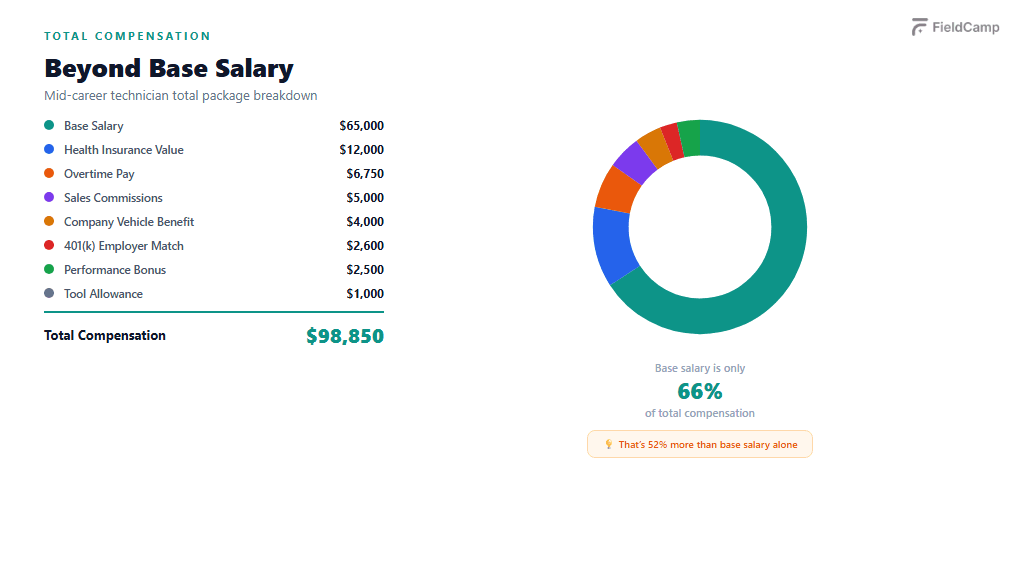
Let’s put it all together for a mid-career technician:
| Component | Value |
| Base Salary | $65,000 |
| Overtime | $6,750 |
| 401(k) Match (4%) | $2,600 |
| Health Insurance Value | $12,000 |
| Performance Bonus | $2,500 |
| Commission | $5,000 |
| Tool Allowance | $1,000 |
| Company Vehicle Benefit | $4,000 |
| Total Compensation | $98,850 |
This example shows how a technician with a $65,000 base salary receives nearly $100,000 in total compensation, about 52% more than base salary alone. When someone asks you, “What do you make?” the real answer is a lot more than your hourly rate suggests.
Understanding key field service metrics can help you track and demonstrate the productivity that earns those bonuses and commissions.
Let’s look at the actual data, not opinions.
According to the Bureau of Labor Statistics:
Those 40,100 annual openings come from both new positions and replacements for technicians who retire, change careers, or leave the field.
The HVAC industry faces a severe and worsening labor shortage:
What This Means for Job Seekers: The shortage creates strong bargaining power for workers. HVAC technicians can be selective about employers, negotiate higher wages, and enjoy job security that few industries can match. If you’re entering the trade now, you’re walking into a seller’s market.
The HVAC market is growing rapidly, according to Grand View Research and ACCA:
Key Growth Drivers:
These growth trends align with broader shifts happening across field service industries, technology adoption, workforce challenges, and evolving customer expectations.
According to Zippia and industry surveys:
Gender: Women represent only 1.6–3% of HVAC technicians, making it one of the most male-dominated trades. However, this is gradually changing as recruiting efforts target underrepresented groups and awareness grows about the earning potential in skilled trades.
Diversity: The HVAC workforce is becoming more diverse, but still lags behind the general population. Active efforts to recruit women, minorities, and veterans are expanding through programs at trade schools and union apprenticeships.
Age: The average HVAC technician is 40–55 years old. The industry desperately needs younger workers to backfill the wave of retirements hitting the trade.
Yes, especially if you:
Consider other paths if you:
Ready to earn more? Here are the strategies that actually move the needle, based on what the highest-earning HVAC technicians consistently do differently.
NATE Certification: The single highest-ROI certification for HVAC technicians. Adds 10–15% to your salary ($5,000–$10,000/year at median earnings). Tests cost $40–$100 each; you’ll make that investment back in your first paycheck.
EPA Universal (vs. just Type I/II): EPA Universal certification allows you to legally work on all refrigerant types. It opens more job opportunities and eliminates restrictions that limit your value to employers.
HVAC Excellence Certification: An industry-recognized credential similar to NATE. Adds a 5–10% salary premium and demonstrates broad competency.
LEED Green Associate: Positions you for green building and energy-efficient HVAC work, a market segment growing faster than almost any other in the trade.
Manufacturer Certifications: Carrier, Trane, Lennox, and other brands offer factory training programs. Completing these makes you more valuable to employers who are authorized dealers and opens warranty service work that pays premium rates.
Commercial Refrigeration: The highest-paying hands-on specialization in HVAC. Requires additional training and safety certifications (especially for ammonia systems), but the pay reflects the complexity and risk.
Building Automation Systems (BAS): Learn Trane, Honeywell, or Johnson Controls systems. This niche combines HVAC knowledge with IT skills and commands premium pay. Employers struggle to find technicians with both skill sets.
Heat Pump/Geothermal Systems: The fastest-growing segment in HVAC, driven by federal incentives and electrification mandates. Specialists in heat pump installation and geothermal systems are in critically short supply.
Smart HVAC/IoT Integration: Position yourself for the future of connected HVAC systems. As smart buildings and predictive maintenance grow, technicians who understand IoT systems will command premium rates.
Data Center HVAC: Mission-critical cooling for server farms. Pays 20–30% premiums because failure isn’t an option; a single cooling outage can cost millions.
“Selling Tech” Model: Learn consultative sales techniques. Technicians who can identify when a system needs replacement, and explain the value to homeowners, earn $10,000–$40,000 in annual commissions on top of their base pay.
Customer Service Excellence: Happy customers refer more business, leave better reviews, tip more, and request you specifically. That translates directly to a higher value in your employer’s eyes and more leverage when asking for a raise.
Accurate Estimating: Learning to write accurate estimates on-site is a skill that companies will pay for. You can sharpen this skill with tools that help generate accurate HVAC estimates using AI assistance.
Modern field service management software helps technicians complete more jobs per day by reducing drive time and administrative work.
The right HVAC apps help you:
More efficient technicians complete more jobs, and in shops that pay productivity bonuses, that directly translates to higher earnings. Solid HVAC dispatching practices at the company level also mean less wasted time between jobs.
Supervisor/Lead Roles: Median salary of $90,800. You’ll oversee crews, manage projects, and handle complex customer situations. It’s more responsibility, but the pay reflects it.
Project Manager Roles: $75,000–$95,000, managing large commercial installations from bidding through completion. This role bridges field experience and business operations.
Business Ownership: Highest earning potential ($70,000–$500,000+) but also the highest risk and responsibility. Not for everyone, but for the right person, it’s transformative.
HVAC Franchising: An alternative to starting from scratch. Buy into an established brand (One Hour, Benjamin Franklin, etc.) with proven systems, marketing support, and operational frameworks already in place.
Whether you’re an HVAC technician looking to boost your earning potential or a business owner aiming to increase revenue and efficiency, the right tools make all the difference.
FieldCamp’s field service management platform helps HVAC professionals:
Your earning potential is directly tied to how efficiently you work. FieldCamp removes the bottlenecks that keep HVAC technicians and business owners from maximizing their income.
The median annual salary for HVAC technicians in 2026 is $59,810, according to the Bureau of Labor Statistics. Depending on experience, location, and specialization, HVAC techs earn between $39,130 (entry-level/rural areas) and $91,020+ (top 10%/major metros). Union technicians and commercial specialists often exceed $70,000–$80,000 annually.
HVAC engineers earn $77,666–$90,684/year, industrial refrigeration specialists earn $70,000–$150,000/year, and HVAC sales engineers earn $80,000–$120,000+ with commissions. HVAC supervisors earn a median of $90,800. The highest earners are business owners with established multi-crew operations, who can earn $200,000–$500,000+ annually.
Yes, though it requires strategic career planning. Proven paths to $100K include: (1) specializing in commercial/industrial refrigeration, (2) moving into supervisory roles, (3) working significant overtime during peak seasons, (4) becoming a selling tech with commission income, (5) union work in high-cost cities, (6) starting a successful HVAC business, or (7) becoming an HVAC sales engineer. Realistic timeline: 5–10 years of experience.
Yes. HVAC offers 8% projected job growth (2024–2034), median pay approaching $60,000, and an industry-wide shortage of 110,000+ technicians, creating exceptional job security. The field requires only 6 months to 2 years of training versus 4+ years for a bachelor’s degree, offers multiple career paths (residential, commercial, supervisory, business ownership), and provides essential services that can’t be automated or outsourced.
Alaska pays HVAC technicians the highest average salary at $80,940–$83,660/year, followed by New Hampshire ($77,445), Washington ($76,796), Washington, D.C. ($75,050), and Massachusetts ($72,680). However, cost-of-living adjusted rankings differ; states like Washington (no income tax) and New Hampshire (no income tax) offer better purchasing power than similarly-paid states with high taxes.
HVAC apprentices and helpers earn $34,073–$41,187/year ($16–$20/hour) on average. Union apprenticeships typically start at $15–$18/hour and progress to $42+/hour after 4–5 years of training. Higher-cost states like California, New York, and Massachusetts pay apprentices $18–$22/hour, while lower-cost states may start at $14–$16/hour.
At the entry level, electricians earn slightly more ($60,600 vs. $54,100 for HVAC). Through mid-career, earnings are comparable. However, HVAC supervisors ($90,800 median) significantly out-earn senior electricians ($76,600). Both trades offer similar long-term earning potential, with top performers and business owners in both fields exceeding $100K. Training time is slightly shorter for HVAC (2–3 years vs. 4–5 years for electricians).
Yes. Union HVAC technicians earn approximately 23% more than non-union workers ($72,210 vs. $58,782 average) according to ZipRecruiter. Union members also receive superior benefits, including pensions (worth 20–30% of lifetime earnings), comprehensive health insurance with minimal employee cost, guaranteed wage increases, and paid apprenticeship training. Trade-offs include union dues (~$30–$100/month) and less flexibility in work arrangements.
Certificate programs take 6–12 months, associate degrees take 2 years, and apprenticeships take 2–5 years (paid on-the-job training). EPA Section 608 certification is required to handle refrigerants and can be obtained in a few weeks of study. Most HVAC technicians enter the workforce within 2–3 years of starting their training, significantly faster than 4-year college degrees, and many earn competitive wages while learning through paid apprenticeship programs.