
Manual J Calculation: The Complete Guide to Proper HVAC Sizing
March 21, 2026 - 27 min read


March 21, 2026 - 27 min read

Table of Contents
| TL;DR: Manual J is the ACCA-approved industry standard for calculating exactly how much heating and cooling a home needs, based on real building data, not guesswork. It sizes HVAC systems within ±5% accuracy, saves homeowners 15–30% on energy bills, and is required by building codes in most U.S. jurisdictions. What it solves: Prevents oversized or undersized HVAC installations (70% of U.S. systems are improperly sized) Who needs it: HVAC contractors sizing equipment, homeowners verifying recommendations, inspectors checking compliance What to ask your contractor: “Are you doing a Manual J, or sizing by square footage?” If the answer is square footage, get a second opinion |
There’s a stat floating around the HVAC industry that should make every contractor uncomfortable: roughly 70% of residential HVAC systems in the U.S. are improperly sized.
Not slightly off. Improperly sized, as in, the wrong equipment was installed because someone eyeballed the load instead of calculating it.
The fix has existed for decades. It’s called Manual J, and it’s the ACCA-approved, ANSI-recognized standard for residential heating and cooling load calculations. When done correctly, it sizes HVAC systems within ±5% accuracy. When skipped in favor of the old “one ton per 500 square feet” rule, that accuracy drops to ±30% and the homeowner ends up with a system that short-cycles, wastes energy, and dies years before it should.
This guide covers everything you need to know about Manual J calculations, whether you’re an HVAC contractor looking to add this as a service or a homeowner trying to understand why it matters before your next equipment install.
Want a quick estimate right now? Try our free HVAC load calculator, it gets within 10–15% of a full Manual J for standard homes.
This guide covers a lot, from calculation steps to software tools to common sizing mistakes. If you want a quick breakdown based on your specific project type and climate zone, let AI help you.
KEY HIGHLIGHTS
Manual J Calculation: What You’ll Learn
Manual J, formally known as ANSI/ACCA 2 Manual J, is the industry standard method for calculating how much heating and cooling a residential building actually needs. It was developed by the Air Conditioning Contractors of America (ACCA) and is currently in its 8th Edition (published 2016).
In simple terms, Manual J tells you the exact BTU output your HVAC system needs to keep a specific home comfortable in both summer and winter, not based on guesswork, but based on the actual characteristics of that building.
It works by analyzing over 30 variables across eight major categories (we’ll break these down shortly), including everything from wall insulation and window orientation to local climate data and how many people live in the home.
The result is a room-by-room breakdown of heating and cooling loads measured in BTU/h (British Thermal Units per hour).
Who uses Manual J:
What Manual J applies to: Single-family homes, condos, townhouses, small multi-unit buildings, and manufactured homes. For large commercial buildings, the equivalent standard is ASHRAE’s Manual N or commercial load calculation methods.
Here’s the sizing method most HVAC contractors learned on the job and still use daily:
“One ton of AC per 400–600 square feet.”
It’s fast. It’s easy. And it’s wrong about 70% of the time.
| Sizing Method | Accuracy | Time Required | Cost | Code Compliant |
| Rule of Thumb (“1 ton per 500 sq ft”) | ±30% | 5 minutes | Free | No |
| Simplified Online Calculator | ±10–15% | 10–15 minutes | Free | No |
| Full Manual J Calculation | ±5% | 1–8 hours | $79–$800 | Yes |
The rule of thumb ignores everything that actually determines a home’s heating and cooling load: insulation quality, window type and orientation, air infiltration, duct losses, local climate data, and internal heat gains.
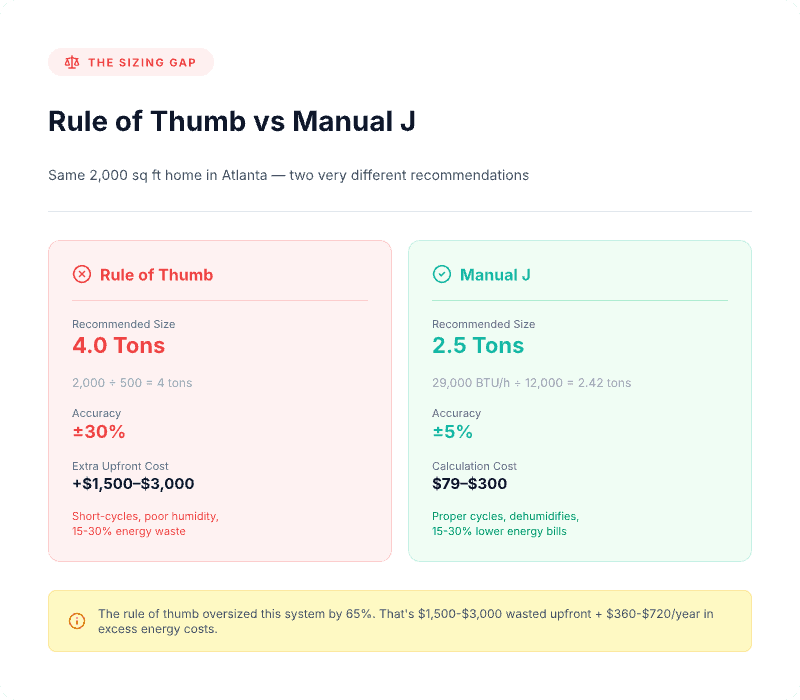
Two 2,000-square-foot homes on the same street can have wildly different load requirements depending on when they were built, how well they’re insulated, and which direction they face.
The result of rule-of-thumb sizing is almost always oversizing, because contractors (understandably) don’t want callbacks. But oversized systems create their own problems, which we’ll cover below.
ACCA’s own data shows that homes properly sized with Manual J save 15–30% on annual heating and cooling costs compared to rule-of-thumb-sized homes. On a $2,400/year energy bill, that’s $360–$720 back in the homeowner’s pocket, every year.
See our HVAC pricing guide for how proper sizing affects the full cost picture for homeowners.
Manual J doesn’t use one formula. It accounts for over 30 variables organized into eight categories. Here’s what each one measures and why it matters.
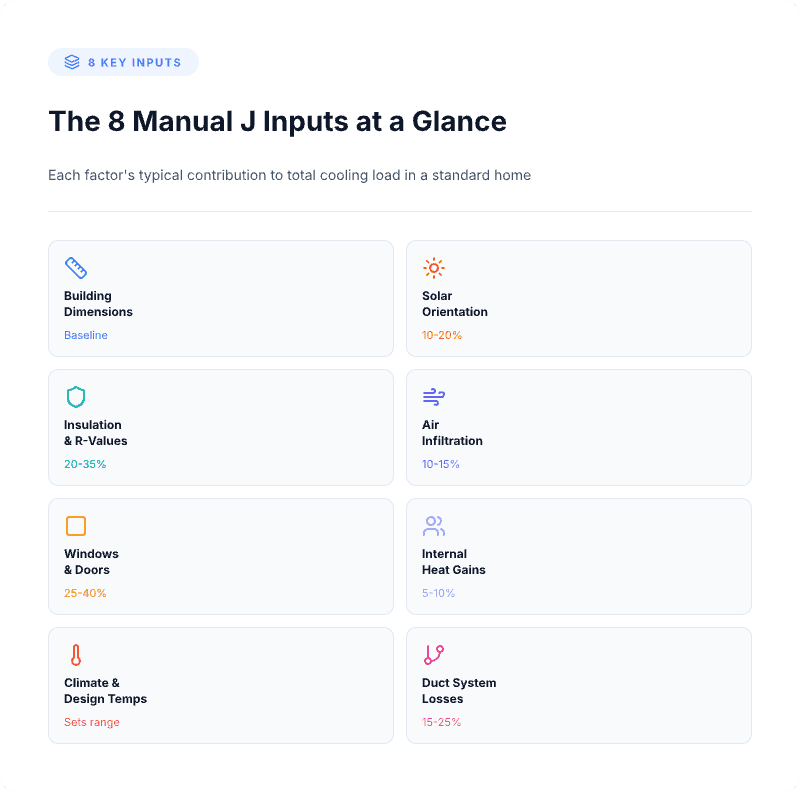
This is the starting point: square footage, ceiling height, and the layout of every room. Manual J is a room-by-room calculation, not a whole-house estimate.
Each room gets its own heating and cooling load based on its size, location in the home, and the surfaces it shares with unconditioned spaces.
A 200-square-foot bedroom over the garage has a very different load than a 200-square-foot bedroom in the center of the house.
The R-value (a measure of thermal resistance; the higher the number, the better the insulation) of your walls, attic, floors, and foundation determines how fast heat moves through the building envelope. Manual J needs the actual R-values, not assumptions.
Older homes with degraded or missing insulation will show dramatically higher loads. This is one of the most common places contractors make mistakes, assuming R-values instead of verifying them.
Windows are the biggest wildcard in any load calculation. Manual J accounts for:
A south-facing wall of floor-to-ceiling windows can add 1,500–2,000+ BTU/h of solar heat gain. The same wall facing north adds a fraction of that. Rule-of-thumb sizing ignores this entirely.
Manual J uses ASHRAE weather data to determine the design temperatures for your specific location, the hottest and coldest conditions the system needs to handle.
These are expressed as 99% winter and 1% summer design temps, meaning the outdoor temperature is expected to be more extreme than the design temp only 1% of the year.
Examples:
The difference between Phoenix and Minneapolis means a 2,000 sq ft home in Phoenix might need 4 tons of cooling but minimal heating, while the same home in Minneapolis needs significant heating capacity but less cooling. The rule of thumb treats them the same.
The direction the home faces changes the cooling load significantly. South- and west-facing surfaces absorb the most solar radiation during peak cooling hours.
Manual J factors in:
Every home leaks air. The question is how much.
Air infiltration, the uncontrolled flow of outside air through cracks, gaps, and openings, can account for 20–40% of a home’s total heating load.
Manual J estimates infiltration based on construction quality, age, and (ideally) blower door test results measured in ACH50 (air changes per hour at 50 Pascals of pressure, essentially, how many times the home’s entire air volume leaks out per hour under standardized test conditions).
Newer, tightly built homes leak less air but may need mechanical ventilation to maintain indoor air quality.
Use our air changes per hour calculator to verify ventilation performance for any space. Older homes leak more but rarely need additional ventilation.
Everything inside the home that produces heat gets counted:
In a standard 3-bedroom home, internal gains are a modest contributor. In a home with a commercial kitchen or a server room, they can be substantial.
If your ductwork runs through an unconditioned attic, crawlspace, or garage, some of your heating and cooling capacity never reaches the rooms. Manual J accounts for:
In a typical home with ducts in an unconditioned attic, duct losses can add 15–25% to the required system capacity. This is why duct design, covered by ACCA’s Manual D, is the natural next step after Manual J.
Let’s walk through a simplified Manual J calculation for a real scenario.
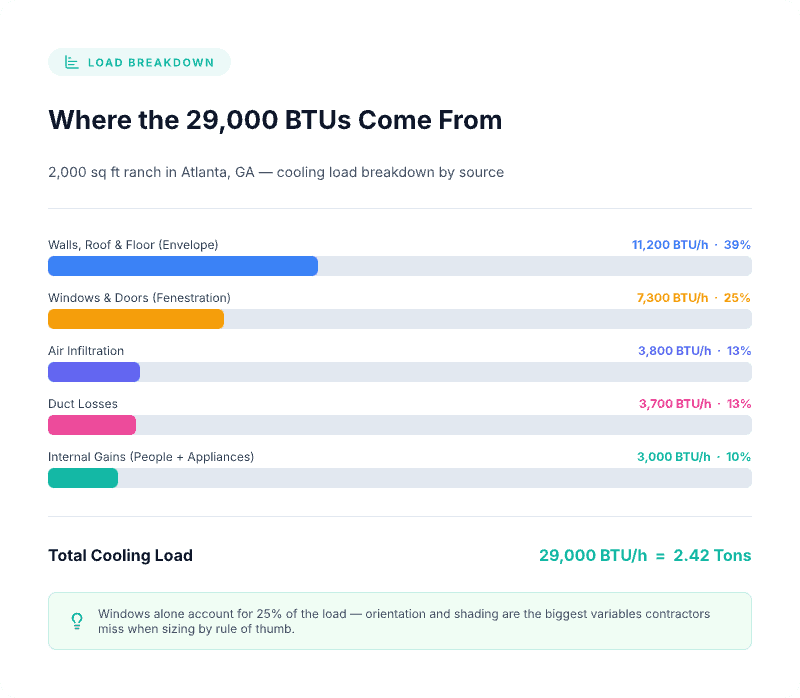
Sample home:
Step 1: Establish design temperatures
Atlanta design temps: 94°F cooling / 23°F heating Indoor design: 75°F cooling / 70°F heating
Step 2: Calculate envelope loads (walls, roof, floor)
Step 3: Calculate fenestration loads (windows/doors)
Step 4: Calculate infiltration load
Step 5: Calculate internal gains
Step 6: Add duct losses
Step 7: Total cooling load
11,200 + 7,300 + 3,800 + 3,000 + 3,700 = 29,000 BTU/h
Step 8: Convert to tonnage 29,000 BTU/h ÷ 12,000 = 2.42 tons
Using Manual S guidelines (cooling capacity within 115% of Manual J load), the correct equipment selection would be a 2.5-ton system.
What rule of thumb would have said: 2,000 sq ft ÷ 500 = 4 tons — 65% larger than needed.
That 4-ton system would cost more to purchase, require constant short-cycle maintenance, never properly dehumidify the home (a real problem in Atlanta’s humidity), and wear out the compressor years early.
Manual J doesn’t exist in isolation. It’s the first step in a four-part ACCA design process. Each manual builds on the one before it:
| Manual | Purpose | What It Determines | Depends On |
| Manual J | Load Calculation | How much heating/cooling is needed (BTU) | Building data |
| Manual S | Equipment Selection | Which specific unit to install | Manual J results |
| Manual T | Air Distribution | Register and grille sizing | Manual J + Manual S |
| Manual D | Duct Design | Ductwork sizing and layout | Manual J + Manual S + Manual T |
Think of it sequentially: J → S → T → D or use the mnemonic: “Just Size The Ducts.”
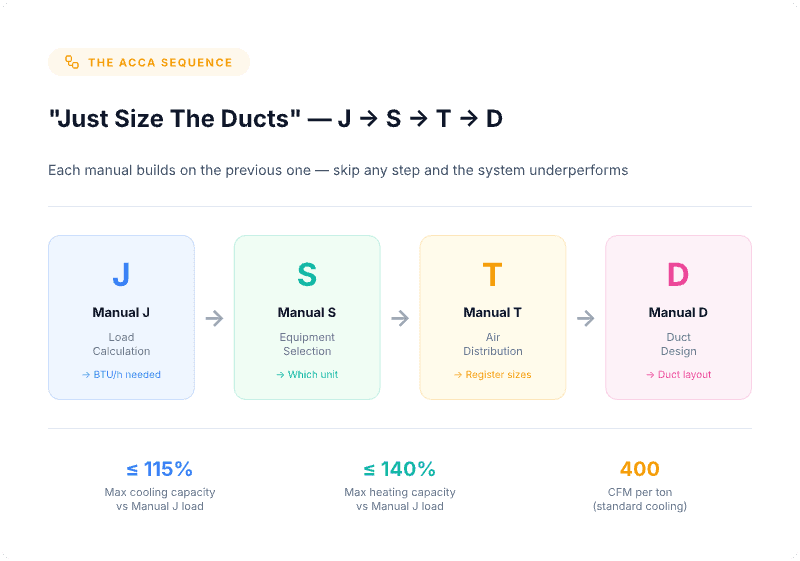
Manual S takes your Manual J results and matches them to specific manufacturer equipment. The key rules: cooling capacity must stay within 115% of the Manual J cooling load, and heating capacity within 140% of the Manual J heating load. This prevents oversizing.
Manual T determines the CFM (cubic feet per minute, the volume of air flowing through the system) each room needs and sizes the supply registers and return grilles accordingly. A room that needs 150 CFM gets a different register than one needing 300 CFM.
Manual D designs the duct system to deliver the right CFM to each room. It determines duct sizes, routing, trunk and branch layout, and ensures the system can actually move the air where it needs to go.
Skipping any step in this sequence, which happens constantly in residential HVAC, is like building a house without a foundation.
The Manual J calculation is accurate, but if the ductwork can’t deliver the air, the system still underperforms.
Manual J isn’t just a best practice; in most of the U.S., it’s the law.
Building codes requiring Manual J:
Other requirements:
The reality: Code enforcement varies widely by jurisdiction. In some areas, inspectors thoroughly verify Manual J documentation. In others, a rule-of-thumb calculation on a napkin passes inspection.
But the trend is toward stricter enforcement, especially for heat pump installations, where improper sizing has more severe performance consequences.
Read our HVAC maintenance plan guide for how proper sizing and ongoing maintenance work together to protect equipment longevity.
With the Inflation Reduction Act driving heat pump adoption, heat pumps outsold gas furnaces by 32% in 2026. Manual J calculations are more important for heat pumps than for any other HVAC system type.
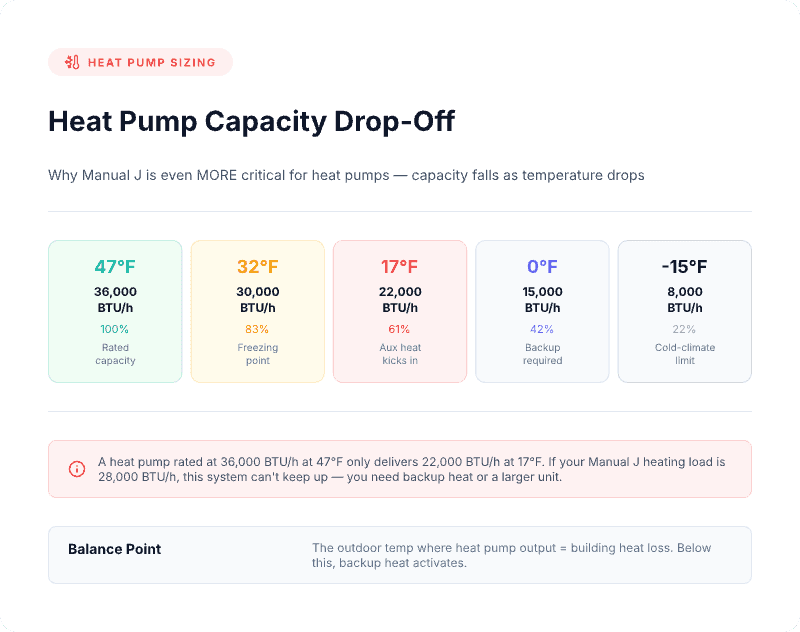
Here’s why: heat pumps lose capacity as outdoor temperature drops. A heat pump rated at 36,000 BTU/h at 47°F might only deliver 22,000 BTU/h at 17°F.
If the Manual J heating load is 28,000 BTU/h at your design temperature, that heat pump can’t keep up, and you’ll be relying on expensive auxiliary heat strips.
Manual J for heat pumps requires:
Manual J for ductless mini splits: Mini splits actually make Manual J MORE useful, not less. Because mini splits allow room-by-room zoning, the room-by-room data from Manual J directly sizes each indoor head unit.
A bedroom needing 6,000 BTU/h gets a 6K head; a living room needing 12,000 BTU/h gets a 12K head.
The common mistake: installers oversizing mini splits because they skip Manual J. An oversized mini split short-cycles just like an oversized central system, and because mini splits modulate (automatically adjust output), some installers assume oversizing doesn’t matter.
It does. Excessive oversizing still causes comfort and efficiency problems. Our guide on how to grow your HVAC business covers how offering accurate sizing builds long-term customer trust.
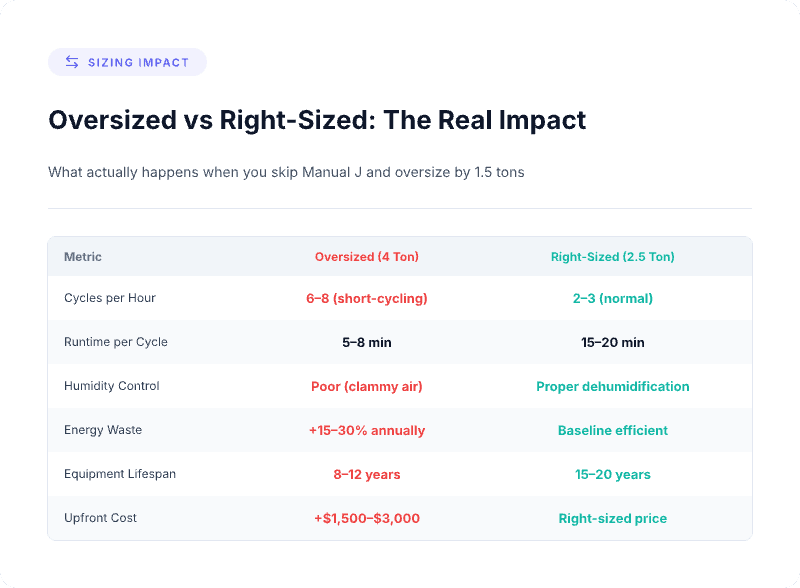
An oversized HVAC system is the most common result of skipping Manual J, and the problems compound over the life of the equipment:
Less common but equally problematic:
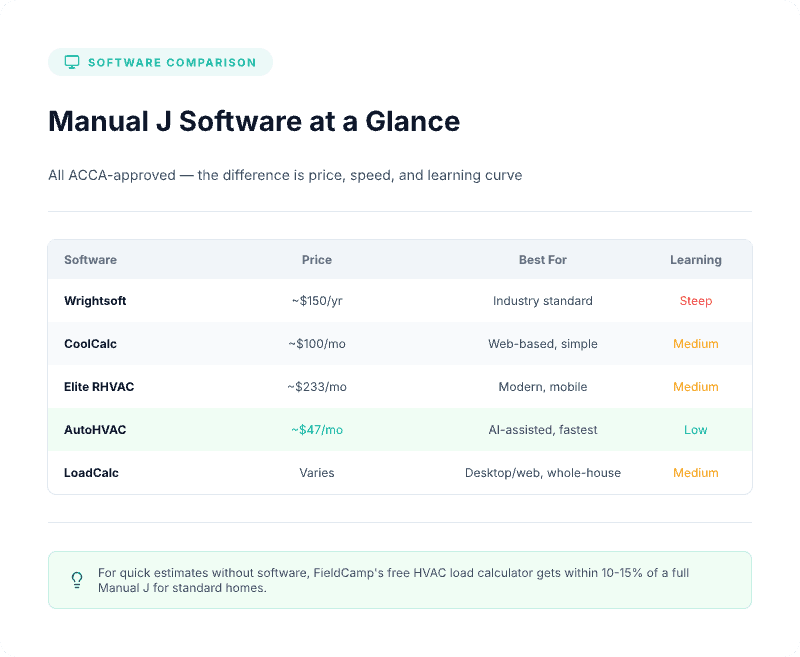
For contractors: Professional software is essential if you’re performing Manual J calculations regularly. Here’s how the major options compare:
All ACCA-approved software uses the same underlying Manual J methodology. The differences are in user interface, speed, data entry workflow, reporting features, and integration capabilities.
For homeowners: Our free HVAC load calculator provides a solid starting point, within 10–15% of a full Manual J for standard homes. It’s not a replacement for a professional calculation, but it gives you a baseline to compare against your contractor’s recommendation.
For regular professional use, CoolCalc or AutoHVAC offer the best balance of price and usability. Wrightsoft is the gold standard but has the steepest learning curve.
| Service Type | Price Range | Turnaround |
| Budget third-party service | $79–$100 | 1–2 business days |
| Mid-range third-party service | $150–$300 | 2–4 business days |
| Complex or large homes | $300–$800 | 3–5 business days |
| HVAC contractor (standalone) | $100–$200 | Same day or next day |
| Included with installation quote | Free | At time of quote |
| DIY with professional software | $47–$233/month (subscription) | Self-paced |
For homeowners: Many HVAC contractors include Manual J as part of their installation quote at no additional charge. If your contractor doesn’t mention it, ask — and be wary of anyone who says they don’t need one.
For contractors: The question isn’t whether you can afford to offer Manual J, it’s whether you can afford not to. At $100–$300 per calculation, it’s a revenue-generating service that differentiates you from every competitor still using the rule of thumb.
It also reduces callbacks, protects against liability, and justifies proper equipment sizing.
Use professional HVAC estimate templates to present your Manual J-backed recommendations in a polished, itemized format that builds homeowner confidence.
For contractors, these are the errors that lead to callbacks, warranty claims, and lost credibility:
For contractors: If you’re still relying on rule-of-thumb sizing, here’s the business case for Manual J:
Revenue opportunity: Charge $100–$300 per Manual J calculation as a standalone service, or include it in your premium installation packages to justify higher ticket prices. Factor Manual J into your overall HVAC pricing strategy to position it as a value-add, not an extra cost.
Competitive differentiator: When you walk into a home with professional software and produce a room-by-room load calculation with a detailed report, you immediately separate yourself from every competitor who eyeballed it. Homeowners notice the difference, and it helps you close more jobs at higher prices through better HVAC lead generation.
Fewer callbacks and warranty claims: A properly sized system doesn’t short-cycle, doesn’t leave rooms uncomfortable, and doesn’t generate “my new system isn’t working” calls two weeks after install. Track every job with proper documentation using work order management to maintain records.
Code compliance and liability protection: If a homeowner ever challenges your equipment recommendation — or an inspector questions your installation, a documented Manual J calculation is your proof of due diligence.
Better equipment recommendations: When you know the exact load, you can recommend the right equipment confidently. No more oversizing “just in case.” That means better performance, happier customers, and more referrals. See our guide on how to grow your HVAC business for how to turn quality work into a repeatable growth system.
Managing it all: Once you’re running Manual J as part of your standard workflow, you need scheduling, dispatch, and job tracking that keeps up. FieldCamp’s AI-powered scheduling and automated dispatching help HVAC contractors manage more jobs with less admin overhead. Pair that with automated invoicing and professional quotes to keep cash flow moving.
A complete Manual J report, the deliverable you provide to the homeowner, inspector, or permit office, typically contains:
For contractors: This report is your professional documentation; keep a copy for every job. It protects you, demonstrates your expertise, and builds a library of real-world data that makes future calculations faster and more accurate. Store reports alongside job records in your CRM so they’re accessible when customers call back for service or upgrades.
For homeowners: Ask your contractor for a copy of this report before signing off on the equipment. If they can’t produce one, that’s a red flag; it likely means they sized your system by rule of thumb.
Still Sizing HVAC Systems by Square Footage?
Your competitors are quoting with data. They’re walking into homes with professional load calculations, recommending the right equipment backed by math, and closing jobs at higher ticket prices because they can show the homeowner exactly why.
FieldCamp helps HVAC contractors run the entire operation, from AI-powered scheduling and dispatching to estimates, invoices, and job tracking, so your team spends less time on admin and more time doing the work that wins customers.
Manual J is the ACCA (Air Conditioning Contractors of America) standard for calculating residential heating and cooling loads. It analyzes over 30 variables — including insulation, windows, climate, orientation, and infiltration — to determine exactly how many BTUs of heating and cooling a home needs. It’s the accepted standard referenced by IECC, IRC, and most state building codes.
A Manual J calculation typically costs between $79 and $800, depending on the provider and home complexity. Third-party services start at $79. HVAC contractors usually charge $100–$200 as a standalone service, and many include it free with an equipment installation quote. DIY options using professional software run $47–$233/month.
Yes, in most U.S. jurisdictions. The International Energy Conservation Code (IECC) and International Residential Code (IRC) both reference Manual J as the standard for residential HVAC sizing. California Title 24 specifically requires Manual J documentation for mechanical permits. Enforcement varies by jurisdiction, but the legal requirement exists almost everywhere.
Technically, yes, with the right software and knowledge. CoolCalc, AutoHVAC, and other ACCA-approved tools are available to homeowners. However, accurate Manual J calculations require understanding construction types, insulation identification, and HVAC fundamentals. Most homeowners benefit from hiring a professional or using a simplified online calculator like our free HVAC load calculator for initial estimates.
Manual J calculates how much heating and cooling a building needs (the load). Manual D designs the ductwork to deliver the heating and cooling to each room. They work in sequence: Manual J → Manual S (equipment selection) → Manual T (registers/grilles) → Manual D (duct design). You need Manual J results before you can do Manual D.
An oversized system short-cycles (turns on and off rapidly), fails to dehumidify properly, creates hot and cold spots, wastes 15–30% more energy annually, and wears out components faster — shortening equipment lifespan. It also costs more upfront. Oversizing is the most common result of skipping Manual J calculations.
Manual J for heat pumps follows the same calculation process, but with an additional critical step: verifying that the heat pump’s heating capacity at your local design temperature (not rated capacity at 47°F) meets the calculated heating load. Because heat pumps lose capacity as outdoor temperatures drop, proper Manual J sizing is even MORE important for heat pumps than for traditional systems.
The most widely used Manual J software includes Wrightsoft Right-J (~$150/yr, industry standard), CoolCalc (~$100/mo, web-based), Elite RHVAC (~$233/mo, modern interface), and AutoHVAC (~$47/mo, AI-assisted). All are ACCA-approved and use the same underlying Manual J 8th Edition methodology. Contractors pair these with field service management software to handle scheduling, dispatching, and invoicing alongside their technical work.