
New HVAC Technology in 2026: 20+ Innovations Every Contractor Should Know
March 26, 2026 - 30 min read


March 26, 2026 - 30 min read

Table of Contents
| TL; DR: The HVAC industry is in the middle of its biggest technology shift in decades. R-454B refrigerants are now mandatory in new residential equipment. Cold climate heat pumps are replacing furnaces in markets that would have laughed at the idea five years ago. Variable-speed compressors, AI-powered diagnostics, and smart zoning systems are turning standard installs into premium service packages. This guide covers 20+ technologies that are either available now, emerging in the next 1–2 years, or on the experimental horizon, with cost data, contractor business cases, and adoption timelines for each. |
The equipment sitting in your distributor’s warehouse today looks nothing like what was there three years ago. Refrigerants are different. Efficiency standards are higher. Compressors modulate instead of cycling. Thermostats predict occupancy patterns. And the contractors who understand these changes are writing bigger tickets, closing more upgrades, and building service agreements that stick.
This isn’t a trend report; for the broader business and market forces driving change, see our breakdown of HVAC industry trends shaping 2026. This guide is a technology playbook. Each section covers what the technology is, how it works, what it costs, and how it creates revenue for your HVAC business.
Whether you run two trucks or twenty, these are the innovations worth knowing and the ones worth investing in.
KEY HIGHLIGHTS
HVAC Technology in 2026
Heat pumps are not new. What is new is how well they work in cold weather.
Traditional air-source heat pumps lost significant heating capacity below 30°F, which made them impractical across most of the northern United States.
That limitation is effectively gone. Modern cold climate heat pumps from manufacturers like Mitsubishi, Daikin, Bosch, and Carrier maintain rated heating output down to 5°F and continue operating at reduced capacity well below -15°F.
The technology behind this is the inverter-driven compressor combined with enhanced vapor injection (EVI). Instead of cycling on and off, the compressor modulates continuously, adjusting speed to match the exact heating load.
EVI injects additional refrigerant vapor into the compression cycle, boosting capacity at low ambient temperatures where older systems would struggle.
What this means for contractors: Heat pumps are now viable replacement options in markets that were previously furnace-only territory. Dual fuel systems (heat pump + gas furnace backup) are becoming the standard recommendation for homeowners who want efficiency but aren’t ready to go all-electric.
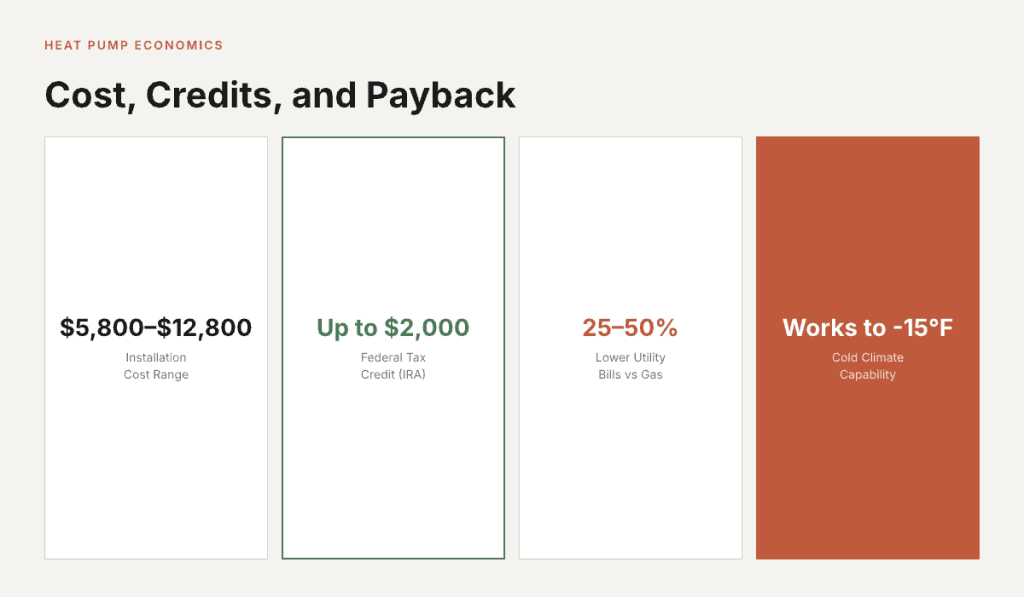
The average heat pump installation runs $5,800–$12,800, depending on system size and complexity, which is higher than a furnace swap, which means bigger tickets.
Federal tax credits under the Inflation Reduction Act (IRA) cover up to $2,000 for qualifying heat pump installations, making the upsell conversation easier.
Make sure your estimates reflect the true installation cost, including any electrical upgrades. Our guide on how to estimate HVAC jobs covers the step-by-step math for heat pump installs specifically.
According to AHRI data, heat pump shipments have been climbing year over year, and roughly 48% of new HVAC installations now involve some form of electrification. This is not a niche product anymore; it is the direction the industry is moving.
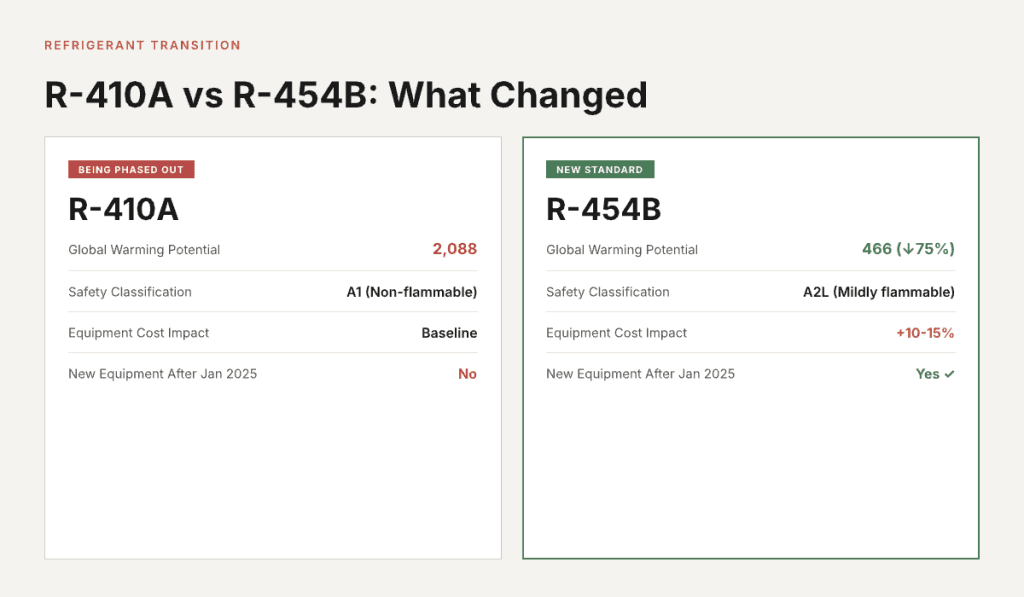
As of January 2025, manufacturers can no longer produce new residential and light commercial AC equipment using R-410A. The replacement is R-454B, a mildly flammable (A2L classification) refrigerant with a Global Warming Potential (GWP) of 466, compared to R-410A’s GWP of 2,088.
That is a 75% reduction, driven by the EPA’s AIM Act phase-down of high-GWP hydrofluorocarbons.
What contractors need to know:
R-410A systems already in homes can still be serviced; the transition applies to new equipment manufacturing, not existing installations. R-410A refrigerant will remain available for service and repair for years. R-454B equipment costs 10–15% more than comparable R-410A units; communicate this to customers as a regulatory change, not an arbitrary price increase.
A2L refrigerants require additional safety measures, including leak detection systems, proper ventilation during installation, and A2L-specific recovery equipment. Technician certification matters, while EPA Section 608 certification still applies, technicians working with A2L refrigerants need additional training on safe handling procedures, updated recovery techniques, and compliance with ASHRAE 15 and state-specific mechanical codes.
R-454B cylinder shortages have been reported in some markets, with prices spiking significantly for 20-lb cylinders at times. Build a buffer into your estimates.
Your HVAC technician salary benchmarks should account for the A2L premium; techs with A2L certification are commanding higher wages because the supply of certified techs hasn’t caught up with demand.
For airflow verification on new-refrigerant systems, use our free CFM calculator to confirm you’re meeting manufacturer specifications.
Single-stage compressors run at 100% capacity or not at all. Two-stage compressors run at two fixed speeds. Variable-speed (inverter-driven) compressors adjust continuously from roughly 25% to 100% capacity, matching the exact load the home needs at any given moment.
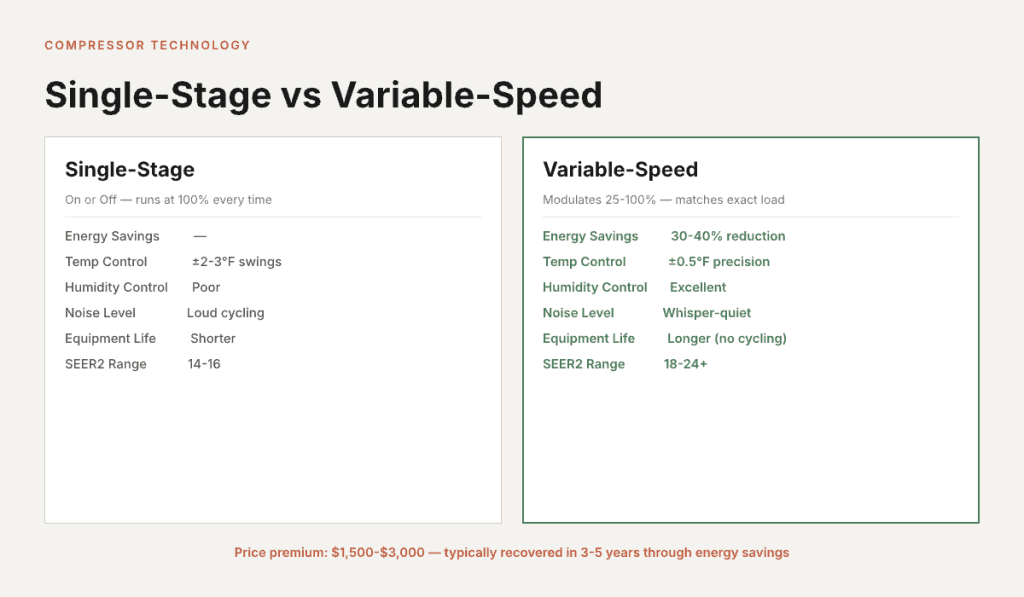
The result is significant: 30–40% energy savings compared to single-stage systems running the same hours; tighter temperature control (±0.5°F instead of the ±2–3°F swings common with cycling systems); lower humidity levels because the system runs longer at reduced capacity, pulling more moisture from the air; quieter operation, a compressor running at 40% capacity is dramatically quieter than one slamming on at full power; and longer equipment life because the system avoids the mechanical stress of constant on-off cycling.
Variable-speed compressors are now standard in systems rated 18 SEER2 and above. Entry-level systems (14–16 SEER2) still use single or two-stage compressors, but the mid-tier and premium segments have shifted almost entirely to inverter technology.
Contractor tip: When presenting options, use our quoting software to build Good-Better-Best proposals where the “Better” tier features a variable-speed system. The energy savings over the system’s lifetime often justify the $1,500–$3,000 price increase, especially when you can show the math using a SEER energy savings calculator.
The $3.8 billion smart thermostat market is just the entry point. The real shift is the connected HVAC ecosystem, where the thermostat, the equipment, the sensors, and the contractor’s service platform all communicate.
Modern smart HVAC systems include learning thermostats like Ecobee, Nest, and Honeywell. These devices track occupancy patterns and automatically adjust schedules for better efficiency.
They also use equipment-level IoT sensors. These sensors monitor compressor amperage, refrigerant pressure, airflow, and system vibration in real time.
Room-by-room sensors help improve comfort. They detect temperature imbalances and adjust dampers to balance airflow across different areas. These systems also integrate with home automation platforms.
This includes Apple HomeKit, Google Home, Amazon Alexa, and Samsung SmartThings. Homeowners can control everything easily. They can adjust comfort settings from their phone or through voice commands.
Why this matters for your business: Connected systems generate continuous equipment data. When that data feeds into your AI-powered CRM, you get a complete service history for every customer, equipment health, performance trends, and early warning signals that a component is degrading.
That shifts your service model from reactive (wait for the call) to proactive (call the customer before the breakdown). Contractors who build HVAC maintenance plans around connected system data see higher retention rates, more consistent revenue, and fewer emergency dispatches.
Artificial intelligence in HVAC goes beyond smart thermostats. The most impactful application for contractors is predictive maintenance, using machine learning algorithms to analyze equipment performance data and identify failures before they happen.
Here is how it works in practice: sensors collect data (compressor current draw, discharge temperature, superheat, subcooling, supply/return air temperature delta, run time patterns); AI models establish baselines by learning what “normal” looks like for each specific unit; deviations trigger alerts, a gradual increase in compressor amp draw might indicate a failing capacitor or low refrigerant charge 2–4 weeks before the unit actually stops working; then you call the customer, not the other way around.
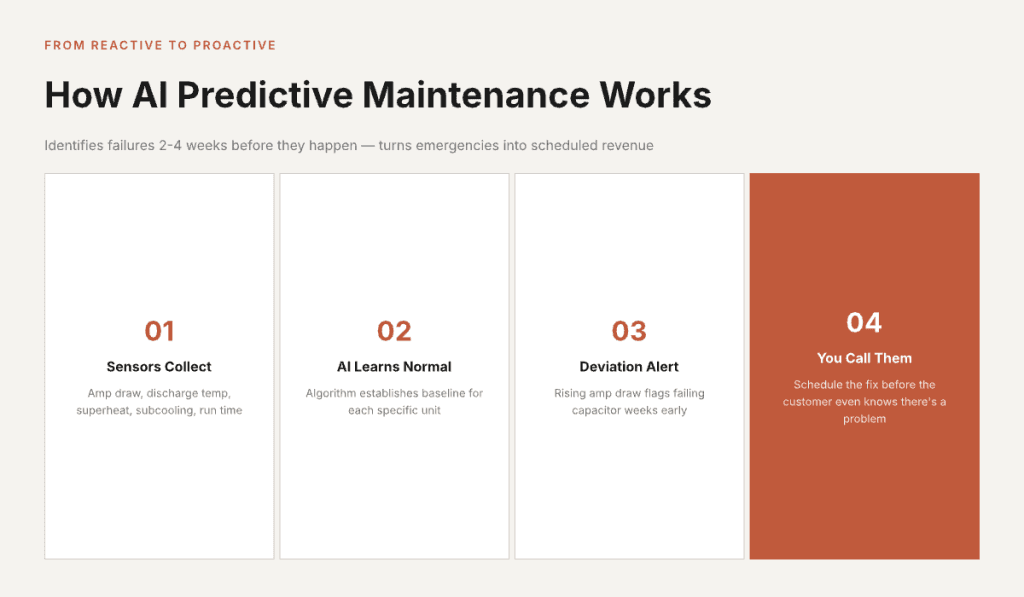
This is a fundamental business model shift. Instead of competing for emergency repair calls (low loyalty, high stress, price-sensitive customers), you’re offering a premium monitoring service that catches problems early.
Some manufacturers like Trane, Carrier, and Lennox now build diagnostic connectivity directly into their equipment. Third-party platforms add IoT monitoring to any existing system for $150–$400 per unit.
Pair this technology with AI job scheduling to automatically route a technician when a predictive alert fires. The system identifies the problem, creates the work order, and dispatches the right tech, all before the homeowner even knows something is wrong.
For dispatching best practices that complement AI-driven scheduling, see our HVAC dispatching tips.
Traditional HVAC systems treat the entire home as a single zone. One thermostat, one temperature reading, one output level. The result is predictable: the room with the thermostat is comfortable, and every other room is either too hot or too cold.
Zoning systems divide the home into independent comfort zones, each with its own thermostat and motorized dampers that control airflow to that zone.
What has changed recently is the shift to wireless damper systems. Older zoning required running low-voltage wires from a zone control board to every damper: labor-intensive and often impractical in retrofit applications.
New wireless dampers from companies like Arzel, EWC, and Keen communicate via radio frequency or Wi-Fi, making zoned retrofits viable in homes where running new wire would be cost-prohibitive.
Cost and business case: A 2–3 zone wired system runs $2,000–$3,500 installed (retrofit). Wireless damper systems run $1,500–$3,000 installed (retrofit). Labor savings on wireless vs. wired: 30–50% fewer installation hours.
Customer value proposition: “Every room, the temperature you want it.” This upsell resonates with every homeowner who has a hot upstairs bedroom.
Zoning pairs naturally with variable-speed equipment. A variable-speed compressor can ramp down to serve just one or two zones without short-cycling, which makes the whole system more efficient and extends equipment life.
Ductless mini-split systems have been mainstream for years, but the technology continues to evolve. Current-generation mini-splits from Mitsubishi, Daikin, Fujitsu, and LG offer SEER2 ratings above 20, heating performance down to -13°F, and built-in Wi-Fi for app-based control.
Variable Refrigerant Flow (VRF) systems take the mini-split concept further. A single outdoor unit connects to multiple indoor air handlers, each independently controlled.
The outdoor unit modulates refrigerant flow to each indoor unit based on demand, so one room can be in cooling mode while another is in heating mode simultaneously.
Where the money is: Single-zone mini-splits ($3,000–$5,500 installed) are ideal for room additions, converted garages, and sunrooms where extending ductwork is impractical. Multi-zone mini-splits ($6,000–$15,000+ installed) compete with traditional ducted systems for whole-home comfort.
Commercial VRF ($15,000–$50,000+ installed) targets light commercial: offices, retail, restaurants, and multi-family buildings.
For contractors, ductless represents a high-margin product category with relatively fast installation times. A single-zone install takes 4–6 hours for a two-person crew.
The key is running a proper Manual J load calculation to size correctly; oversizing a mini-split causes the same comfort and efficiency problems as oversizing a ducted system.
Verify sizing with our free HVAC load calculator.
Modern homes are built more tightly than ever. Better insulation, air-sealed envelopes, and energy-efficient windows reduce heating and cooling loads, but they also trap stale air, moisture, VOCs, and CO2 inside the home.
An Energy Recovery Ventilator (ERV) solves this by exchanging indoor air with fresh outdoor air while recovering 70–80% of the energy from the outgoing air stream.
In summer, the ERV pre-cools and dehumidifies incoming outdoor air using the cooler, drier exhaust air. In winter, it pre-heats incoming air using the warm exhaust.
A Heat Recovery Ventilator (HRV) works similarly but transfers only heat, not moisture. ERVs are generally preferred in humid climates; HRVs work better in dry, cold climates.
Why this is growing: ASHRAE 62.2 ventilation standards increasingly require mechanical ventilation in new construction and major renovations. The indoor air quality (IAQ) market is valued at approximately $12 billion and growing, driven by post-pandemic awareness.
ERVs pair naturally with high-efficiency systems — customers spending $8,000–$12,000 on a new heat pump installation are receptive to an additional $1,500–$3,000 for whole-home ventilation. Many energy codes now mandate some form of mechanical ventilation in new construction.
Position ERV installation as part of a complete IAQ upgrade alongside air purification and humidity control.
Indoor air quality has moved from a nice-to-have to a selling point that closes deals. Three technologies dominate this space.
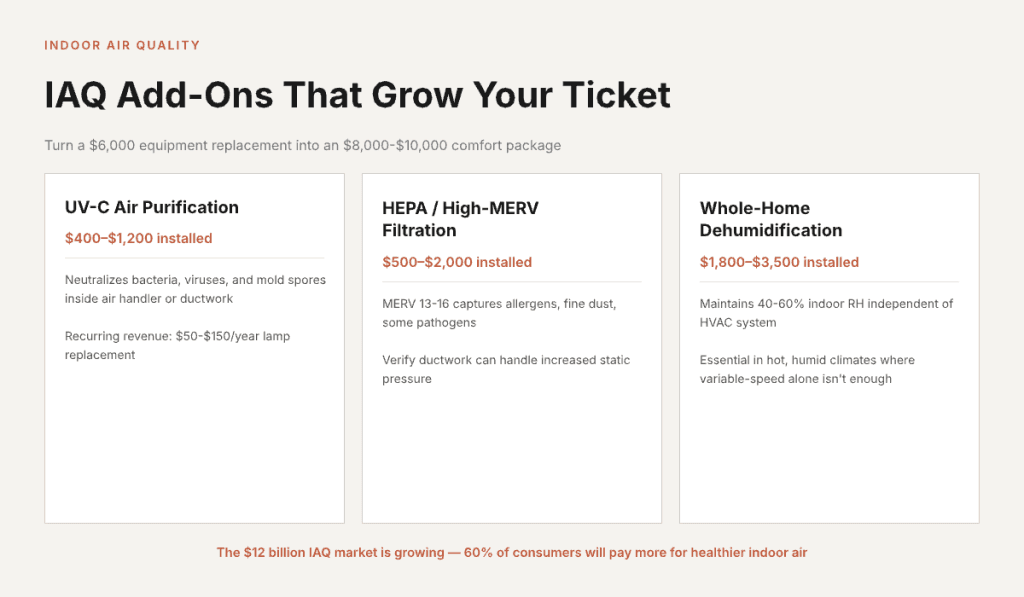
UV-C light installed inside the air handler or ductwork neutralizes airborne bacteria, viruses, and mold spores as air passes through. Systems from brands like RGF, Honeywell, and Fresh-Aire UV cost $400–$1,200 installed and create recurring revenue through annual lamp replacements ($50–$150 per lamp).
Standard residential filters are MERV 8–11. High-MERV filters (MERV 13–16) and whole-house HEPA filtration systems capture smaller particles, including allergens, fine dust, and some airborne pathogens. These systems typically require a bypass configuration to avoid excessive static pressure on the blower.
Verify that the duct system can handle higher-MERV filters without starving the equipment for airflow. Our guide on how to calculate CFM for HVAC covers the airflow math.
Standalone whole-home dehumidifiers (AprilAire, Santa Fe, Ultra-Aire) operate independently of the HVAC system to maintain indoor relative humidity between 40–60%. Installed cost runs $1,800–$3,500 and addresses a problem that variable-speed systems improve but don’t always fully solve, especially in hot, humid climates.
The business case is simple: IAQ add-ons turn a $6,000 equipment replacement into an $8,000–$10,000 complete comfort package. Build these options into your estimate templates as standard Better and Best tier upgrades.
Geothermal (ground-source) heat pumps use the stable temperature of the earth, roughly 50–55°F year-round at depths of 6–10 feet, as their heat exchange medium instead of outdoor air. This makes them 300–500% efficient (a coefficient of performance of 3.0–5.0), compared to 250–400% for the best air-source heat pumps.
The numbers: Installation cost runs $15,000–$35,000+, depending on lot size, soil conditions, and loop type (horizontal vs. vertical bore). Operating cost is 25–50% less than conventional HVAC systems.
Equipment life is 20–25 years for the heat pump and 50+ years for the ground loop. The federal tax credit under the IRA covers 30% with no cap; a $25,000 installation becomes $17,500 after the credit. Payback period is typically 5–10 years, depending on local utility rates and the system being replaced.
Geothermal installations require specialized knowledge, loop design, drilling or trenching, and antifreeze solutions. Contractors who invest in GeoExchange or IGSHPA certification can access a premium market segment with very little local competition.
The reality check: Geothermal is not for every home or every market. Lot size, soil conditions, drilling costs, and local utility rates all affect feasibility. But in markets where it works, it’s the highest-margin HVAC installation you can offer.
Solar-powered HVAC takes two primary forms.
Solar PV + Electric HVAC: Solar panels generate electricity that offsets the power consumption of an electric heat pump or air conditioner. This is the most common and practical approach; the homeowner installs a solar array large enough to cover some or all of their HVAC energy use, reducing or eliminating the utility cost of heating and cooling.
Thermal Energy Storage: Instead of converting solar energy to electricity, thermal storage systems use solar heat directly, storing thermal energy in phase-change materials (PCMs), water tanks, or even ice.
Ice-based thermal storage systems, where the AC runs at night (when electricity is cheaper) to freeze a tank of water, then uses the ice for cooling during the day, are gaining traction in commercial applications and in residential markets with time-of-use utility pricing.
For contractors, the solar-HVAC conversation usually starts when a homeowner is already getting solar quotes. Positioning a high-efficiency heat pump alongside a solar installation creates a compelling whole-home energy package, especially when both qualify for separate IRA tax credits.
Smart thermostats have matured beyond basic scheduling and remote access. The current generation uses occupancy learning (detecting patterns and adjusting automatically without manual programming), weather-responsive pre-conditioning (using local weather API data to start heating or cooling earlier on extreme weather days), geofencing (using the homeowner’s phone GPS to trigger home/away mode transitions), and demand response integration (automatically adjusting settings during peak grid demand in exchange for bill credits or incentives).
The latest evolution is AI load forecasting, where the thermostat or a connected building management system doesn’t just react to current conditions, but predicts future heating and cooling loads based on weather forecasts, occupancy predictions, solar gain patterns, and thermal mass characteristics of the building.
For contractors offering maintenance agreements, smart thermostat installation is a natural service add-on. The cost is modest ($200–$350 installed), the homeowner sees immediate value, and you gain a touchpoint that keeps your company connected to the customer’s HVAC system.
A digital twin is a virtual replica of a physical HVAC system, a software model that mirrors the real system’s components, configuration, and performance characteristics. Changes made to the digital twin can be simulated before being applied to the real system.
This technology is currently most relevant in commercial HVAC, where building management systems (BMS) use digital twins to simulate the impact of equipment changes before committing to a purchase, optimize system settings for energy efficiency without trial-and-error on live equipment, train technicians on complex system configurations in a virtual environment, and predict how the system will respond to extreme weather events or unusual load conditions.
For residential contractors, digital twin technology is still in its early stages. But manufacturers are moving in this direction; Trane and Carrier both have cloud platforms that create equipment-level digital models for diagnostics and optimization.
The contractor takeaway: this technology is coming downstream. Contractors who are already comfortable with connected equipment, cloud-based diagnostics, and data-driven service will have a significant head start when digital twins reach the residential market.
The smartphone in your technician’s pocket is arguably the most impactful “new technology” in HVAC, not because the phone itself is new, but because what it can do on a job site has changed dramatically.
Modern HVAC field apps handle digital estimates and proposals built and sent from the driveway using quoting software with pre-loaded pricebooks; photo and video documentation tagged to the customer record; real-time dispatch with job assignments, customer history, and navigation through AI dispatch and scheduling; invoicing and payment collection via card or ACH on the spot using field service invoicing; refrigerant tracking and EPA compliance logging per unit; and diagnostic reference tools including superheat/subcooling calculators, wiring diagrams, and fault code databases.
For a comprehensive comparison, see our roundup of the best HVAC apps for technicians and office managers.
The field app isn’t a nice-to-have anymore. It’s the difference between a 30-day collection cycle and a same-day collection cycle, and between a customer who gets a handwritten estimate three days after the visit and one who gets a professional proposal in their inbox before you leave the driveway.
The HVAC skills gap is real; experienced technicians are retiring faster than new ones are being trained. Virtual reality (VR) and augmented reality (AR) are helping close that gap.
VR training puts trainees inside a simulated HVAC environment where they can practice diagnostics, equipment installation, and safety procedures without touching real equipment. They can make mistakes, learn from them, and repeat scenarios until they build confidence, all without wasting materials or risking injury.
AR overlays use a tablet or smart glasses to superimpose wiring diagrams, component labels, or step-by-step instructions onto the physical equipment a technician is looking at.
This is especially valuable for A2L refrigerant handling, where new safety procedures need to be followed precisely.
Manufacturers, including Carrier, Trane, and Lennox, have all invested in VR training programs for their dealer networks. Third-party platforms like Interplay Learning offer subscription-based VR training libraries covering HVAC fundamentals through advanced diagnostics.
For a growing HVAC business, VR/AR training reduces onboarding time for new hires and keeps existing techs current on new equipment platforms without pulling them off the schedule for days of classroom training.
3D printing (additive manufacturing) is beginning to influence HVAC in several ways: custom ductwork fittings for tight retrofits where standard fittings don’t work; heat exchanger designs with complex internal geometries that improve thermal transfer efficiency beyond what traditional manufacturing allows.
Prototype and low-volume parts when a specific bracket, adapter, or mounting component isn’t available from the manufacturer, and replacement parts for discontinued equipment that’s still functional but has unavailable replacement parts.
This technology is still too early for field contractors. But manufacturers are integrating 3D-printed components into production equipment, and commercial HVAC contractors are beginning to use portable 3D printers for on-site custom fabrication.
Status: Experimental for most contractors. Worth watching.
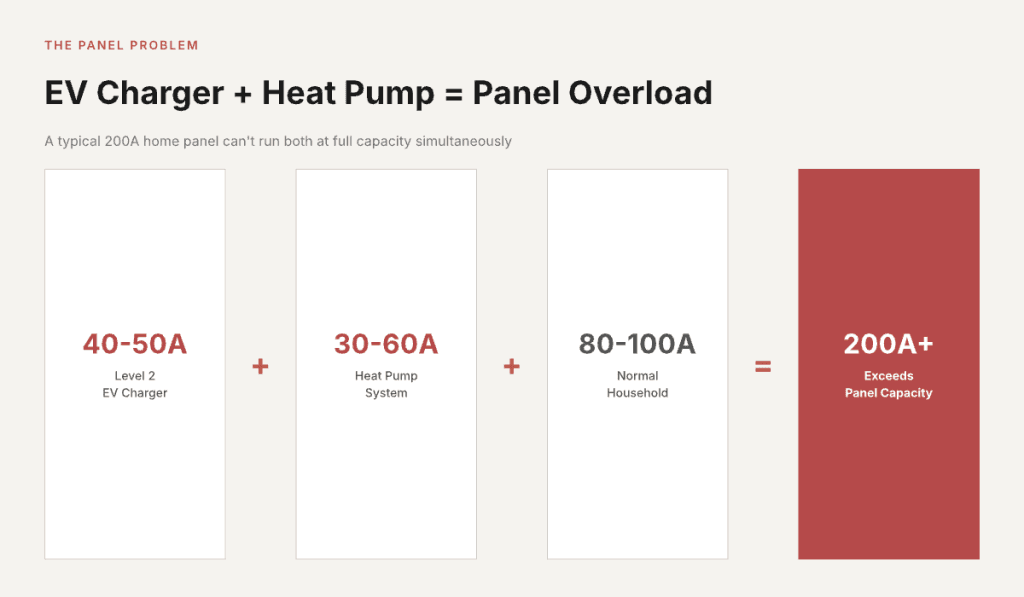
Here is a problem that almost nobody is talking about yet: a typical home’s electrical panel is 200 amps. A Level 2 EV charger draws 40–50 amps. A heat pump draws 30–60 amps. Running both simultaneously, along with normal household loads, can exceed panel capacity.
As more homeowners install both heat pumps (replacing gas furnaces) and EV chargers (replacing gas cars), panel capacity is becoming a bottleneck that HVAC contractors need to understand.
Solutions emerging now include smart electrical panels (Span, Lumin, Schneider) that dynamically allocate power between loads; load-sharing devices that allow the EV charger and HVAC to share a single circuit, alternating priority based on demand; 200A to 400A panel upgrades ($2,000–$5,000 for the upgrade alone); and heat pump scheduling that uses thermal mass or a buffer tank to store heating/cooling energy during off-peak hours.
Why this matters to HVAC contractors: If you’re quoting a heat pump installation and the homeowner already has or is planning an EV charger, you need to verify panel capacity. Otherwise, the installation fails inspection or trips breakers.
Contractors who understand this intersection: HVAC, electrical, and EV, can position themselves as the whole-home electrification expert.
Factor the electrical work into your estimates. Our labor cost calculator helps you price the additional hours for panel evaluation and coordination with electricians.
Instead of selling a $10,000 HVAC system outright, some contractors and manufacturers are offering HVAC-as-a-Service, where the homeowner pays a monthly subscription ($100–$300/month) that covers the equipment, installation, all maintenance, repairs, and eventual replacement.
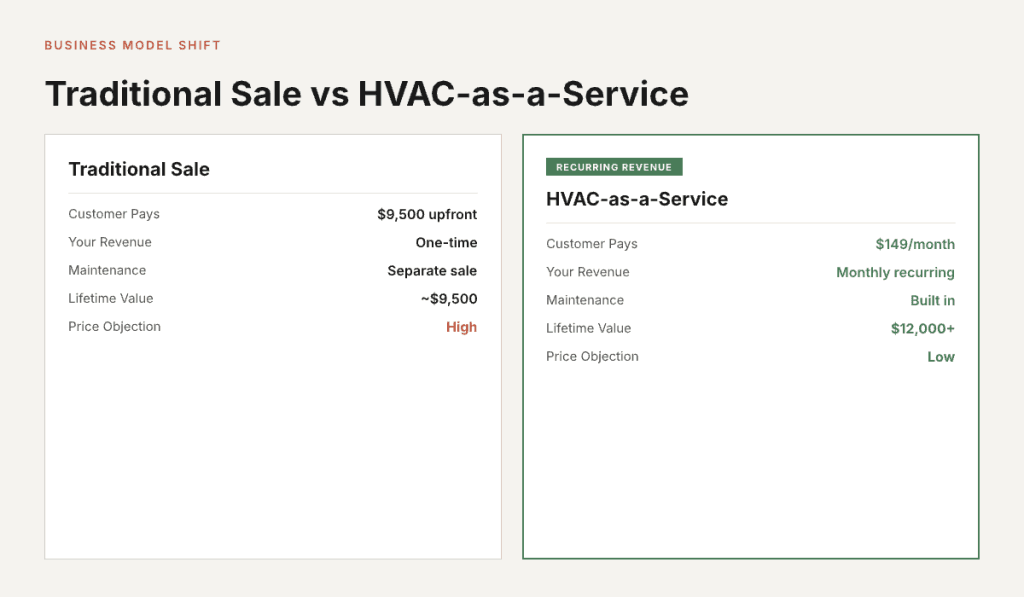
How it works for the contractor: Monthly recurring revenue instead of one-time project revenue; higher lifetime value per customer ($100/month × 120 months = $12,000+ per system); built-in maintenance relationship, no selling service agreements separately; lower price objection at point of sale (“$149/month” is psychologically easier than “$9,500 today”); and potential to finance the equipment through a third-party capital partner.
The challenges: Requires upfront capital (you own the equipment until it’s paid off through subscriptions); needs a financing partner or enough cash reserves to float the equipment cost. This is more complex accounting with subscription revenue recognition vs. project-based, and customer acquisition cost is lower, but churn management becomes critical.
This model is gaining traction with larger HVAC companies that have the capital structure to support it.
For smaller contractors, a modified version, offering equipment financing through GreenSky or Synchrony while bundling a mandatory maintenance agreement, captures some of the recurring revenue benefits without the capital requirements.
Radiant systems use heated or cooled water circulating through tubing embedded in floors, walls, or ceilings to deliver thermal comfort without forced air.
Radiant floor heating is well-established, particularly in new construction and renovations. What’s newer is radiant ceiling cooling, chilled water panels installed in the ceiling that absorb heat from the room through radiation and convection.
These systems operate silently, don’t circulate dust or allergens, and can be more energy-efficient than forced-air alternatives because water carries heat more efficiently than air.
Where this fits for contractors: Radiant floor heating ($6–$15 per square foot installed) is a premium upgrade for bathrooms, basements, and whole-home new construction applications. Radiant ceiling cooling is primarily commercial and high-end residential, paired with a dedicated outdoor air system (DOAS) for ventilation and dehumidification.
Both systems require knowledge of hydronic design, pipe sizing, pump selection, mixing valves, and controls.
The contractor opportunity is in the premium residential market, custom homes, major renovations, and homeowners who prioritize comfort and air quality over the lowest first cost.
These technologies are not yet commercially available for residential or light commercial applications, but they represent where the industry may be heading in the next 5–10 years.
Instead of compressing and expanding a gas refrigerant, magnetic refrigeration uses the magnetocaloric effect, where certain materials heat up when exposed to a magnetic field and cool down when the field is removed.
No compressor, no refrigerant, no GWP concerns, and significantly quieter operation. Currently limited to research and prototype applications, but major manufacturers and the DOE are funding development.
Uses high-intensity sound waves to create cooling without traditional refrigerants or compressors. A resonating gas is compressed and expanded by sound energy, creating a heat-pumping effect. Still largely academic, but the absence of moving parts and harmful refrigerants makes this a promising long-term technology.
Thermoelectric (Peltier) devices have existed for decades in niche applications (coolers, electronics). New materials and configurations are pushing solid-state cooling toward viability for larger applications. No moving parts, no refrigerant, instant on/off, and precise temperature control, but currently limited by low efficiency and high cost per BTU.
Contractor takeaway: You won’t be installing any of these next year. But when a homeowner asks, “What’s coming next in HVAC?” being able to answer that question intelligently positions you as the expert they trust.
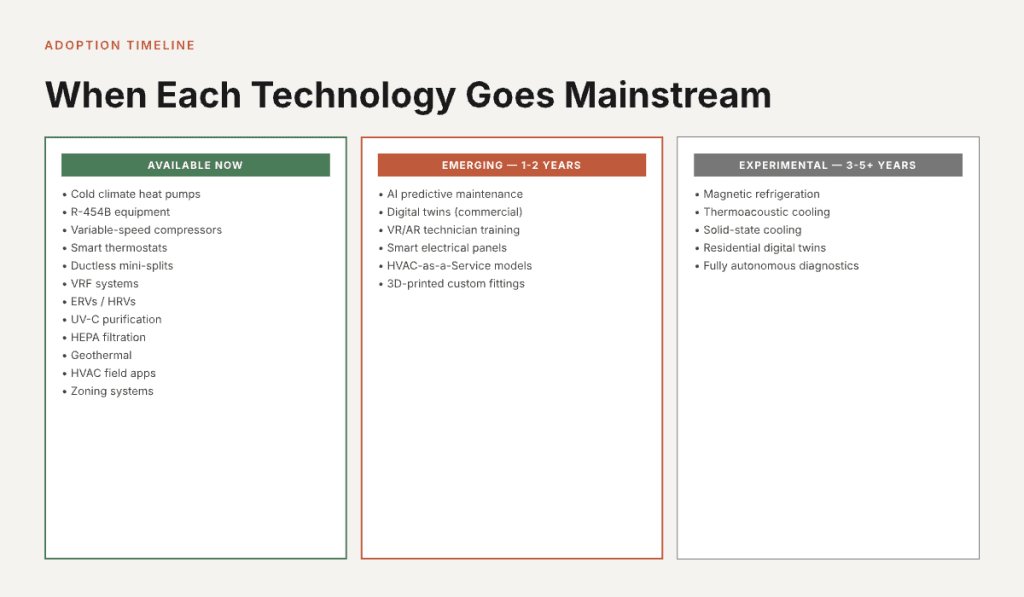
| Status | Technologies |
| Available Now — Install Today | Cold climate heat pumps, R-454B equipment, variable-speed compressors, smart thermostats, ductless mini-splits, VRF, ERVs, UV-C purification, HEPA filtration, geothermal, HVAC field apps, zoning systems |
| Emerging — 1–2 Years | AI predictive maintenance (manufacturer-integrated), digital twins (commercial), VR/AR training, smart electrical panels for load management, HVAC-as-a-Service models, 3D-printed custom fittings |
| Experimental — 3–5+ Years | Magnetic refrigeration, thermoacoustic cooling, solid-state cooling, residential digital twins, fully autonomous HVAC diagnostics |
The HVAC industry is not waiting for you to catch up. R-454B is already in the warehouse. Heat pumps are outselling furnaces in some markets. Smart thermostats are in a third of American homes. AI is scheduling your competitor’s technicians while you’re still doing it on a whiteboard.
You don’t need to adopt every technology on this list. But you do need to understand them well enough to answer customer questions, price installations accurately, and decide which ones create the most value for your business.
Start with the technologies that are available now and directly affect your revenue: get A2L certified if you aren’t already, it’s not optional; add heat pumps to your product mix if you haven’t (the demand is there and the margins are strong); build Good-Better-Best proposals that include variable-speed systems, IAQ upgrades, and smart thermostats as standard upgrade tiers.
Explore predictive maintenance as a service offering, it transforms your business model from reactive to proactive; and use field service software that keeps up, digital estimates, AI scheduling, automated follow-ups, and mobile invoicing aren’t future tech. They’re table stakes.
The contractors who thrive over the next five years won’t necessarily be the ones who install the most cutting-edge equipment.
They’ll be the ones who understand the technology well enough to recommend the right solution for the right customer, and have the business systems to deliver it efficiently.
New HVAC Technology Means Bigger Tickets. Don’t Let Operations Be the Bottleneck
FieldCamp handles AI scheduling, dispatching, estimates, and invoicing, so your team can sell and install the premium systems, not drown in admin.
The biggest shift in 2026 is the mandatory transition to R-454B (A2L) refrigerants in all new residential AC and heat pump equipment. Beyond refrigerants, cold climate heat pumps, AI-powered predictive maintenance, and variable-speed compressors are the technologies seeing the fastest adoption. Smart zoning systems with wireless dampers are also gaining significant traction because they make whole-home comfort achievable in retrofit applications.
R-454B is the primary replacement refrigerant for residential and light commercial split-system air conditioning in the United States. It has a Global Warming Potential of 466, compared to R-410A’s 2,088 — a 75% reduction. The transition is mandated by the EPA under the AIM Act. R-32 is another low-GWP alternative used in some applications, particularly in ductless systems.
Yes, for most applications. Variable-speed (inverter-driven) compressors deliver 30–40% energy savings, tighter temperature control (±0.5°F vs. ±2–3°F), lower humidity, quieter operation, and longer equipment life compared to single-stage systems. The upfront cost is $1,500–$3,000 more, but the energy savings typically recover that premium within 3–5 years. They’re the default in systems rated 18 SEER2 and above.
Modern cold climate heat pumps maintain rated heating capacity down to 5°F and continue operating at reduced capacity below -15°F. This is a dramatic improvement over heat pumps from even five years ago, made possible by inverter-driven compressors and enhanced vapor injection technology. Dual fuel systems (heat pump + gas furnace backup) are the most common configuration in cold-climate markets, providing heat pump efficiency for most of the winter with gas backup for the coldest days.
AI applications in HVAC include predictive maintenance (identifying equipment failures 2–4 weeks early), intelligent scheduling and dispatching (matching the right technician to the right job based on skills and location), load forecasting (predicting heating/cooling needs based on weather and occupancy data), and automated diagnostics (analyzing system performance data to identify faults). For contractors, AI job scheduling and AI dispatch are the most immediately impactful applications.
The federal minimum is 14 SEER2 in northern states and 15 SEER2 in southern states (DOE South region). For customer recommendations: 16–17 SEER2 is the sweet spot for most budgets and climates, offering meaningful efficiency gains without the premium pricing of top-tier systems. 18–20+ SEER2 makes financial sense in hot climates with high cooling hours, for customers who plan to stay in the home long-term, or when utility rebates and tax credits bridge the cost gap. Use a SEER energy savings calculator to show customers the actual dollar savings.
EPA Section 608 certification remains the baseline for handling refrigerants. For A2L refrigerants like R-454B, technicians need additional training on safe handling, leak detection, and recovery procedures — offered through ESCO Institute, RSES, and manufacturer-specific programs. Heat pump installation often requires manufacturer certification for warranty compliance. Geothermal installations benefit from IGSHPA or GeoExchange certification. VRF system installation typically requires manufacturer training from Daikin, Mitsubishi, or the specific brand being installed. Check current HVAC technician salary data to understand the wage premium these certifications command.
Geothermal systems cost $15,000–$35,000+ installed but operate at 300–500% efficiency (COP of 3.0–5.0), reduce utility bills by 25–50%, and qualify for a 30% federal tax credit with no cap. The ground loop lasts 50+ years. Payback is typically 5–10 years. Geothermal is most cost-effective in areas with moderate to high utility rates, available land for loop installation, and favorable soil conditions. It’s not practical for every home, but where it works, it offers the lowest lifetime cost of any HVAC system. —