

Free Construction Estimate Template
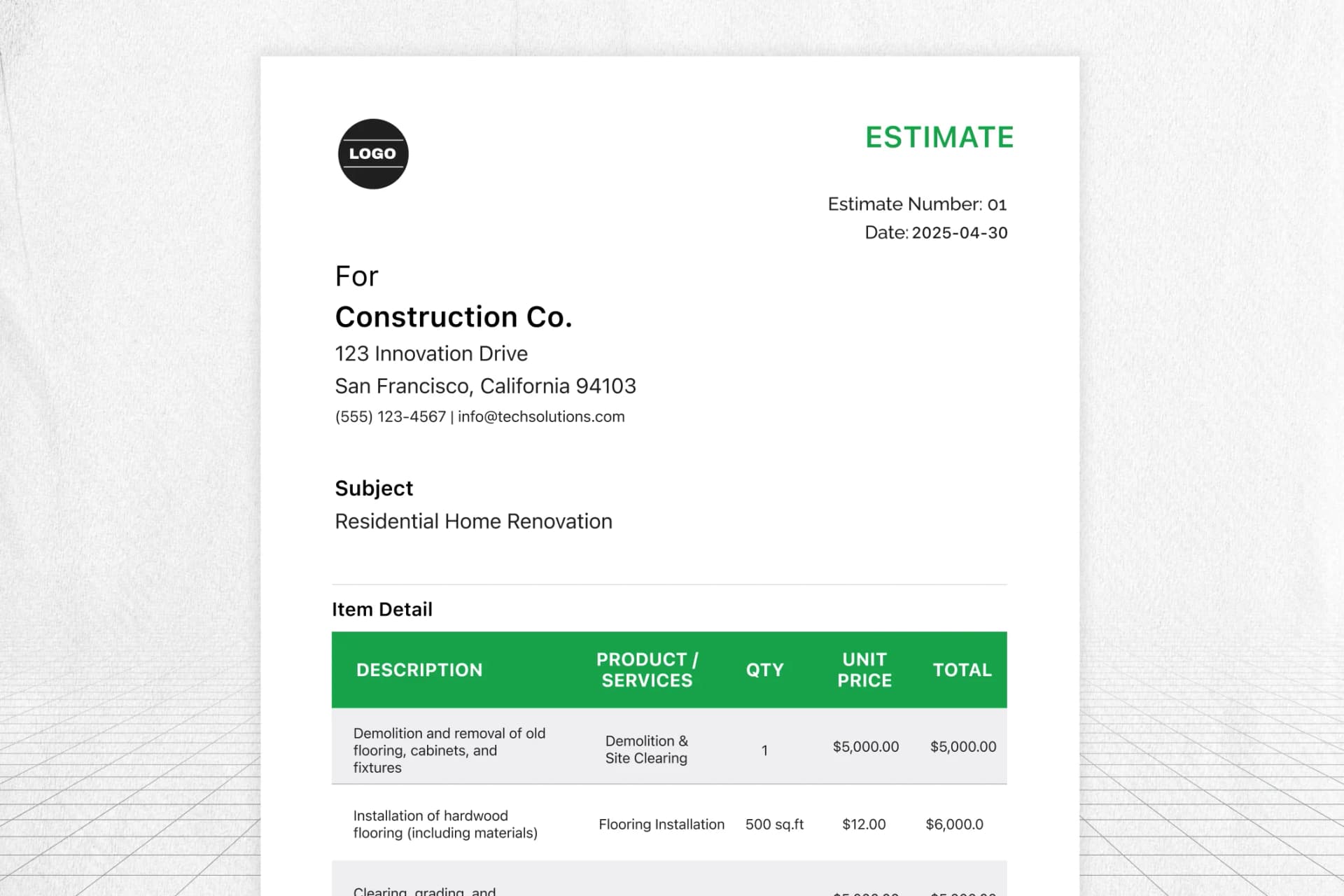
About this template
Looking for a professional construction estimate template that actually makes you look good? You’re in the right place. Whether you’re a general contractor bidding on your next big project or a specialty trade looking to streamline your quoting process, this free template for construction estimate work will help you create clear, itemized quotes that clients trust and approve.
No more cobbling together numbers in a blank spreadsheet. No more forgetting line items and eating the cost later. Just download, customize, and send.
Key Features
- Smart cost breakdown for materials and labor
- Auto-calculating formulas that prevent math errors
- Clean, professional layouts that win more contracts
- Fully customizable template for any construction project
,
|
ESTIMATE
#1
Issued: 2026-04-03
Due: 2026-04-03
BILL TO:
Services Provided
| DESCRIPTION | PRODUCT / SERVICE | QTY | UNIT PRICE | TOTAL |
|---|---|---|---|---|
| Wood frame construction, walls, and roof structure | Framing Labor | 1 | $65.00 | $65.00 |
| Supply, hang, tape, and finish drywall | Drywall Installation | 1 | $2.25 | $2.25 |
| Prep, prime, and paint two coats on walls/ceilings | Interior Painting | 1 | $2.00 | $2.00 |
Why You Need a Proper Estimate Template for Construction Work?
Here’s the thing about construction estimates: they’re often the first real impression a client gets of how you run your business. A messy quote with vague line items and rounded numbers? That screams “I’m guessing.” A clean, detailed contractor estimate template with specific quantities, unit costs, and clear payment terms? That says you know exactly what the job takes.
The problem is, most contractors don’t have time to build a professional estimate from scratch every single time. That’s where having a solid template for construction estimate projects comes in. You set it up once, customize it for each job, and you’re out the door with a quote that looks like it came from a firm twice your size.
FieldCamp’s free construction estimate template handles the heavy lifting. It separates materials from labor, auto-calculates your totals and taxes, and presents everything in a format clients can actually understand without calling you to ask what “misc. work” means.
What Makes This Construction Estimate Template Different?
This isn’t some generic spreadsheet we slapped together. It’s built specifically for how contractors actually work, whether you’re a solo operator quoting weekend jobs or running a crew across multiple sites.
Itemized Construction Cost Breakdown Template – Materials, labor, equipment, subcontractor costs, each gets its own section, so clients see exactly where their money goes. No more “but I thought that was included” conversations.
Auto-Calculating Formulas – Punch in your quantities and unit costs. The template handles the math, line totals, subtotals, taxes, and total. No calculator app, no rounding errors, no embarrassing email corrections.
Need help with labor math? Our labor cost calculator pairs perfectly with this template.
Professional Layout That Builds Trust – Clean formatting with your logo, license number, and contact info. It looks like it came from an established firm, not a rushed job between site visits.
Works for Any Trade – General contractors, electricians, plumbers, HVAC techs, roofers, painters, remodeling contractors, this builder estimate template adapts to whatever you do.
We also have trade-specific templates if you want something more tailored.
Who This Contractor Estimate Template Is Built For?
We designed this estimate template for construction professionals across every trade and business size. Here’s how different contractors use it:
General Contractors – Break down full-scope projects into phases: demo, framing, mechanicals, finishes, and punch list. When clients can see the whole build laid out clearly, they’re more confident signing off. This general contractor estimate template gives them that visibility.
If you’re running a general contracting business, having a standardized estimate format is non-negotiable.
Subcontractors & Specialty Trades – Whether you’re running electrical, plumbing, HVAC, or roofing, you can customize line items to match how you actually scope and price work. The template flexes to fit your trade, not the other way around.
Remodeling Contractors – Kitchen, bath, basement, whole-home, this remodeling estimate template lets you detail room-by-room costs with material allowances so homeowners understand what’s included and what drives upgrades.
We also have a dedicated remodeling estimate template for renovation-specific work.
Commercial & Multi-Site Teams – When every estimator on your team uses the same construction quoting template, reviewing bids and tracking margins gets way easier. Consistency across crews means fewer surprises.
Builders & New Construction – Use this building estimate template to quote ground-up projects with clear phase breakdowns. Clients building their first home especially appreciate seeing exactly where their investment goes.
Once your client approves the estimate, generate a matching construction invoice to keep everything consistent from first quote to final payment.
How to Use This Free Construction Estimate Template?
Getting your first estimate out takes about five minutes. Here’s the process:
Step 1: Download and Open
Grab the free contractor estimate template and open it on whatever device you’re using: laptop, tablet, or phone. Start it at your desk, finish it on-site. It works either way.
Step 2: Add Your Company Information
Fill in your business name, address, phone, email, and contractor license number. Drop in your logo so every estimate carries your branding. Save it once, and this info auto-populates on every future estimate.
Step 3: Enter Client Details
Add your client’s full name (or business name), address, phone, and email. Sounds basic, but getting this right keeps your records clean and ensures the estimate reaches the decision-maker, especially if you’re working through a property manager or GC.
A solid field service CRM can help you manage all this client info in one place.
Step 4: Set Up the Header
Assign a unique estimate number (EST-1047, CE-2026-003, whatever system works for you) so you can reference it later without confusion. Give the project a clear, descriptive title, “Basement Finishing – 742 Maple Drive” instead of “Smith Job.” Add the issued date and a valid-until date (30 days is standard) so clients know this pricing won’t stay open forever.
Step 5: Build Your Line Items
This is where the detail lives, and where you separate yourself from contractors who ballpark everything.
For each task or material, enter:
- Description – Plain-language explanation of the work (“Install 12 recessed LED fixtures with dimmer switches”)
- Quantity – Hours, square feet, linear feet, units, whatever matches how you price
- Unit Cost – Your rate per unit
The template calculates line totals and the total automatically. Group related items together (demo, rough-in, finishes) so the estimate reads logically.
Step 6: Review Before Sending
Double-check that quantities match your takeoff and unit costs reflect current supplier pricing. Verify the tax rate for your jurisdiction. If you’re adding a contingency, list it as its own line item; transparency builds trust.
Compare your labor rates against actual crew costs (including burden—taxes, insurance, benefits), so you’re not accidentally underbidding.
Step 7: Save, Send, Follow Up
Export as PDF. Email it directly or print it for in-person presentations. The unique estimate number makes tracking easy; you’ll always know which quotes are pending, approved, or expired.
Pro tip: Follow up in 3-5 days if you haven’t heard back. A quick call referencing the estimate number keeps you top-of-mind without being pushy.
How to Create Accurate Construction Cost Estimates?
A professional construction estimate template only helps if the numbers inside it are right. Here’s how to make sure they are.
Break the Project Into Clear Categories
Start by separating costs into buckets you can actually track:
Materials – Lumber, concrete, drywall repair cost, fixtures, hardware, fasteners, adhesives. Get real supplier quotes, don’t guess from what you paid six months ago.
Labor – Calculate based on crew size, hourly rates, and realistic productivity. A two-person crew working eight-hour days doesn’t frame at the same pace as a four-person crew.
Not sure what to charge? Check out our guide on how much to charge per hour as a contractor.
Equipment – Rental costs for excavators, scaffolding, lifts, and specialty tools you don’t own outright.
Subcontractors – Written quotes from your subs for plumbing, electrical, HVAC, or any trade work you’re not self-performing.
Permits & Inspections – Check with your local building department. Fees vary wildly by municipality and project scope.
Overhead – Insurance, vehicle costs, office expenses, software, fuel, and the fixed costs of running your business that exist whether you’re on a job or not.
Learn more about service pricing strategies to make sure you’re covering all your bases.
Profit Margin – This isn’t overhead. It’s your return for managing the project, carrying the risk, and delivering results. Most contractors target 10-20% net margin, depending on market and project type.
Use Current, Verified Pricing
Material prices move constantly. Lumber that cost X six months ago might cost 1.3X today. Always confirm pricing with suppliers before finalizing—especially on larger jobs where a small per-unit difference compounds fast.
Add a Contingency Buffer
Surprises aren’t possible on construction projects. They’re guaranteed. Industry standard is 5-10% for remodels and renovations (more unknowns behind walls) and 3-5% for new construction (fewer surprises from scratch).
List contingency as a visible line item. Clients appreciate the honesty, and you’ll appreciate having a cushion when something inevitably comes up.
Construction Estimating Guidelines: Quick Reference
Every project is different, but these benchmarks help you sanity-check your numbers before sending:
Typical Cost Distribution
| Cost Category | % of Total Project Cost |
| Materials | 40-50% |
| Labor (including burden) | 25-35% |
| Equipment & Rentals | 5-10% |
| Permits, Fees & Insurance | 3-7% |
| Overhead & Profit | 15-25% |
These ranges shift by trade, region, and complexity. Labor-intensive work like custom tile skews higher on labor; materials-heavy work like roofing skews the other way.
For roofing specifically, our roofing cost calculator can help you dial in your numbers.
Payment Milestones for Projects Over $10K
A milestone-based payment schedule protects both you and the client. The 40/30/30 structure shown in the sample estimate above is industry standard: deposit on approval, progress payment at rough-in, final payment at walkthrough. This keeps your cash flow healthy without asking clients to front the whole job.
Price It Right, Win the Client
Stop losing clients to pricing errors or missed costs. With FieldCamp’s construction estimating software, you can create accurate, consistent quotes that boost profitability and protect your margins.
More Resources for Contractors
Related Templates: General Contractor Invoice • Remodeling Invoice • All Estimate Templates
Helpful Guides: Service Pricing Guide • Best General Contractor Software
Frequently Asked Questions
How do I estimate construction costs?
Break the project into components: materials, labor, equipment, subcontractors, and permits. Measure the scope carefully: square footage, linear footage, unit counts, and price each piece using current supplier quotes and your actual labor rates. Factor in labor burden (typically 1.3x to 1.5x base hourly wage for taxes, insurance, benefits), add your overhead percentage, include a contingency buffer, then apply your profit margin. The goal isn’t being the cheapest bid, it’s being the most accurate one.
How to calculate a building estimate?
Start with a detailed scope of work and accurate measurements from the job site or plans. Multiply material quantities by current supplier rates, adding a 5-15% waste factor depending on the material (tile and hardwood waste more than drywall or paint). Calculate labor by estimating hours per task times your burdened hourly rate. Add equipment rentals, sub quotes, permit fees, and inspections. Layer in overhead (typically 10-15% of direct costs) and profit margin (10-20%).
Basic formula:
Total Cost = (Materials + Labor + Equipment + Subs + Permits) × (1 + Overhead %) × (1 + Profit %)
What should a professional construction estimate include?
A complete estimate includes: your company info and license number, client details, unique estimate number, project name and address, itemized line items with descriptions, quantities, unit prices, and totals, applicable taxes, payment terms, estimate validity period, and any exclusions or assumptions. The more specific your line items, the fewer disputes later. “Electrical work, $5,000” invites scope arguments. “Install 14 recessed LED fixtures, 2 GFCI outlets, and a dedicated 20A circuit for the kitchen island, $5,000” sets clear expectations.
What’s the standard contingency for a construction estimate?
Industry standard is 5-10% for renovation and remodeling (more hidden conditions behind walls) and 3-5% for new construction (fewer unknowns). Always list contingency as a separate, visible line item rather than padding individual prices; it builds client trust and gives you a clear cushion.
How do I customize this template for my specific trade?
The template is fully editable. Swap out sample line items for your trade, HVAC ductwork, roofing squares, concrete yardage, whatever you quote. Adjust quantity units to match how you price (per hour, per square foot, per fixture, lump sum). Many contractors save separate versions for residential vs. commercial projects since scope, language, and payment structures often differ. We also offer trade-specific templates for handyman, landscaping, painting, flooring, concrete, and drywall work.
What’s the difference between a construction estimate and a bid?
An estimate is an informed projection that can change as the scope evolves or conditions are discovered. A bid is a firm, contractual offer to complete defined work at a specific price. In practice, many contractors use the terms interchangeably, but the distinction matters for client expectations. If pricing could change based on site conditions or material selections, label it an estimate and note assumptions clearly.
How do I handle material price fluctuations?
Include an estimate validity period; 30 days is standard. State that material pricing is based on supplier quotes as of the estimate date. For longer-lead projects, consider an escalation clause allowing price adjustments for specific material categories (lumber, steel, copper). This protects your margins without blindsiding clients.
Can I use this template to track actual vs. estimated costs?
Yes. As the project progresses, compare actual invoices and labor logs against each line item to see where you’re over or under budget. This cost-to-complete tracking sharpens your estimating accuracy over time.
What mistakes should I avoid when creating estimates?
The costly ones: underestimating labor hours (especially on renovation work where demo and cleanup take longer than the install), using stale material prices, forgetting indirect costs like dumpsters, temporary utilities, and travel time, skipping contingency, using vague line items like “miscellaneous,” and omitting a validity period (without an expiration, clients can accept six-month-old pricing when your costs have changed).
Is construction estimating hard to learn?
The fundamentals are straightforward: measure the work, price the components, and add your margins. What’s challenging is accuracy, knowing how long tasks actually take, accounting for real-world conditions, and staying current on material costs. Experience helps, but so does using a structured estimate template that forces you to think through every cost category instead of ballparking from memory.