

| TL;DR: Singapore commercial cleaning runs on MOM work permit compliance, helper-swap logic, and WhatsApp – not calendar apps, not US-style route-optimisation tools, and not shift schedulers built for retail F&B. This guide evaluates eight software platforms against six SG-specific criteria: MOM permit-aware deployment, helper-swap scheduling, GeBIZ-compatible reporting, transit-aware routing, WhatsApp coordination, and PSG grant eligibility. FieldCamp and Genic Teams are the two platforms SG cleaning operators most frequently shortlist in 2026. |
A town council cleaning supervisor gets a 5am WhatsApp from a cleaner: “Cannot come today, MC.” The reliever she calls in is already assigned to a different estate that morning. Nobody knows this until 9am, when the original site client calls to ask why their lobby has not been swept.
The reliever was deployed without checking her work permit status against the contract site. It is a MOM compliance failure dressed up as a scheduling oversight – and it will happen again next week unless the software understands the difference between a reliever with the right permit and one without.
This is the defining operational failure in Singapore commercial cleaning, and it has a name in the industry: helper-swap failure. Among the platforms evaluated in this guide, none other than FieldCamp has built helper-swap logic as a structured, permit-enforced dispatch workflow for a Singapore cleaning operator. Genic Teams recognises the problem exists but has not shipped native enforcement for it.
The second structural pressure is margin. Singapore cleaning operates on 2–8% net margins with labour at 60–70% of cost. Under MOM’s Work Pass framework, every Work Permit holder is employer-specific and sometimes site-specific. Deploying the wrong worker to the wrong client is a compliance breach with direct financial consequence. For a broader view of how Singapore service operators are building their tech stacks in 2026, the FieldCamp Singapore field service overview covers the full market picture.
Want to see how FieldCamp handles helper-swap logic and MOM-compliant deployment before reading the full breakdown? Explore the documentation or book a walkthrough below.
Eight platforms compared across MOM permit tracking, helper-swap scheduling, GeBIZ reporting, and PSG eligibility. Let AI pull the short version for your crew size and contract mix.
KEY HIGHLIGHTS
Best Cleaning Company Software in Singapore 2026
- Helper-swap failure is a MOM compliance event, not just a scheduling inconvenience: deploying a reliever without verifying her work permit status against the site contract is a direct Ministry of Manpower violation – no spreadsheet or generic FSM catches this before it becomes a fine.
- Singapore cleaning margins leave no room for manual labour utilisation: at 2–8% net with labour at 60–70% of cost, a single underutilised shift or misassigned reliever is not an admin error – it is a margin event that software must prevent, not report after the fact.
- GeBIZ-format reporting is a contract requirement, not a nice-to-have: town council, MOE school, and MOH hospital contracts require specific digital reporting formats – ops managers compiling these from WhatsApp screenshots the night before the deadline are one resignation away from losing the contract.
Platform Overview: Singapore Cleaning Company Software at a Glance
Before diving into each platform, here is how the eight options in this guide compare across the criteria that matter most to MOM-licensed cleaning operators in Singapore. Use this table as your shortlisting filter before reading the detailed picks below.
| Platform | MOM Permit Tracking | Helper-Swap Logic | GeBIZ Reports | Transit Routing | Xero/MYOB | PSG | |
|---|---|---|---|---|---|---|---|
| FieldCamp | Custom self-serve | Built (SG operator) | Configurable | Native | AI Dispatcher | Native Xero | In evaluation |
| Genic Teams | Manual | Manual | Manual | Notification only | Zone-based | Functional | Pre-approved ✅ |
| Deputy | Partial (shift only) | Shift swap only | None | None | None | Native | Not listed |
| Connecteam | Custom fields | Manual | None | In-app only | None | Third-party | Not listed |
| Swept | None | None | None | None | None | Not listed | Not listed |
| Hubstaff | None | None | None | None | Basic GPS | Third-party | Not listed |
| Jobber | None | None | None | None | None | Native | Not listed |
| ServiceM8 | None | None | None | None | None | Native | Not listed |
What Singapore Cleaning Companies Actually Need from Software
Most software comparison guides rank platforms by star rating or feature count. For MOM-licensed cleaning operators managing 50 to 1,000 ground staff across dozens of sites, that methodology is irrelevant. What matters is whether the tool understands the regulatory model, the labour structure, and the contract reporting requirements your business runs on every day.
The six questions below define what a real SG cleaning software shortlist looks like.
1. MOM work permit compliance at deployment level – not just an HR module. Under MOM’s Work Pass framework, every Work Permit holder is tied to a specific employer. Permit category, validity date, and in some contracts, site restrictions, determine whether a specific cleaner can legally be deployed to a specific location. Software that assigns “next available cleaner” without modelling permit status creates a compliance exposure on every shift. Permit expiry tracking must be automated – not a calendar reminder an area supervisor sets on her personal phone.
2. Helper-swap logic with permit-aware reliever scheduling. The single most common operational failure in SG commercial cleaning: a regular cleaner calls out sick, a reliever is dispatched, and the reliever either lacks the right permit for that site category or is already committed to a different estate. The client calls at 9am. Software that models helper-swap as a structured workflow – matching permit, site familiarity, and availability in one step – eliminates this failure mode entirely.
3. GeBIZ-compatible reporting for government contracts. Town council cleaning contracts, MOE school facility agreements, and MOH hospital service contracts require specific digital reporting formats for SLA verification, shift attendance, and incident documentation. If your operations manager compiles these manually from attendance sheets and WhatsApp screenshots the evening before submission, you are one key person’s departure away from a contract performance breach.
4. Transit-aware routing – MRT and bus, not fleet vehicles. Singapore commercial cleaning crews do not use company vehicles. Ground staff travel between sites via MRT and bus, and routing software that calculates driving distance generates schedules that are physically impossible during peak hours. Zone-based deployment (North/South/East/West/Central) is the practical model, but software that optimises within zones for transit time produces meaningfully better crew utilisation.
5. WhatsApp as the primary coordination channel. Over 84% of Singapore internet users are active on WhatsApp. For cleaning ground staff – many of whom are on Work Permits and unfamiliar with specialist apps – WhatsApp is the default and often only reliable communication channel. Shift confirmations, site access instructions, reliever deployment notices, and client escalations all travel via WhatsApp. Software that routes operational communication through email or an in-app messenger your ground staff will not open creates friction at every touchpoint.
6. Labour utilisation visibility – because at 2–8% margin, every underutilised shift is a loss event. Labour is 60–70% of cost. A supervisor without real-time visibility into which cleaners are deployed, which are idle, and which are approaching overtime is making margin decisions without information. Utilisation dashboards that show deployment efficiency across sites are a margin management tool, not a reporting output.
Best Cleaning Company Software in Singapore: 2026 Picks
The eight platforms below are the ones Singapore MOM-licensed cleaning operators most commonly evaluate in 2026. The assessment covers what each platform does genuinely well in a Singapore cleaning context, where it stops fitting, who it is built for, and what questions to ask before signing up. No sticker prices for FieldCamp – current SG tiers are on the Singapore pricing page. Competitor pricing is referenced at category level only.
1. FieldCamp — Best for MOM-Compliant Deployment, Helper-Swap Logic, and WhatsApp-Native Ground Staff Coordination
Among the eight platforms reviewed here, FieldCamp is the one that has built helper-swap logic as a live, structured workflow for an actual Singapore cleaning operator – not as a roadmap item, not as a configuration exercise, but as a deployed capability tested against real MOM work permit constraints.
Rather than shipping a fixed schema and asking your operation to adapt, FieldCamp provides a configurable data model where the core objects – workers, sites, shifts, permits, incidents – sit underneath a layer your operations team defines.
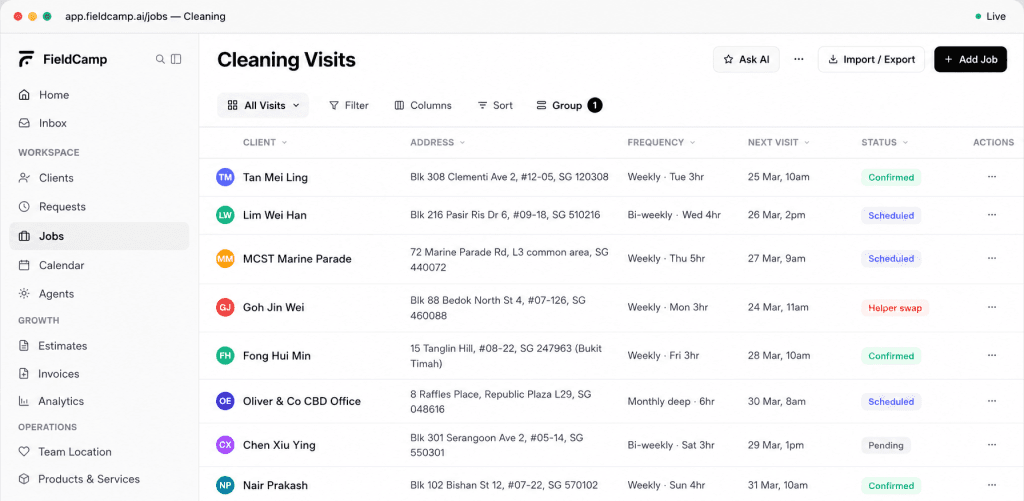
For a Singapore cleaning company, this means work permit categories, expiry dates, site-specific deployment restrictions, reliever pools, and helper-swap workflows all exist as first-class structured data on every shift record. Not spreadsheet columns running in parallel.
Think of it this way: every other FSM tool gives you a standard site visit model and says “build your cleaning operation on top of it.” FieldCamp gives you the components to build exactly the crew deployment model your operation requires – same reliability, your design, without the SGD50,000 custom development invoice.
“The software handles invoicing. But which tech goes where – that is still manual.”
– Field service ops lead (verified operator interview)
This is the gap FieldCamp’s AI Dispatcher closes for SG cleaning operations: permit-aware, site-aware, reliever-pool-aware deployment that prevents the 5am call from becoming a 9am client escalation.
Strengths specific to Singapore cleaning operations:
- Helper-swap workflow built for SG permit constraints. When a regular cleaner calls out, the system identifies available relievers from a defined pool, checks each against the permit requirements for that specific site, surfaces only compliant options, and dispatches the selected reliever with full site briefing – all before the area supervisor leaves the house.
Permit expiry alerts fire automatically, not after a MOM inspection surfaces the breach. This capability was built for a Singapore cleaning customer and is deployed, not theoretical.
- MOM work permit data as structured job record fields. Each ground staff profile stores Work Permit category, permit number, validity dates, employer tie, and approved site categories. The AI Dispatcher checks these fields before suggesting any deployment. A WP holder approaching permit expiry is flagged before the shift assignment is made.
For operators managing HDB estate and town council contracts simultaneously, the HDB and condo maintenance contract management guide covers how multi-site records work on a single platform.
- GeBIZ-format report templates as configurable AI agents. AI agents built around your town council or MOE school report template compile shift attendance, incident logs, chemical usage records, and supervisor sign-offs – formatted for GeBIZ submission without manual assembly. Runs automatically on your reporting cycle without ops staff involvement after initial setup.
- WhatsApp Command Center for ground staff and supervisors. Shift confirmations, reliever dispatch notices, site access instructions, and client escalation alerts reach ground staff and area supervisors via WhatsApp from a single registered business number. No app download required from your cleaners. No in-app inbox they will not check.
See the full WhatsApp booking system guide for Singapore service companies for how native WhatsApp integration works across the full job lifecycle.
- Transit-aware AI Dispatcher for MRT/bus routing. The AI Dispatcher models zone-based deployment across Singapore’s North, South, East, West, and Central zones, with travel time estimates calibrated for public transit rather than fleet vehicles. A cleaner finishing a Tampines commercial building at 11am is routed to Pasir Ris – not Jurong – reducing dead travel time that comes directly out of utilisation.
- Labour utilisation dashboard for margin management. Real-time visibility into deployment status across all sites: who is on-shift, who is idle, who is approaching overtime, and where deployment efficiency is below threshold. For operators managing 50 to 500 ground staff across a dozen or more simultaneous contracts, this is the primary margin management tool.
- Xero sync and GST 9% invoicing. Client invoices sync to Xero with Singapore’s 9% GST applied per contract line item. For operators building toward InvoiceNow (IRAS’s Peppol-based e-invoicing mandate rolling out from April 2026), the Xero-to-Peppol pathway handles the compliance requirement cleanly.
- Works with existing tools. MYOB, Google Calendar, and WhatsApp Business API connections mean migration is an addition layer, not a rip-and-replace reset on a system your team has used for years.
Best for: MOM-licensed cleaning operators with 20 to 500 ground staff, a contract mix of town council, commercial F&B, office, and healthcare accounts, and the need to manage helper-swap, work permit compliance, and GeBIZ reporting in a single structured system.
PSG eligibility: FieldCamp is currently in the IMDA evaluation process for PSG pre-approval listing. Contact the team for current status before building PSG timelines into your procurement decision. For the full PSG application walkthrough, see the complete PSG grant guide for Singapore field service software.
Limitations: FieldCamp is over-engineered for a sole-proprietor or a team of 3–5 cleaners doing primarily residential one-off deep cleans with no commercial SLA reporting, work permit complexity, or GeBIZ obligations. The platform earns its value at 20-plus ground staff where permit compliance, helper-swap scheduling, and client reporting are simultaneously live operational pressures.
Verdict: The most defensible choice for Singapore commercial cleaning operators where MOM-compliant deployment, helper-swap logic, WhatsApp-native ground staff coordination, and GeBIZ-format reporting all need to be solved on one platform.
Manage Cleaning Operations the Singapore Way
MOM-compliant helper-swap dispatch, GeBIZ report generation, and WhatsApp-native ground staff coordination – configured for Singapore commercial cleaning operators. See the full workflow live.
2. Genic Teams — Best for PSG Pre-Approval Speed and SG-Built Familiarity
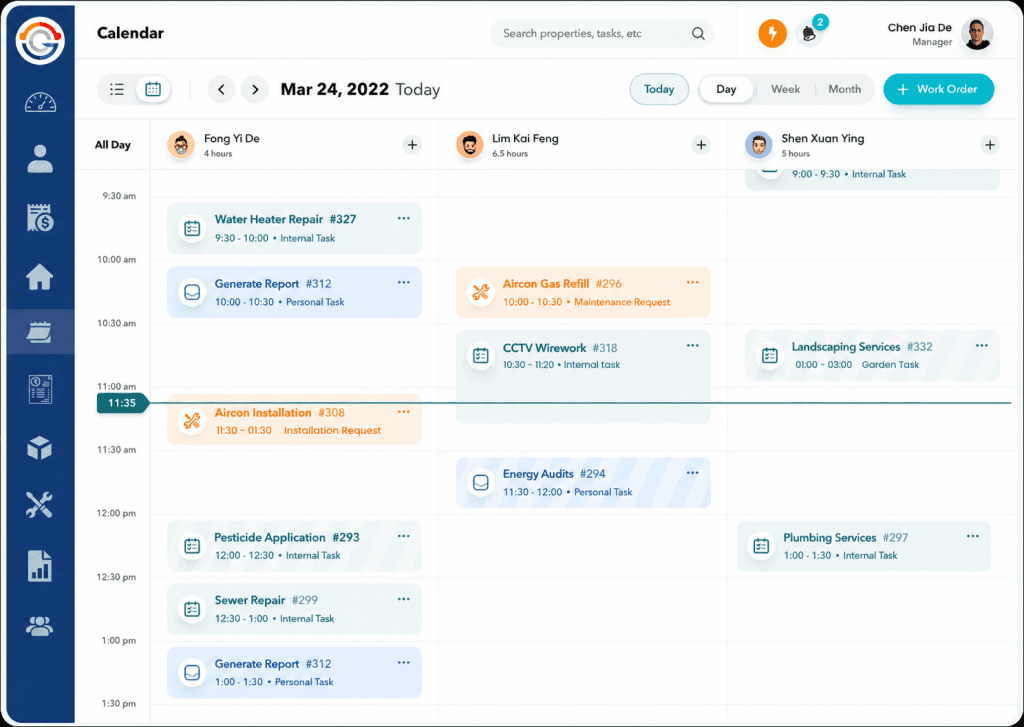
Genic Teams is the most recognised Singapore-built FSM platform. IMDA-listed, with a local account management team and a PSG approval pathway that is documented and familiar to IMDA reviewers.
Strengths:
- PSG pre-approved. The grant application process for Genic Teams has been completed by cleaning and facilities management operators before – the pathway is well-trodden.
- SG-native scheduling with GST invoicing in SGD and local support on Singapore business hours.
- Familiar dispatcher workflow for operations teams transitioning from spreadsheet-based scheduling – the learning curve is low.
- Zone-based scheduling and mobile app for supervisors and area managers.
Limitations:
- MOM work permit tracking is not a native structured field. Most operators manage permit compliance via a separate Excel file referenced manually before each deployment.
- Helper-swap logic does not exist as a workflow. Reliever scheduling is manual – the area supervisor calls available staff, checks their permit status in the spreadsheet, and assigns by phone.
- WhatsApp integration functions as an outbound notification layer. Inbound ground staff messages still require manual processing.
- GeBIZ-format report templates require manual assembly – the platform generates attendance logs, not government-contract-formatted submissions.
- Pricing scales per-seat and becomes aggressive above 50 ground staff accounts.
Best for: Cleaning operators for whom PSG pre-approval is a hard procurement requirement, and who have an operations team capable of managing work permit compliance and GeBIZ reporting manually alongside the scheduling system.
Verdict: The right default when PSG speed and local-vendor familiarity outweigh the need for permit-aware deployment automation. For a direct head-to-head, see Genic Teams vs FieldCamp for Singapore operators and the independent Genic Teams review.
3. Deputy — Best for Shift Scheduling and Attendance Compliance in Large Cleaning Teams
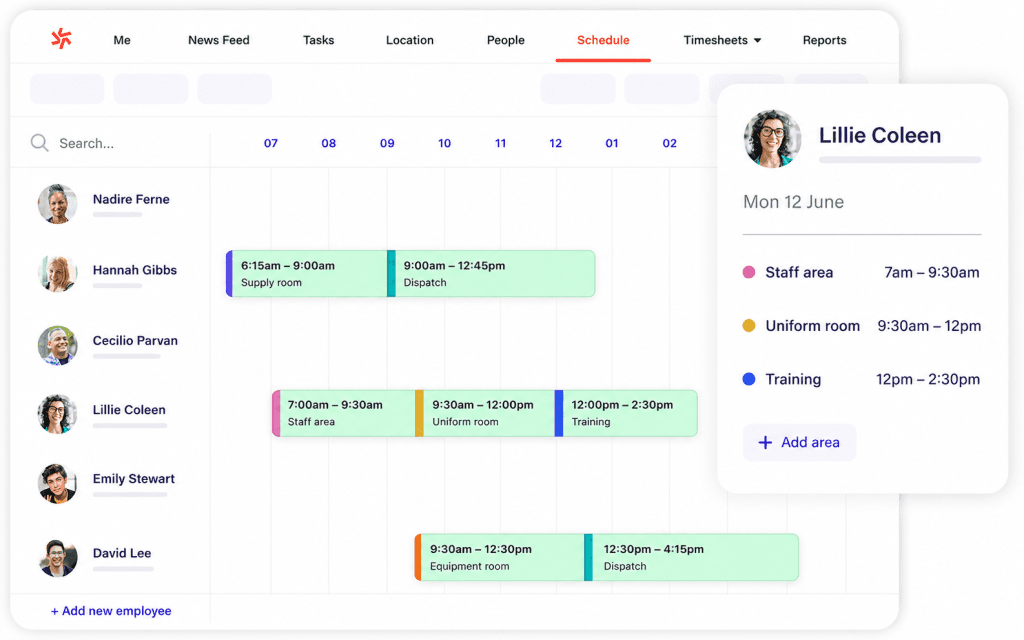
Deputy is an Australian workforce management platform with strong adoption across Singapore’s service sector – including commercial cleaning companies that run large shift-based teams. It is purpose-built for shift scheduling, not field service management.
Strengths:
- Strong shift scheduling with leave management, availability tracking, and overtime alerts – well-suited to the daily/nightly shift model commercial cleaning runs on.
- Attendance verification with GPS check-in – useful for confirming cleaners are on-site at the scheduled time.
- Award interpretation and compliance alerts – built for Australian labour law, but configurable for MOM overtime rules.
- Solid Xero and MYOB integration – invoicing and payroll data transfer cleanly.
- Well-established in Singapore service operations, with local customers and support.
Limitations:
- No MOM work permit tracking. Permit categories, expiry dates, and site-specific deployment restrictions require a separate system or manual spreadsheet.
- Helper-swap logic does not exist. Shift swap covers employee-initiated swaps only – it does not model reliever pool management with permit-constraint checking.
- No GeBIZ reporting templates. Report generation for government contracts requires manual compilation.
- No WhatsApp integration. Ground staff communication routes through the Deputy mobile app – an additional download and login requirement for cleaners who operate primarily on WhatsApp.
- Not field service management – no job record, client CRM, or invoice generation.
- Not PSG-eligible for cleaning operations.
Best for: Cleaning operations where the primary pain is shift scheduling, leave management, and attendance verification – and where work permit compliance, helper-swap, and GeBIZ reporting are managed through separate systems.
Verdict: A genuinely strong shift management platform that stops fitting Singapore commercial cleaning once MOM compliance, reliever dispatch, and client reporting requirements are factored in.
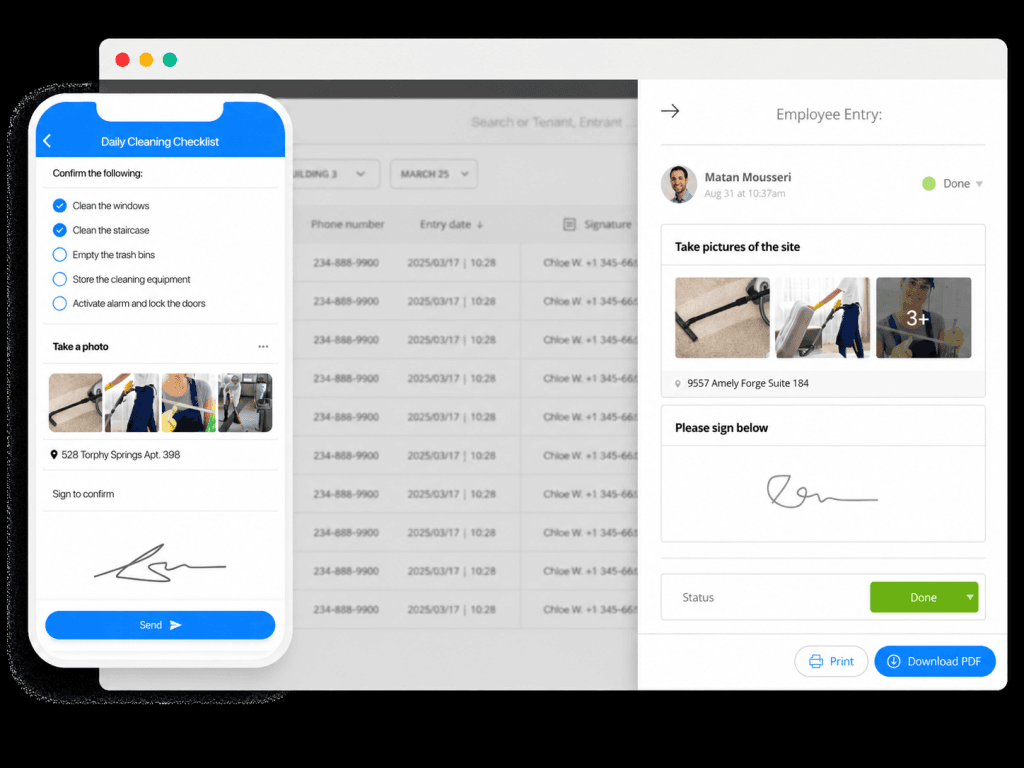
4. Connecteam — Best for Mobile-First Workforce Communication Across Large Dispersed Cleaning Crews
Connecteam is a mobile-first workforce management platform designed for frontline teams – used by cleaning, security, and facilities management companies globally to manage scheduling, communication, and training across large dispersed workforces.
Strengths:
- Mobile-first design optimised for frontline workers who operate primarily on smartphones – lower adoption friction than platforms requiring desktop login.
- Strong internal communication tools: group chat, announcements, task checklists, and digital forms supervisors can assign to ground staff by site.
- Shift scheduling with open shift claiming – useful for managing reliever pools informally, though without permit-constraint enforcement.
- Custom form builder for digital checklists, incident reports, and site handover documentation.
- Reasonable pricing for large teams on a per-location rather than per-user model.
Limitations:
- No MOM work permit tracking or permit-aware deployment enforcement.
- No helper-swap logic with permit validation – reliever management remains a manual supervisor decision.
- No GeBIZ reporting templates. Custom forms can capture attendance data, but government-contract-format report assembly requires manual work.
- No WhatsApp integration – communication runs through the Connecteam app, requiring a separate download and account from ground staff.
- No native Xero or MYOB integration – accounting sync requires third-party connectors.
- Not PSG-eligible for cleaning operations.
Best for: Cleaning operations where the primary pain is internal communication, digital checklists, and shift visibility across a large dispersed workforce – and where the operator is willing to run a separate FSM or accounting system alongside Connecteam.
Verdict: A useful workforce communication tool for large cleaning teams, but not a standalone solution. The absence of WhatsApp integration and MOM permit tracking are structural gaps for the SG market.
5. Swept — Best for Cleaning-Specific Job Management in Smaller Commercial Cleaning Businesses
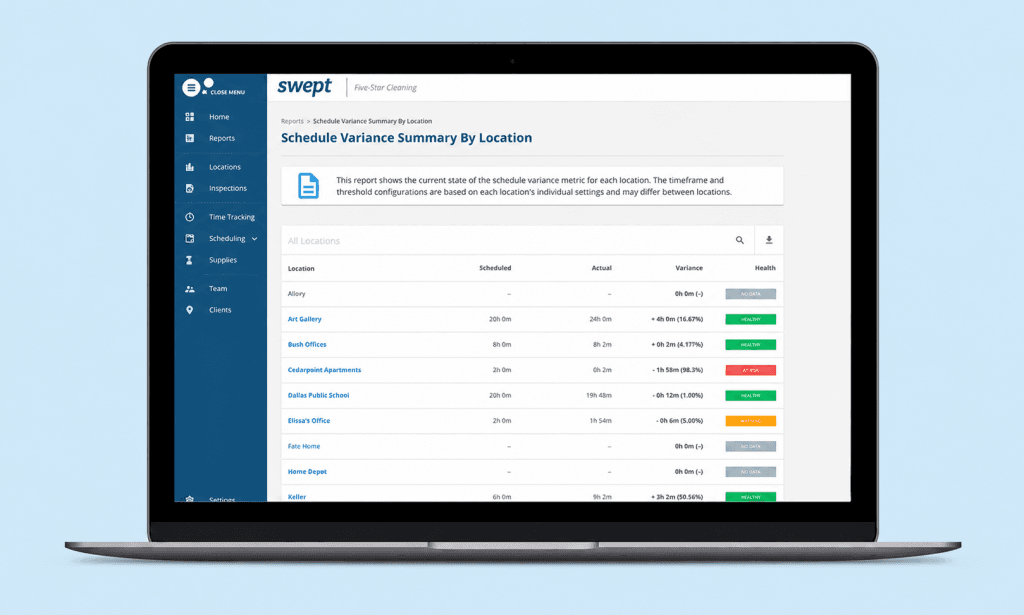
Swept is a cleaning-specific operations platform built for commercial cleaning companies – one of the few tools on this list designed exclusively for the cleaning industry rather than adapted from a generic FSM base.
Strengths:
- Cleaning-specific data model: client accounts, recurring cleaning schedules, inspection checklists, and supply tracking are all native objects – no configuration required for a basic commercial cleaning workflow.
- Inspector and quality control tools: supervisors can conduct site inspections on mobile, score quality against a standard checklist, and generate PDF reports for client review.
- Strong recurring schedule management for regular commercial contracts – daily, weekly, bi-weekly cadences are first-class objects.
- Messaging between office, supervisors, and cleaners within the platform.
Limitations:
- No MOM work permit tracking, helper-swap logic, or GeBIZ reporting templates – none of the SG-specific compliance requirements are built in or configurable.
- No WhatsApp integration. All team communication routes through the Swept app – a significant friction point for Singapore ground staff who operate on WhatsApp as their primary channel.
- US-built and US-focused. Pricing in USD, support in US timezones, no PSG eligibility, no SGD invoicing, no Xero/MYOB native sync.
- Scale ceiling: designed for 10–100 cleaner teams. The architecture does not comfortably handle the 500-plus-cleaner operations common among Singapore town council and hospital contract holders.
Best for: Smaller Singapore commercial cleaning companies – 10 to 50 cleaners, primarily private commercial contracts – who want a cleaning-specific tool and are willing to manage MOM compliance and government reporting through separate systems.
Verdict: The most cleaning-specific platform on this list, but built for a different regulatory market. The WhatsApp gap and absence of MOM compliance tooling are disqualifying for the majority of SG operators.
6. Hubstaff — Best for GPS Time Tracking and Proof of Attendance Across Multiple Cleaning Sites
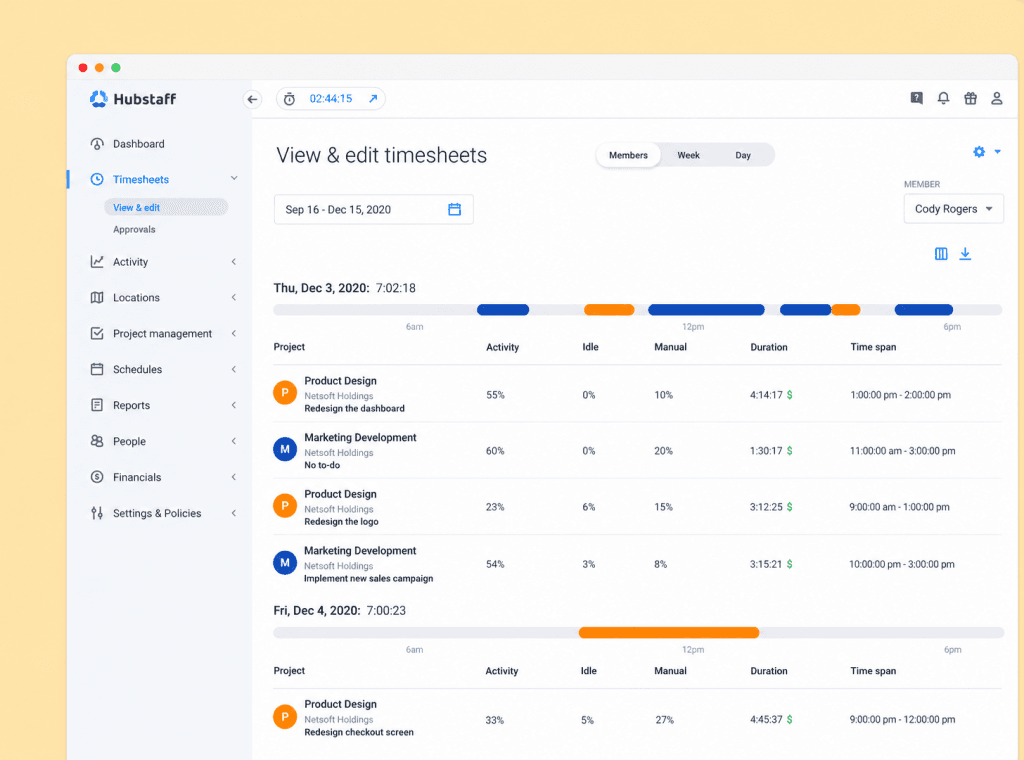
Hubstaff is a time tracking and workforce monitoring platform with GPS tracking, screenshot capture, and activity monitoring. It is used by cleaning companies globally to verify that cleaners are on-site and working during scheduled shifts.
Strengths:
- GPS tracking with geofenced clock-in – cleaners can only clock in when physically at the assigned site location, providing proof of attendance for client billing and SLA verification.
- Time tracking with per-site and per-project reporting – useful for contract billing and labour cost analysis across a portfolio of cleaning sites.
- Scheduling and shift management, with overtime and hours alerts.
- Basic invoicing capability tied to tracked hours.
Limitations:
- No MOM work permit tracking, helper-swap logic, or GeBIZ reporting.
- No WhatsApp integration – communication runs through the Hubstaff app.
- No cleaning-specific data model – site inspection checklists, quality scoring, and supply tracking are absent.
- USD pricing, no PSG eligibility, no Xero/MYOB native sync for SG accounting workflows.
Best for: Singapore cleaning operators who need reliable GPS-verified attendance and billable hours tracking across multiple sites, and who are comfortable running a separate scheduling, compliance, and reporting system alongside Hubstaff.
Verdict: A solid proof-of-attendance tool that solves one specific problem well. The absence of MOM compliance, WhatsApp integration, and GeBIZ reporting makes it insufficient as a standalone solution for commercial cleaning in Singapore.
7. Jobber — Best for Small Independent Cleaning Businesses with Residential and Light Commercial Accounts
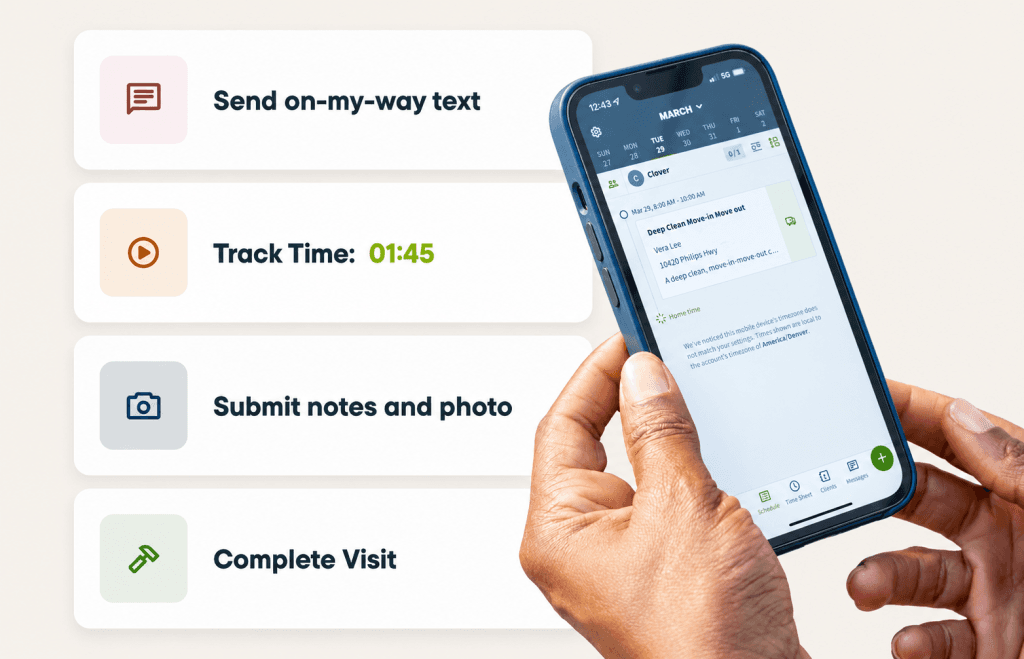
Jobber is among the most polished global SMB field service platforms – clean interface, strong onboarding, mature mobile application, and a large community of operators who have shared workflow templates.
Strengths:
- Best-in-class onboarding experience. A small cleaning team can be operational within a few days.
- Strong quote-to-job-to-invoice workflow for one-off and recurring residential or light commercial cleaning contracts.
- Client-facing booking portal and reminder automation.
- Native Xero integration.
Limitations:
- No MOM work permit tracking, helper-swap logic, or GeBIZ reporting – none of the SG commercial cleaning compliance requirements are modelled.
- No native WhatsApp. Customer and team communication routes through SMS and email – channels SG ground staff use far less reliably than WhatsApp. See how Singapore customers prefer WhatsApp over all other channels.
- Country-level feature restrictions for users logging in from certain countries – a direct blocker for operators with admin or supervisory staff based in Malaysia, Indonesia, or the Philippines. Verify with a live account test before any commitment.
- Not PSG-eligible. USD pricing. No InvoiceNow-ready integration for Singapore’s 9% GST compliance.
- Designed for 3–15 technician operations. Does not scale to 50–500-cleaner commercial cleaning operations.
Best for: A small cleaning business of 3 to 10 cleaners doing primarily residential or light commercial accounts, with a locally based Singapore admin team and no government contract, work permit, or GeBIZ reporting obligations.
Verdict: A polished product that stops fitting Singapore commercial cleaning once government contracts, work permit compliance, or remote admin teams enter the picture. For the full analysis, see the Jobber alternative guide for Singapore operators.
8. ServiceM8 — Best for Small Australian-Origin Cleaning Businesses Extending to Singapore
ServiceM8 is an Australian-built FSM platform with strong adoption across Australia, New Zealand, and some Southeast Asian operators – including a small number of Singapore cleaning businesses.
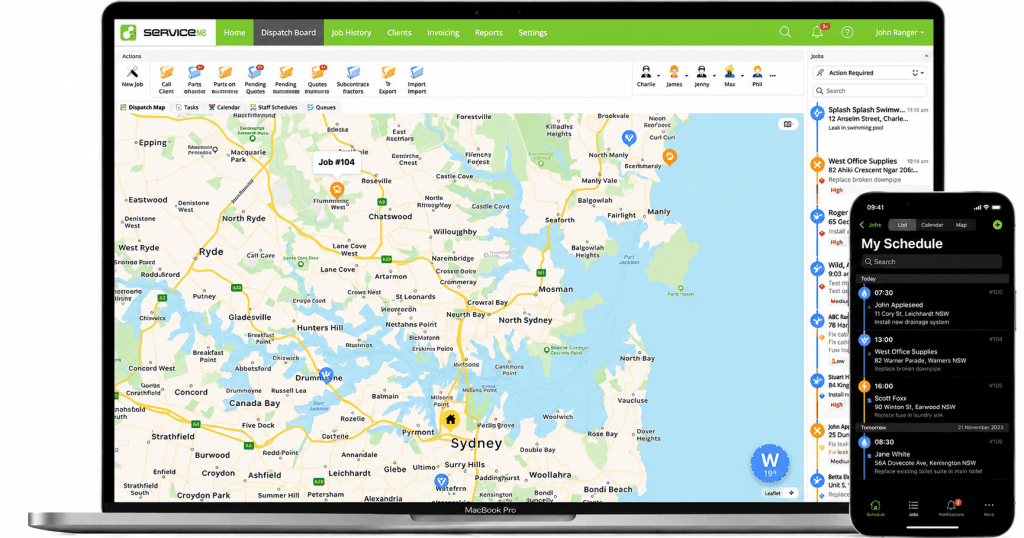
Strengths:
- Clean mobile-first experience with a low learning curve for supervisors and small cleaning teams.
- Strong Xero integration – invoices sync cleanly, relevant for SG operators already on Xero.
- Good job card flow for recurring cleaning contracts and one-off commercial cleans.
- Reasonable pricing for small teams on a per-job model rather than per-seat.
Limitations:
- No MOM work permit tracking, helper-swap logic, or GeBIZ reporting.
- No native WhatsApp. Communication routes through SMS and email, creating the same channel mismatch as Jobber in the Singapore market.
- Not PSG-eligible. Australian-based support and AUD billing.
- Scale ceiling: designed for small service teams of 5–20. Does not handle 50-plus-cleaner commercial cleaning operations.
- No labour utilisation dashboards or transit-aware routing for MRT/bus crew deployment.
Best for: Singapore cleaning firms already using ServiceM8 in an affiliated Australian operation who want to extend the same platform to their SG team, or small residential-focused cleaning businesses comfortable with AUD billing and limited local support.
Verdict: A capable small-business tool that fits a narrow SG use case. For most MOM-licensed commercial cleaning operators with government contracts or remote supervisory staff, the compliance and WhatsApp gaps are disqualifying.
How to Choose: Decision Framework for SG Cleaning Operators in 2026
Before requesting demos, work through these four questions. Your answers will narrow the shortlist from eight to two or three without wasting time on platforms that cannot clear your baseline requirements.
Do you hold town council, MOE school, or MOH hospital contracts? If yes, you need GeBIZ-compatible reporting as a hard requirement. FieldCamp’s AI agent model handles automated GeBIZ report generation. Genic Teams, Deputy, Connecteam, Swept, Hubstaff, Jobber, and ServiceM8 all require manual assembly for government-contract-format output.
Do you deploy Work Permit holders across multiple sites? If yes, rule out any platform without native permit tracking before the first demo. The MOM compliance exposure from deploying a permit-expired or site-ineligible cleaner is immediate and financial. Of the platforms reviewed here, FieldCamp is the one with permit-aware deployment enforcement built and tested against Singapore operator requirements. All others require a parallel spreadsheet for permit tracking.
Is PSG grant funding a hard requirement in your procurement decision? Genic Teams is the only PSG pre-approved option on this list as of 2026. FieldCamp is in the IMDA evaluation pipeline. For a step-by-step breakdown of how to structure your application timeline, see the PSG grant guide for Singapore field service software. Do not let PSG status narrow your shortlist prematurely if the grant timeline is flexible – the most operationally capable platform often recovers the PSG offset within three to six months of efficiency gains at SG cleaning margins.
Does your supervisory or admin team include staff based outside Singapore? If yes, verify country-level feature access with a live account test before signing any contract. Jobber has documented restrictions for certain overseas locations. FieldCamp, Genic Teams, Deputy, Connecteam, and ServiceM8 have no documented country-level access restrictions – but always verify with a live test from your overseas admin’s actual location, not a vendor assurance.
“Revenue has been increasing almost double every year and we have the pain of not having a software to manage the jobs. So everything is very manual and things get very messy.”
The operational pattern Andy describes – manual coordination holding back a scaling operation – is precisely the breaking point for Singapore cleaning companies moving from 30 to 100 ground staff. The helper-swap spreadsheet works at 20 cleaners. At 80 across six town council estates, it generates a compliance breach every fortnight. At 200 across three contract types, it generates one every week.
For Singapore cleaning companies comparing specific software transitions, the Genic Teams vs FieldCamp comparison and the Genic Teams alternatives guide cover the two most frequently shortlisted platforms – alongside the best aircon servicing software guide for Singapore operators for multi-trade FM operators evaluating the same decision.
Ready to replace the helper-swap spreadsheet with a system that actually enforces permit compliance?
See how FieldCamp handles MOM work permit tracking, helper-swap dispatch, GeBIZ report generation, and WhatsApp-native ground staff coordination – all in a single platform built for Singapore commercial cleaning operations.
Frequently Asked Questions
What is the best cleaning company software for Singapore operators?
FieldCamp is the strongest fit for MOM-licensed commercial cleaning operators managing work permit compliance, helper-swap scheduling, and GeBIZ reporting. Genic Teams is the right choice if PSG pre-approval is a hard requirement and your team can manage compliance documentation manually. The deciding variables are crew size, contract type (government vs private commercial), and whether your supervisory staff are Singapore-based or overseas. For small residential cleaning businesses with no government contract obligations, Jobber or ServiceM8 may be sufficient.
Does any cleaning software handle MOM work permit tracking natively in Singapore?
Among the platforms in this guide, FieldCamp is the one that has modelled work permit compliance as a structured deployment constraint – built and tested for an actual Singapore cleaning operator. All other platforms require a parallel spreadsheet or a separate HR system to track permit categories, expiry dates, and site-specific restrictions. The compliance gap this creates is real: deploying a permit-expired or site-ineligible Work Permit holder is a direct MOM violation regardless of which scheduling tool was used to assign the shift.
Can I use the PSG grant for cleaning company software in Singapore?
Yes – if the software is on IMDA’s pre-approved vendor list. Genic Teams is currently the only option on this list with PSG pre-approval for cleaning and facilities management operators. FieldCamp is in the IMDA evaluation pipeline – contact the team for current status. Deputy, Connecteam, Swept, Hubstaff, Jobber, and ServiceM8 are not PSG-listed for cleaning operations. The grant covers up to 50% of qualifying costs. Full walkthrough at the PSG grant guide for SG field service companies.
How do Singapore cleaning companies manage helper-swap without purpose-built software?
The most common approach is a WhatsApp group for the reliever pool and a shared spreadsheet with permit details. A supervisor receives the absence notification, opens the spreadsheet, identifies available relievers with the correct permit for that site, calls them in sequence, and updates the shift log manually. This process works at 20 cleaners and fails systematically at 80 or more – missing permit expiries, deploying to wrong site categories, and generating compliance breaches that only surface during MOM audits. Of the platforms reviewed here, FieldCamp is the one with this workflow built as an automated, permit-enforced dispatch process.
What software do Singapore cleaning companies use for GeBIZ reporting?
Most operators with government contracts compile GeBIZ submissions manually – combining attendance sheets, WhatsApp-captured incident records, and supervisor reports into a formatted document. This is the single highest-risk manual process in SG commercial cleaning: one missed detail in a MOH hospital or MOE school report is a contract performance issue. FieldCamp’s AI agents automate report compilation against a configured GeBIZ template. No other platform on this list generates government-format reports without manual assembly.
Does cleaning company software in Singapore need to handle transit routing?
It depends on crew size and contract density. For a 10-cleaner operation serving 3 sites, zone assignment is sufficient. For a 100-cleaner operation with 15 simultaneous contracts across Singapore, transit-aware routing produces meaningful utilisation improvements – reducing the dead travel time that comes directly out of a 2–8% margin. FieldCamp’s AI Dispatcher models MRT/bus travel times for zone-based deployment. All other platforms on this list calculate driving distance or use manual zone assignment without transit optimisation.
Can FieldCamp replace the Excel spreadsheet SG cleaning companies use for permit tracking?
For the core permit tracking use cases – permit category, expiry date, employer tie, site-specific restrictions, and reliever pool management – FieldCamp’s structured worker profile model covers them without a parallel spreadsheet. One thing to verify in your demo: the specific permit categories your operation uses and whether they map cleanly to FieldCamp’s configurable fields. Bring your actual Work Permit and S Pass data to the demo session rather than testing with sample data – the edge cases in permit compliance are always in the real data, not the demo scenario.
What is the best cleaning company software for HDB estate and town council contracts in Singapore?
For HDB estate and town council contracts, the core requirements are block-level deployment records, MOM-compliant shift logs, GeBIZ-formatted monthly reports, and the ability to manage multiple concurrent estates under a single contract record. FieldCamp handles this via site-specific records per HDB block or estate zone, with permit-enforced assignment and AI-generated report compilation. For the broader multi-trade context of HDB and town council contracts that combine cleaning with pest control or maintenance, see HDB and condo maintenance contract management with software.