
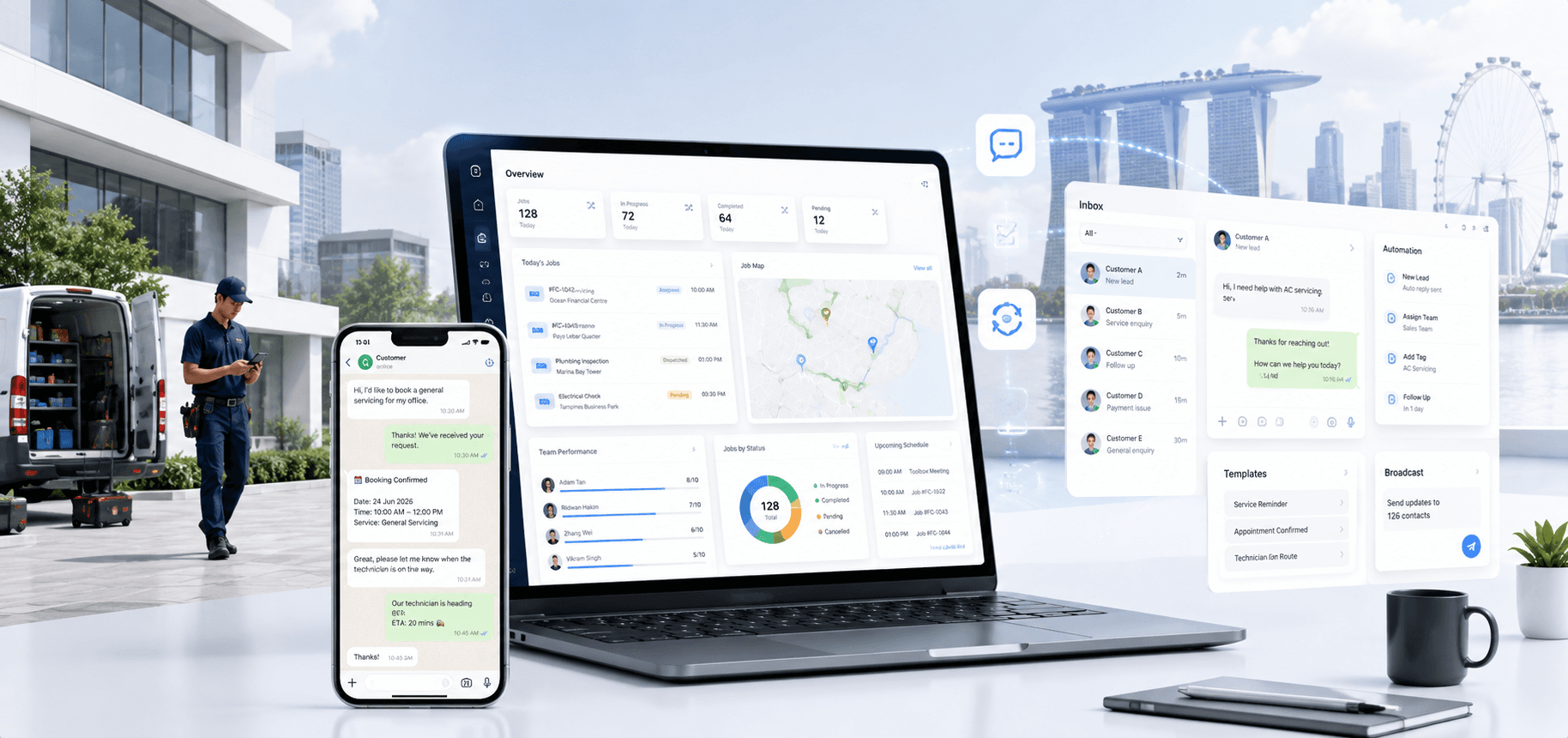
| TL;DR: Most Singapore service operators using Wati are paying SGD 300–500/month for job notifications, booking confirmations, and technician updates — operational messages a field service platform should handle natively through workflow automation. Wati is a WhatsApp marketing and messaging platform built for sales pipelines and broadcast campaigns. It has no connection to jobs, dispatch, invoicing, or Xero. If your main Wati use case is operational messages rather than marketing, you are likely paying for a tool that duplicates what your FSM should already be doing. |
Eddie Aw, owner of The Pest Control Co in Singapore, was paying over SGD 400/month on Wati. By his own account, he wasn’t fully using the platform — just job notifications and booking confirmations. The real frustration was that Wati and his FSM never talked to each other. Every job confirmation had to be manually triggered. Every technician dispatch message was copy-pasted from the job sheet into a WhatsApp template. The data lived in two places and neither tool knew what the other was doing.
Across Singapore’s service sector — aircon, cleaning, pest control, facilities management, this is a common setup: a Wati account handling the messaging layer and a separate platform for jobs, scheduling, and invoicing. It works, but it costs money and breaks down the moment any detail changes.
This guide explains what Wati actually does, what field service operators are actually using it for, and whether built-in WhatsApp inside an FSM is a smarter approach for a Singapore service business in 2026.
Wati, built-in FSM WhatsApp, or both — not sure which setup fits your Singapore service business? Let AI pull a quick answer tailored to your trade.
KEY HIGHLIGHTS
WhatsApp vs Wati for Singapore Service Companies 2026
- ✓Wati is a marketing and messaging platform, not a field service tool: it manages broadcasts, chatbots, and shared inboxes but has no concept of a job, technician, schedule, GST invoice, PayNow, or Xero — operators using it only for operational notifications are using about 20% of what it was built for.
- ✓The real Wati bill for a 5-technician Singapore team is SGD 300–405/month: the advertised plan price is the floor, not the ceiling — message markups, per-seat fees, and add-ons typically push the actual bill 30–50% above the listed price, and that’s before the FSM and Xero subscription running alongside it.
- ✓Field service platforms with native WhatsApp send the same operational messages automatically: booking confirmations, dispatch alerts, job completion notices, and invoice links fire from workflow triggers tied to job status — no manual triggers, no separate subscription, no data gap between messaging and job records.
1. WhatsApp Business App, WhatsApp API, and Wati: Three Tools Singapore Service Companies Confuse
Before comparing Wati to a field service platform, it helps to clarify what each tool actually is — because most operators who are frustrated with their WhatsApp setup are conflating three different things.
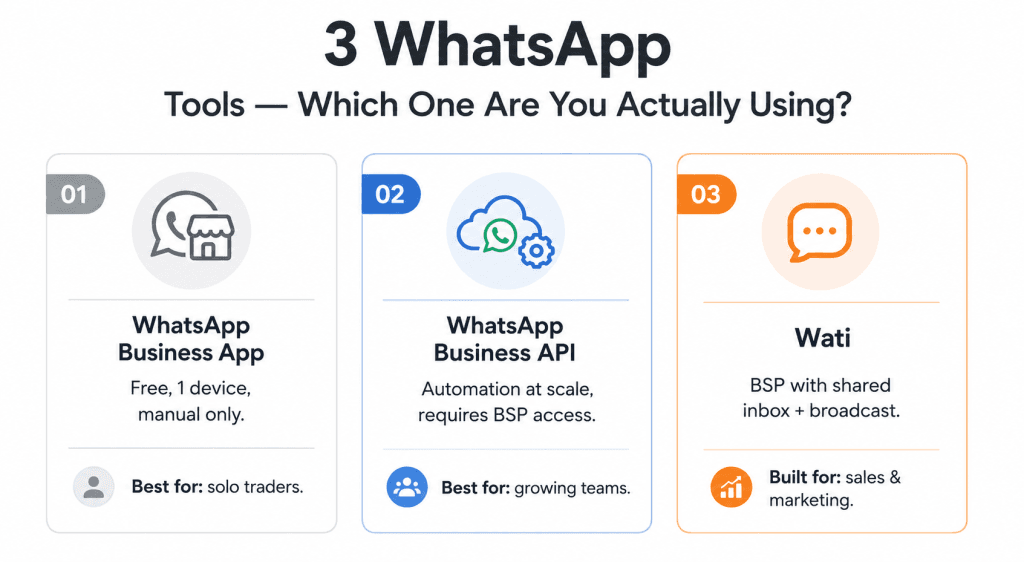
| Tool | What it is | Who it is for | Field service gap |
|---|---|---|---|
| WhatsApp Business App | Free app — 1 device, 1 number, manual messaging only | Solo traders, micro-teams | No automation, no multi-agent, no templates at scale |
| WhatsApp Business API | Developer API for automation at scale — only via approved BSP | Medium to large teams needing automation | Requires technical setup unless your platform handles it natively |
| Wati | A BSP wrapping the WhatsApp API with shared inbox, broadcast tools, and a chatbot builder | Sales, marketing, and support teams | No job management, no dispatch, no invoicing, no Xero |
| FSM with built-in WhatsApp | A field service platform where WhatsApp is wired to job workflows — messaging tied to real job data | Field service operators who need operational messaging | Not suited for broadcast marketing campaigns |
You cannot access the WhatsApp Business API directly from Meta as an SME — access is granted exclusively through approved BSPs. Wati is one BSP. Field service platforms that include native WhatsApp act as another access path, with the difference that messaging is wired into the job workflow rather than presented as a standalone tool.
2. What Is Wati and Who Is It Actually Built For?
Wati is a WhatsApp Business API platform with 16,000+ customers across Southeast Asia. It gives companies a shared team inbox, broadcast campaigns, chatbot flows, and contact management — all delivered over WhatsApp. It was built for sales, marketing, and customer support teams handling high volumes of inbound messages and outbound campaigns.
In Singapore, Wati has strong adoption among e-commerce businesses, retail brands, and B2C marketing teams running lead nurturing sequences, cart abandonment reminders, and customer support queues. That is the use case it was designed for.
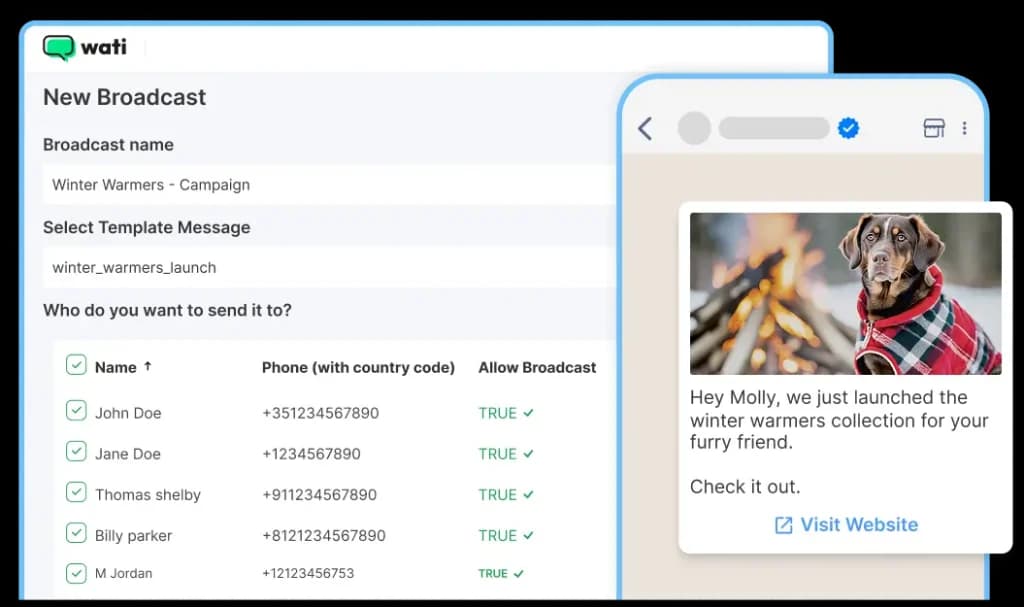
Most field service companies on Wati are using roughly two features: broadcast messages (job reminders, service confirmations) and the shared inbox. That is a thin use case for a platform priced for full marketing automation.
- Jobs, job status, or job history
- Technicians, availability, or dispatch queues
- GST 9% invoices or PayNow payment collection
- Xero or accounting integrations
- Recurring service contracts or scheduling calendars
Every operational step — scheduling, dispatch, invoicing — still happens in a separate system. Wati sits alongside as a messaging layer, but nothing flows between them automatically.
3. Wati Pricing in Singapore: What the Plans Show vs What You Actually Pay
Wati’s 2026 plans on annual billing: Growth at USD 59/month, Pro at USD 149/month, Business at USD 349/month. Monthly billing runs higher — USD 69, USD 229, and USD 449. Each plan includes 5 users; additional seats cost USD 12–24/month per tier.
What the plans don’t show is the markup on WhatsApp conversation fees. Meta charges BSPs a base rate per 24-hour conversation window; BSPs pass this on with a margin. Wati marks up Meta’s standard rates by approximately 20%, and up to 80% on utility and authentication messages. For a Singapore service business sending 150–300 operational messages per month, those markups add SGD 60–150/month on top of the plan cost.
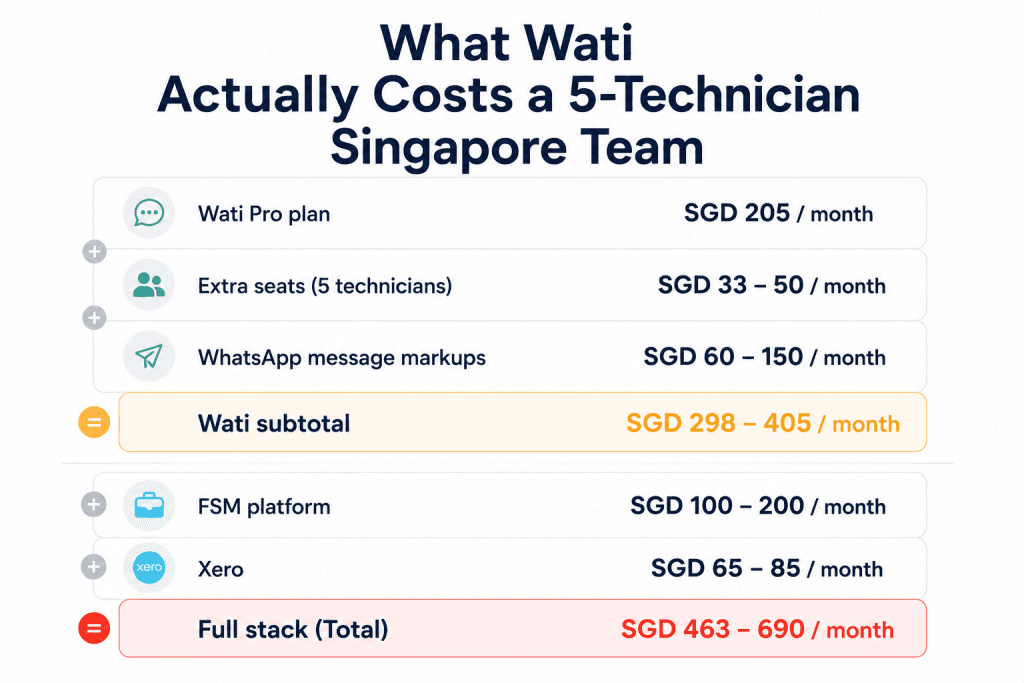
- Wati Pro plan (annual billing): SGD 205/month
- Extra seats beyond 5 included: SGD 33–50/month
- WhatsApp conversation fees at Wati markup: SGD 60–150/month
- Wati subtotal: SGD 298–405/month
- FSM platform (jobs, scheduling, dispatch): SGD 100–200/month
- Xero (GST F5, InvoiceNow): SGD 65–85/month
- Full disconnected stack: SGD 463–690/month
This matches what operators report publicly. On G2, “Expensive” appears in Wati reviews 39 times and “Pricing Issues” 23 times. Multiple Trustpilot reviewers have documented continued charges after requesting cancellation. The advertised plan price is the floor, not the ceiling.
4. The 5 WhatsApp Messages Every Singapore Field Service Company Sends
Strip away the marketing features and what most Singapore field service operators actually need from WhatsApp comes down to five operational messages — each tied to a job status change, not a marketing calendar.
- Booking confirmation — “Your appointment is confirmed for [date] at [address]. Technician: [name].”
- Technician dispatch alert — “Your technician [name] is on the way. Estimated arrival: [time].”
- Job completion message — “Your job is complete. Invoice: [link]. Pay via PayNow: [UEN].”
- Appointment reminder — “Reminder: your [service type] appointment is tomorrow at [time].”
- Recurring contract reminder — “Your quarterly aircon servicing is due. Reply to confirm your preferred date.”
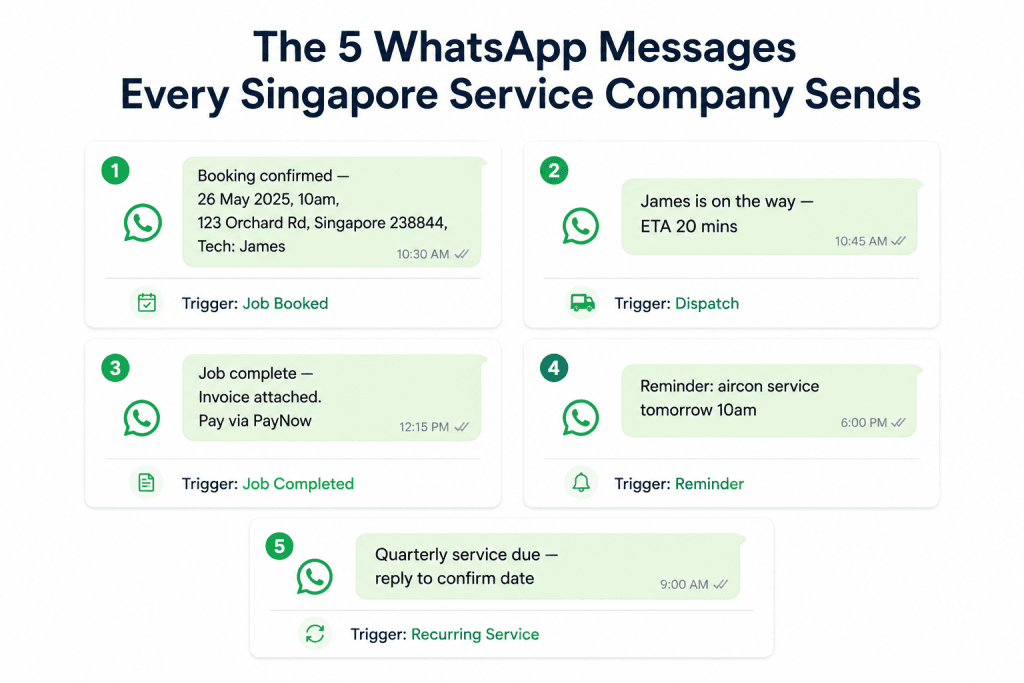
None of these messages need a chatbot, a broadcast campaign, or a sales pipeline. They need accurate data from a job record and a trigger that fires when job status changes. Sending these through Wati means manually triggering each one or building chatbot flows that break when job details change.
5. How Field Service Platforms Handle WhatsApp Natively
Field service platforms that include WhatsApp as a built-in channel wire it into the workflow engine — so messages trigger based on what’s happening in the job, not what a staff member remembers to send. When a job is booked, the booking confirmation fires. When a technician is dispatched, the alert fires. When an invoice is generated, the payment link fires. No separate tool. No manual step in between.
FieldCamp’s approach uses its Workflow Automation engine. From June 2026, businesses in Singapore can complete WhatsApp Business API onboarding directly inside FieldCamp via WhatsApp Embed Signup — no separate Twilio or Meta developer setup required. Seven Meta-approved message templates are included, with a variable picker that auto-fills client name, job address, technician name, and scheduled time from the live job record. See the workflow builder guide for configuration details.
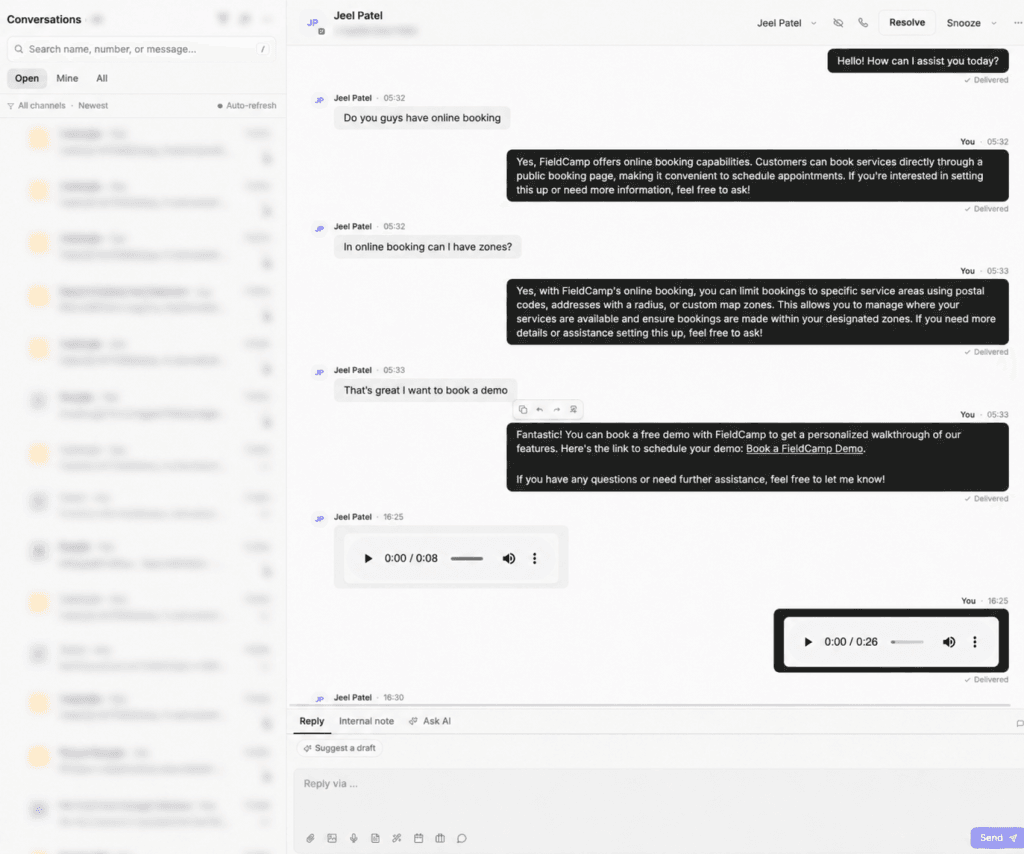
For inbound WhatsApp, the AI Receptionist handles incoming messages including photos, a customer sends a photo of a faulty unit, the AI reads it, creates a job record, and routes it to the right queue. All conversations sit in the Unified Inbox alongside calls, email, and SMS. Full setup in the WhatsApp integration guide.
6. Setting Up WhatsApp in Singapore: Wati vs a Native FSM
Getting a WhatsApp Business API number live through Wati in Singapore requires four steps:
- Meta Business Manager verification — verified account matching your legal business name, website domain, and UEN
- Phone number registration — the number cannot be active on any existing WhatsApp account
- Template approval — outbound templates require Meta review; typical approval is 2–7 business days per batch
- BSP onboarding documentation — business license or GST registration certificate
From first step to first message sent, most Singapore service businesses report a 1–2 week setup timeline with Wati. By contrast, FieldCamp’s Embed Signup lets operators complete the same onboarding inside the platform in under 30 minutes — no separate Meta developer portal, no third-party BSP coordination.
7. Wati vs Built-In FSM WhatsApp: Full Feature Comparison
| Feature | Wati | FSM with built-in WhatsApp (e.g. FieldCamp) |
|---|---|---|
| Job dispatch notifications | Manual — no job data, trigger set up separately | ✓ Automated via workflow trigger on job dispatch |
| Booking confirmations | Manual or chatbot-triggered (no real job data) | ✓ Auto-sends with live job details on booking |
| GST invoice via WhatsApp | ✗ Cannot generate invoices | ✓ GST 9% invoice + PayNow link on job completion |
| Recurring contract reminders | ⚠ Possible via broadcast but manual scheduling | ✓ Contract-triggered, auto-scheduled |
| Inbound WhatsApp + photos | ✓ Shared inbox, manual handling | ✓ AI Receptionist reads photos, creates job records |
| Chatbot intelligence | Rule-based keyword triggers only | ✓ LLM-based — handles nuanced requests |
| Broadcast / marketing campaigns | ✓ Core feature | ✗ Not designed for marketing broadcasts |
| Xero integration | ✗ No accounting integration | ✓ Native two-way Xero sync |
| PayNow collection | ✗ No payment collection | ✓ Native PayNow + Xero reconciliation |
| PSG eligibility | ✗ Not PSG-qualifying | ✓ PSG application in progress — see PSG guide |
| Setup time (Singapore) | 1–2 weeks (Meta verification + BSP onboarding) | Under 30 mins (Embed Signup inside platform) |
| Monthly cost (5-tech SG team) | SGD 300–405/month (plan + markups) + FSM separately | All-in — no separate messaging subscription |
8. When Wati Is Still the Right Choice
Wati makes sense for certain service businesses. The honest answer is not “never use Wati” — it is “know what you’re paying for.”
If your primary WhatsApp use case is customer acquisition — broadcast campaigns to past customers, lead nurture sequences, or a chatbot qualifying enquiries before routing to a human — Wati is well suited. A larger B2C cleaning franchise running seasonal promotions at scale has a genuine use case for it alongside an FSM.
Use Wati if your primary need is:
- WhatsApp broadcast campaigns to customer lists
- Lead nurturing and re-engagement sequences
- Chatbot handling inbound sales enquiries at scale
- WhatsApp as a marketing channel alongside operations
Wati is overkill if your primary need is:
- Booking confirmations
- Technician dispatch alerts
- Job completion notifications
- Invoice and PayNow delivery via WhatsApp
9. Do Singapore Service Companies Actually Need Both Tools?
Some service businesses run both legitimately — a larger cleaning company might use an FSM with built-in WhatsApp for operational messages while keeping Wati for acquisition campaigns. The tools serve different audiences and different purposes.
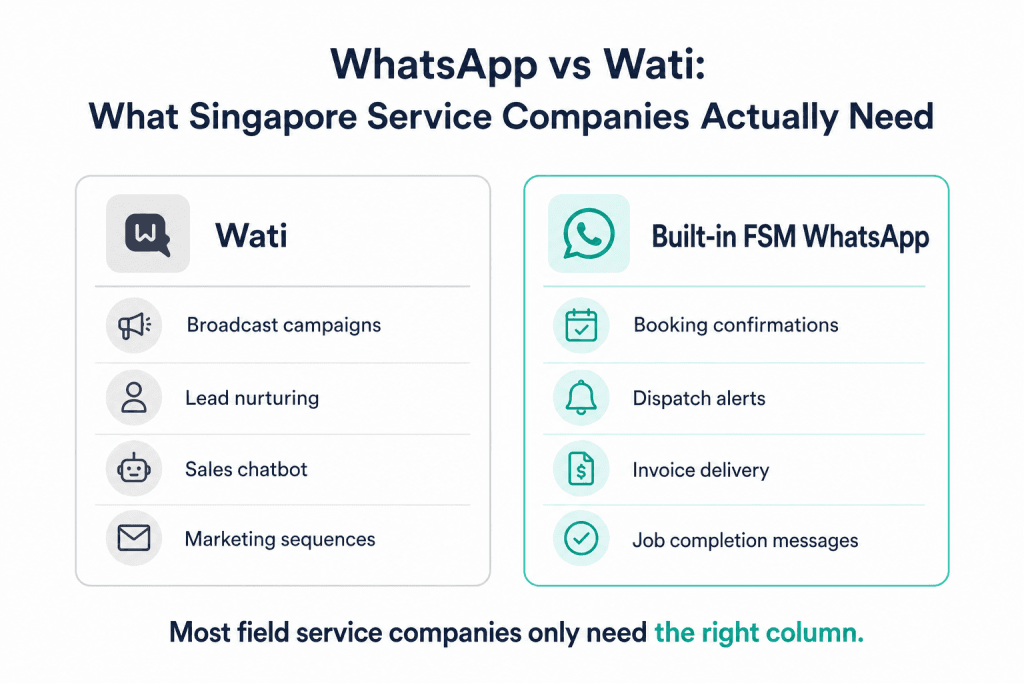
For most Singapore service operators with 3–20 technicians, the honest answer is: if your Wati bill is going almost entirely toward operational notifications and you’re also paying for an FSM, you’re paying twice for overlapping functionality. Look at your last 30 days of Wati messages — how many were broadcast campaigns and sales flows, and how many were job confirmations, dispatch alerts, and invoice links? If the answer is mostly the latter, you’re paying for the wrong tool.
Operators who have moved their operational WhatsApp into their FSM typically save SGD 200–400/month. For how this plays out by industry, see how aircon servicing companies in Singapore manage recurring contracts and how pest control operators automate their job workflows.
10. Singapore-Specific Factors: PSG Grant, InvoiceNow Mandate, and PDPA
PSG Grant eligibility
Wati is not a PSG-qualifying solution. The Productivity Solutions Grant (administered by EnterpriseSG) covers pre-approved operational tools — accounting, CRM, HR, and operations platforms. WhatsApp messaging tools are not in scope. Field service management platforms with Singapore-specific features (GST invoicing, InvoiceNow, PayNow, Xero) can qualify and substantially offset the platform cost. Check the PSG grant guide for field service software for current qualifying vendors, or the GoBusiness PSG portal directly.
InvoiceNow mandate
From April 2026, new voluntary GST registrants in Singapore must use InvoiceNow (Peppol e-invoicing) for B2B transactions. Wati has no role in this — InvoiceNow compliance happens in your FSM and accounting stack, not your messaging tool.
PDPA compliance
Singapore’s Personal Data Protection Act governs how businesses collect, use, and store customer data. Any platform handling customer communication — WhatsApp messages, contact records, job history — must comply. When evaluating Wati, request their Data Processing Agreement and confirm where Singapore customer data is stored. Adding a third-party BSP alongside an existing FSM creates an additional compliance layer worth reviewing, particularly for operators subject to sector-specific requirements (NEA licensing, MCST contracts).
11. Industry Breakdown: Aircon, Cleaning, Pest Control, and Facilities Management
Aircon servicing
Most aircon servicing companies in Singapore run recurring quarterly contracts. The highest-value WhatsApp touch points are automated contract renewal reminders, job completion messages, and invoice delivery — all operational and trigger-based. Wati can approximate this via broadcast, but message content must be assembled manually since Wati has no visibility into the service schedule.
Cleaning companies
For cleaning companies in Singapore, WhatsApp is often the primary booking channel for one-time and recurring clients. Cleaning companies with a strong B2C acquisition strategy may have a case for Wati alongside their FSM, but most operators with under 20 staff don’t run at that marketing volume.
Pest control
Pest control operators run contract-based work with NEA licensing requirements and multi-visit treatment schedules. Pest control software in Singapore needs to handle recurring treatments, compliance documentation, and visit sequences — none of which Wati touches. The WhatsApp layer is entirely operational: confirm visit, alert on arrival, send completion report and invoice.
Facilities management
FM operators managing MCST or commercial properties run high-volume job dispatch across multiple sites. A facilities management platform with native WhatsApp handles job-triggered communication without a separate messaging tool — important when you have multiple site contacts, multiple technicians, and multiple concurrent jobs.
Ready to consolidate your WhatsApp and FSM into one tool?
See how FieldCamp handles booking confirmations, dispatch alerts, invoice delivery, and inbound WhatsApp through workflow automation — without a separate Wati subscription running alongside it.
Frequently Asked Questions
Can a field service platform replace Wati for a Singapore service company?
For most field service operators in Singapore, yes. A platform with built-in WhatsApp covers the operational message types that operators actually use Wati for: booking confirmations, dispatch alerts, completion messages, invoice delivery, and appointment reminders — all via workflow triggers tied to job status. What it does not replace is Wati’s broadcast and campaign features. If you’re actively running WhatsApp marketing campaigns to customer lists, you’d need to retain Wati or a similar broadcast tool for that function specifically.
What does Wati actually cost a Singapore service business in 2026?
The real bill runs 30–50% above the advertised plan price. A 5-technician Singapore service business typically pays SGD 298–405/month on Wati alone — plan fee plus conversation fee markups plus extra seats. That is before the FSM and Xero subscription. The full disconnected stack commonly runs SGD 463–690/month for three tools that do not share data.
Is Wati PSG-approved in Singapore?
No. Wati is not a PSG-qualifying solution. The Productivity Solutions Grant covers pre-approved operational tools — accounting, CRM, HR, and field service platforms. WhatsApp messaging tools are not in scope. A PSG-eligible FSM with built-in WhatsApp is the relevant comparison for Singapore SMEs. Check the PSG grant guide for field service software for current qualifying vendors.
What is the difference between WhatsApp Business App, WhatsApp API, and Wati?
WhatsApp Business App is the free manual app for micro-teams — one device, one number, no automation. WhatsApp Business API is the developer API for automation at scale, only accessible through approved BSPs. Wati is one BSP that wraps the API with a shared inbox and chatbot tools. Field service platforms with native WhatsApp act as another access path, with the difference that messaging is wired directly into the job workflow engine rather than presented as a standalone tool.
Does FieldCamp’s WhatsApp require a separate WhatsApp Business account?
You connect your existing WhatsApp Business number or create a new one during setup. From June 2026, FieldCamp supports WhatsApp Embed Signup — full WhatsApp Business API onboarding directly inside the platform with no separate Meta developer portal. This significantly reduces setup friction compared to Wati’s onboarding process. Full steps in the WhatsApp setup guide.
How does PDPA compliance apply to using Wati in Singapore?
Singapore’s PDPA requires any platform handling customer communication data — WhatsApp messages, contact records, job history — to comply with data protection obligations. When evaluating Wati, request their Data Processing Agreement and confirm where Singapore customer data is stored and processed. Adding a third-party BSP alongside an existing FSM creates an additional compliance review layer, particularly for operators subject to sector-specific requirements like NEA licensing or MCST contracts.
Can FieldCamp handle WhatsApp for a company with multiple branches in Singapore?
Multi-branch or multi-number setups are a common requirement for Singapore aircon and cleaning companies operating across East and West zones with separate team WhatsApp numbers. Confirm current multi-number support directly with the FieldCamp team — capability can depend on plan tier and configuration — before migrating a multi-branch setup.
Does FieldCamp replace Wati for a cleaning company running seasonal promotions?
Not fully. FieldCamp’s WhatsApp is an operational tool — it sends messages triggered by job events. It is not designed for bulk broadcast campaigns or promotional messaging sequences. A cleaning company that relies on seasonal promotions or re-engagement campaigns over WhatsApp would still need Wati or a similar broadcast platform for that specific function. The point of evaluation is whether the operational side alone justifies the Wati cost — for many Singapore service operators, it does not.


