
The first 97°F Monday in June, or the first night below freezing in November, the phones start early and don’t stop until dark. The surge is predictable. Every trade has its own hard weeks, and most of them are on the calendar a month ahead.
FieldCamp AI Receptionist for field service calls, built on FieldCamp Voice, keeps your CSRs first. When they’re all on a line, the voice agent takes the next caller, screens for an emergency, and captures the job. With FieldCamp AI Dispatcher connected, it books the visit with the technician AI Dispatcher suggests, once the caller agrees to the time.
This guide is about the weeks you can plan for: capacity, seasonal rules and pre-season setup. The everyday busy-line mechanics have their own guide, linked below.
How does an AI receptionist handle peak season call volume?
An AI receptionist handles peak season call volume by answering the calls your CSRs can’t reach, several at a time up to your plan’s concurrent-call limit, triaging each one on your rules and booking the job. Unlike a peak season call volume answering service, it ends the call as a booked visit rather than a message.
The work that decides how the surge goes happens weeks before it: limits, seasonal rules and coverage windows.
What peak season does to a field-service phone line
Off-season, one or two CSRs hold the phones with time to spare. Peak season is the same team, the same lines, and a wave of calls that all arrive in the same few hours: the first hot afternoon, the first freeze, the first storm, the week before a holiday.
| Trade | When calls spike | What the calls are |
|---|---|---|
| Plumbing | The freeze, and the thaw a few days later | Burst pipes, water through a ceiling, split lines found once the ice melts |
| HVAC | The first heatwave, and the first hard freeze | No cooling, no heat, units that won’t start after sitting all season |
| Grease trap and used cooking oil | The holiday stretch, from Thanksgiving to New Year’s | Restaurants running more covers and more fryer oil, asking for pickups before the next scheduled visit |
| Septic | Spring thaw and heavy-rain weeks | Slow drains and backups as drain fields saturate |
| Roofing and restoration | Storm and hurricane season | Leaks, tarps and water damage after one storm, all at once |
Why the front desk caps out
A CSR takes one call at a time. When every CSR is on a line, caller number four waits, hangs up, or drops to voicemail. In a surge week, a voicemail is a job the next company on the search results books tonight.
The usual fixes all hit the same wall. A temporary seasonal hire has to be recruited and trained before the season, then learns your rules during your busiest weeks. A human answering service caps out in the same storm week your team does, and it hands you messages to re-key. Voicemail and message-taking both stop at “we’ll call you back.”
Peak Season Call Coverage Checklist
Two printable pages: what to set six weeks out, two weeks out and the night before, a table for your seasonal emergency rules in your own words, and the surge-day rules to keep by the phone.
How FieldCamp handles peak-season call volume
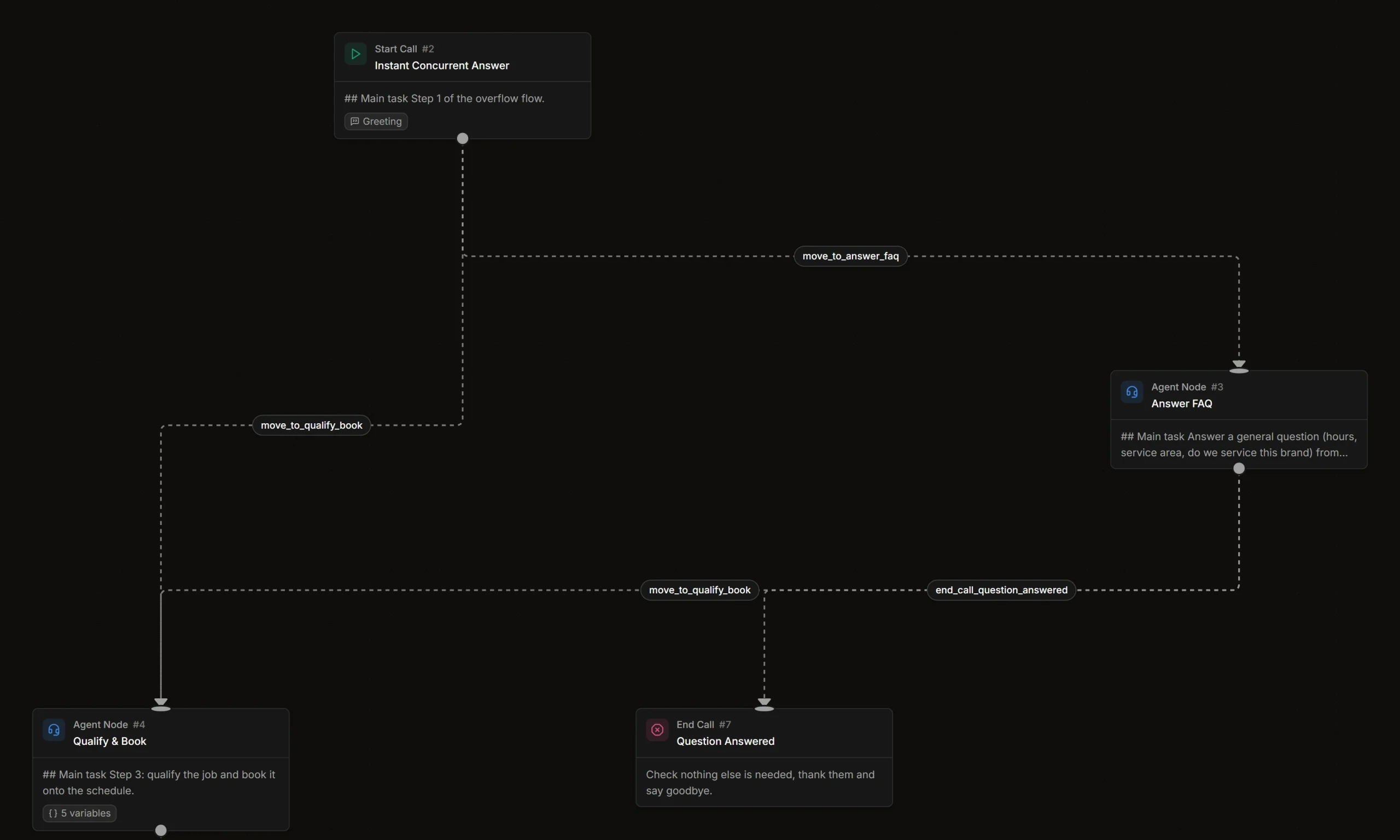
The call moves through the same steps on a quiet Tuesday and on the first day of a heatwave. What changes at peak is how many calls reach the voice agent, and which rules you’ve set for the season.
- Your CSRs Answer First: Your call flow rings your team first. The voice agent takes the call after a ring time you set, when every CSR is busy, or on every call inside the coverage windows you choose, such as after hours and weekends. You can widen those windows for your peak weeks and narrow them again in the off-season.
- Several Calls at Once: The voice agent holds several conversations at the same time, up to your plan’s concurrent-call limit, confirmed during setup. The surge is answered instead of rolling to voicemail or a busy signal.
- Recognize the Caller: With FieldCamp connected, the agent looks up the caller by phone number, so a returning customer or a restaurant account on your route isn’t re-interviewed from scratch.
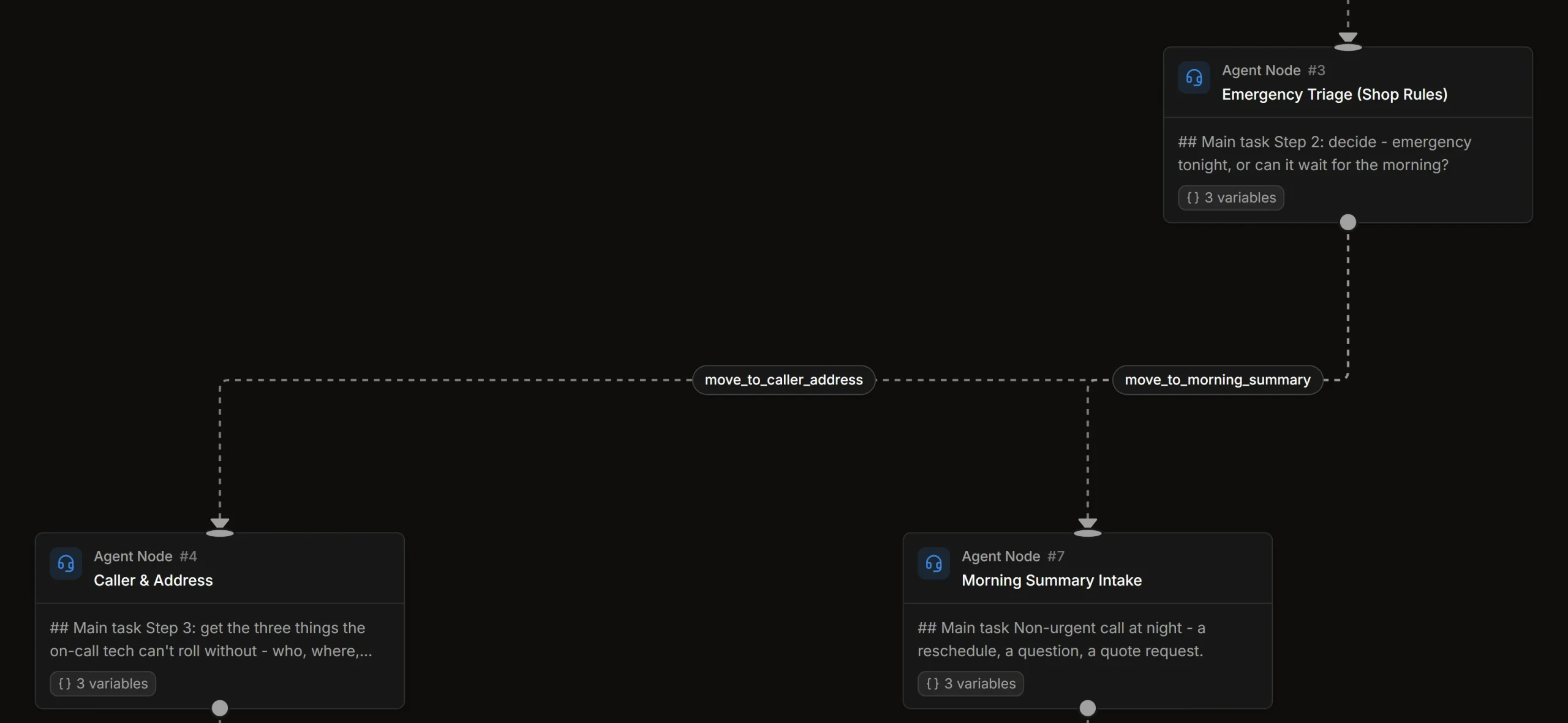
- Triage on Your Rules: Emergency triage on your own rules runs against the definitions your shop writes. FieldCamp ships no emergency definition of its own. If the agent is unsure, the call goes to a person instead of being guessed.
- Book With the Suggested Tech: FieldCamp AI Dispatcher suggests the technician for the job on skills, location, availability, workload and route. The agent offers the window, and books the visit once the caller agrees. It only says “booked” after the booking is confirmed.
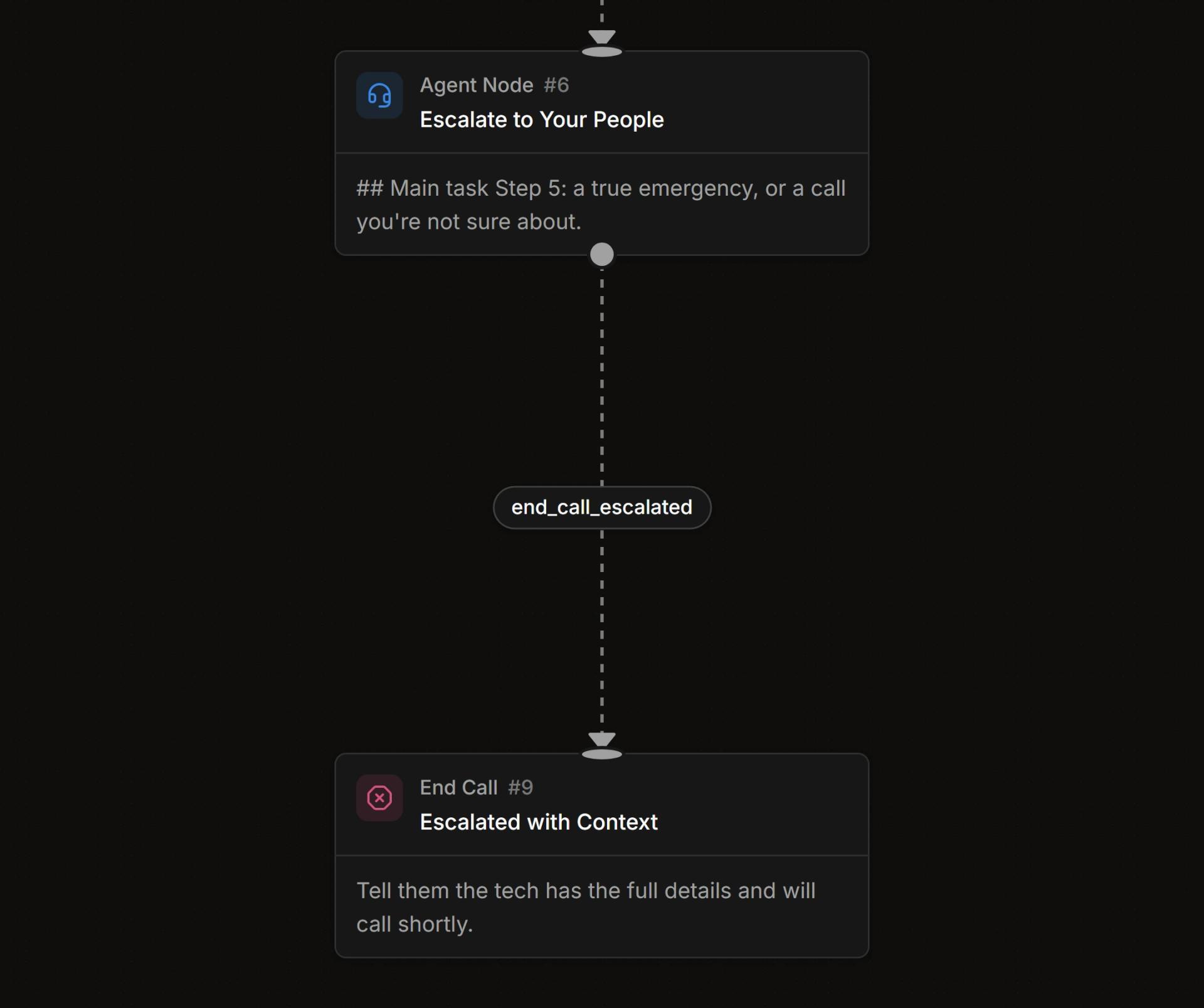
- Hand Off to Your People: True emergencies and anything the agent shouldn’t handle go to your own CSR or on-call tech. Warm transfer, where your team hears a short whisper before picking up, works on Twilio. The transcript and recording stay with the call.
Without AI Dispatcher connected, the agent still answers, triages and captures the caller’s details, then creates a request your team converts into a job. Either way, the morning after a surge starts with work to schedule, not a voicemail box to dig through.
How peak-season coverage differs from everyday overflow
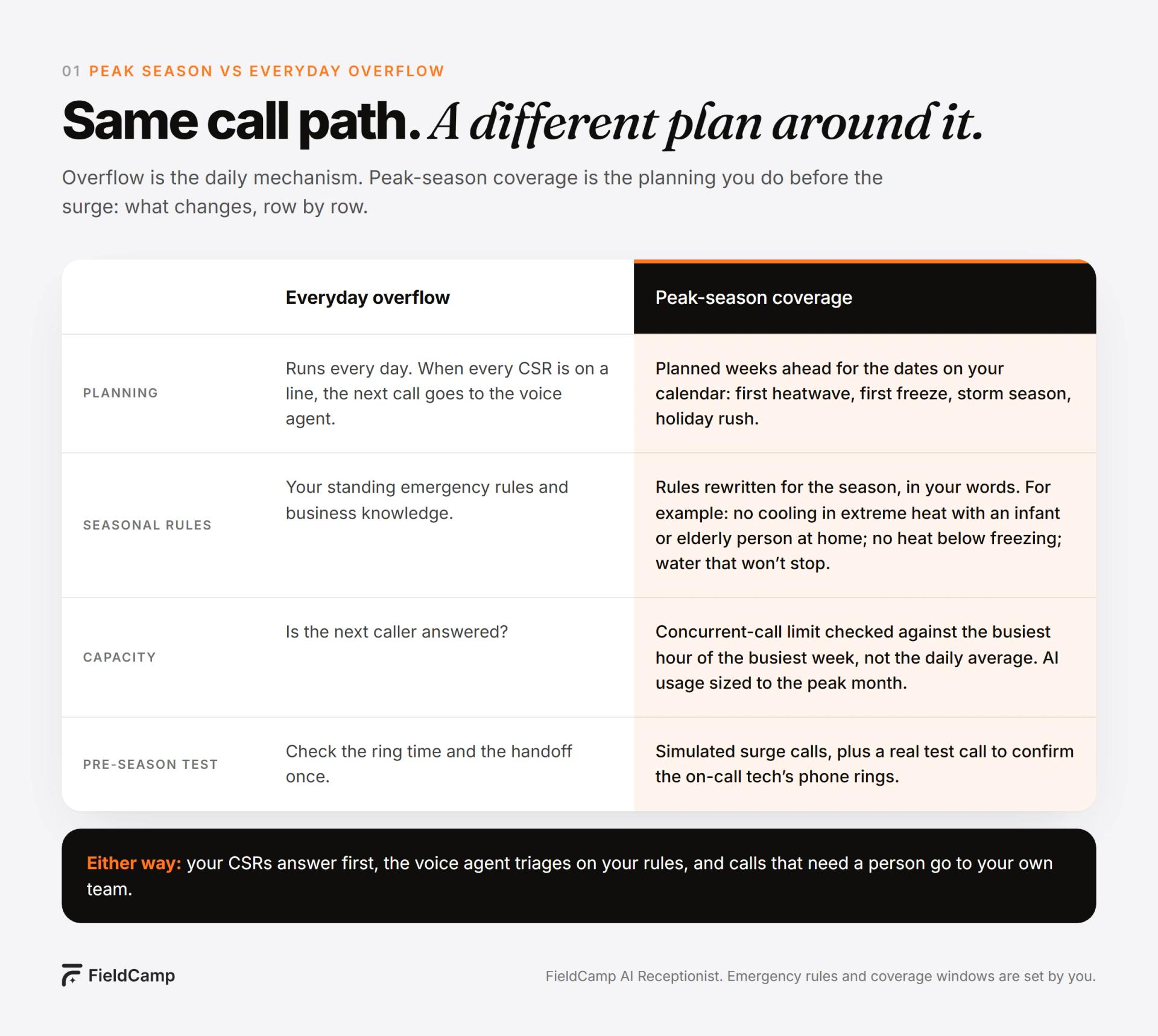
Overflow is what happens on any given day when the line is busy: every CSR is on a call, so the next one goes to the voice agent. The overflow calls guide walks through that path step by step, and CSR-first overflow covers how your team stays in front.
Peak season is a planning problem on top of that. It asks different questions:
- How many at once, at the worst hour? Overflow asks whether the next caller gets answered. Peak season asks whether your concurrent-call limit covers your single busiest hour of the year, not an average Tuesday.
- Which rules change with the weather? A no-cooling call in July and a no-heat call in January are emergencies for some households and routine for others. Your seasonal rules decide which.
- What gets pushed? In a surge, a routine maintenance request is still worth booking, just not into tomorrow’s emergency slots. The agent needs your surge policy in writing.
- Who is on call, week by week? The escalation target for a freeze-week night isn’t always the one from last month.
Before your next peak season: the setup checklist
The first hot day is a bad day to write emergency rules. Do the setup three or four weeks before your first hard week, while the phones are quiet enough to test.
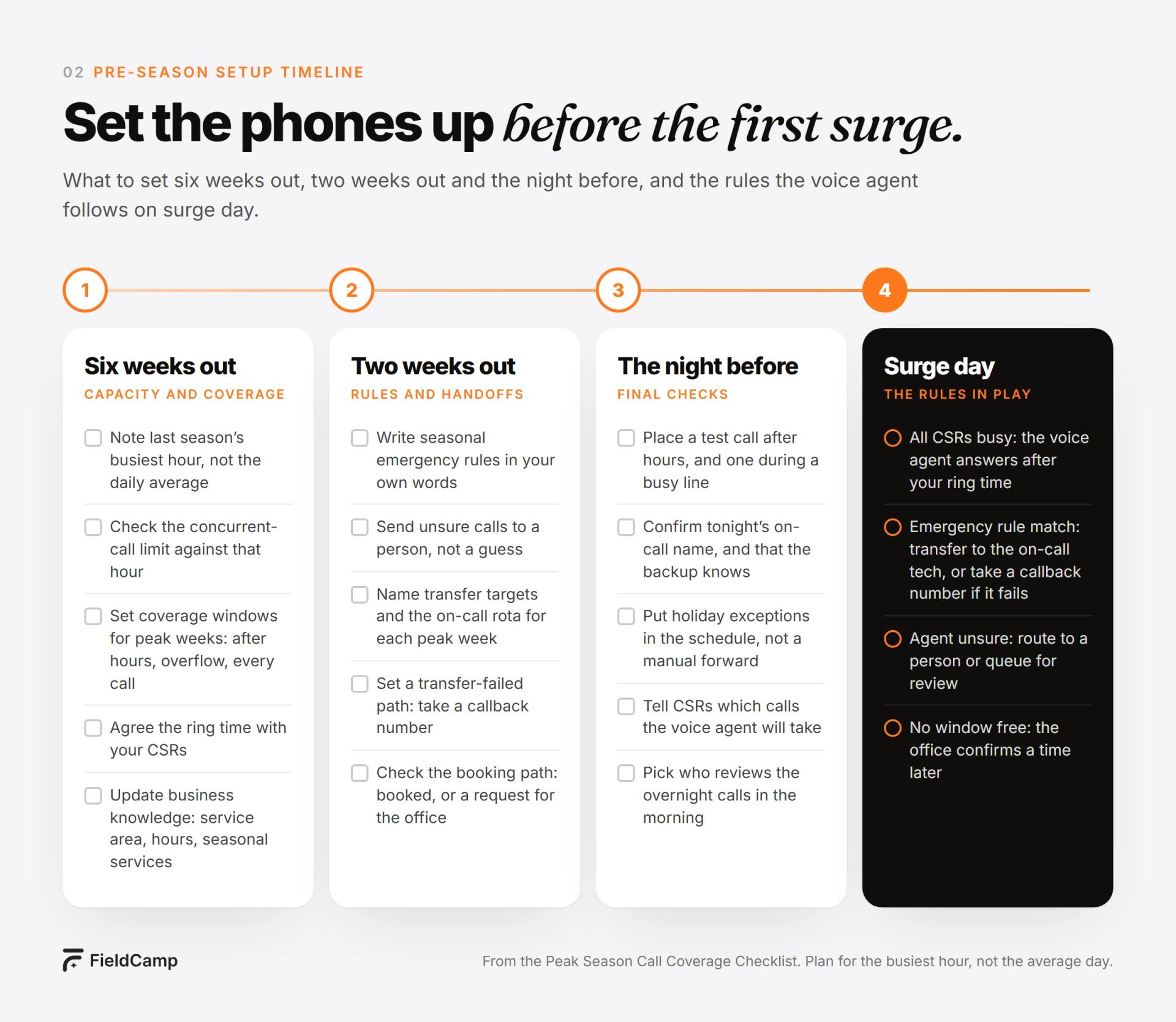
- Pull last year’s worst weeks. From your phone records, find the busiest days and the busiest hour inside them. That hour, not the daily total, is the number your coverage has to fit.
- Check the concurrent-call limit against that hour. Several callers can reach the voice agent at once, up to your plan’s limit. Confirm it during setup, before the season.
- Size AI usage to the peak month. On FieldCamp, AI usage is metered and pauses at the plan limit instead of billing overage. That protects you from a surprise bill, and it also means a plan sized for March won’t carry July.
- Rewrite the emergency rules for the season. The template triggers, such as no heat below freezing or water that won’t stop, are examples to replace. Add the summer ones your shop uses, like no cooling in extreme heat with an elderly person or an infant in the home.
- Load your surge policy as business knowledge. Service area, hours, what you will and won’t quote on the phone, and how you book routine work during a surge. The agent only states what it has been told.
- Set the seasonal coverage windows. For example: overflow only on weekdays, every call on weekends and after hours, for the six weeks your trade runs hardest.
- Confirm the on-call roster and test a real transfer. The browser test doesn’t place real transfers, so call the line yourself and make sure the on-call tech’s phone actually rings.
- Run surge scenarios as simulated tests. An AI plays the caller, such as a panicked burst-pipe call at 2 AM or a routine request in the middle of a surge, and grades the result against your success criteria. Simulated tests use no call minutes.
- Turn on no-booking alerts. You get an email when a voice call ends without a booking, so the calls that slipped through surface the same day.
Mark the surge days before you set the rules
The checklist covers the setup. The Peak-Day Overflow Planner covers the days themselves: mark last season’s surge days, count the calls that rolled to voicemail, and set the rule for when overflow picks up.
Peak-season calls, trade by trade
The steps don’t change between trades. The calls do.
Plumbing: the freeze, and the thaw
At 2 AM in a freeze week, water is coming through a kitchen ceiling. The agent asks one question at a time, follows the safety line your shop wrote into its rules, such as where to find the main shutoff, and puts the call through to the on-call plumber. Two days later the thaw brings a second wave: split lines found under sinks and in crawl spaces. Most of those are urgent but not emergencies, and they’re booked in order instead of stacking up as messages.
HVAC: the first heatwave and the first freeze
It’s 4:40 PM and 97°F outside. Your CSRs are each on a call, and the next caller reaches the voice agent, which asks who is in the home. There’s a 90-year-old parent, and your summer rule makes that a priority call, so it goes straight to a person. The caller after that wants a tune-up. Your surge policy says routine visits go after the heatwave, so the agent books next week’s window once the caller agrees. In November the same pattern runs in reverse, with no-heat calls on your “below freezing” rule. The HVAC AI receptionist page covers trade-specific setup.
Route-based services: the holiday rush and the spring thaw
The week before Christmas, a restaurant on your grease-trap route calls about a slow floor drain ahead of a full weekend. With FieldCamp connected, the agent recognizes the account by its number. AI Dispatcher suggests the truck and the day by route and workload, and the agent books the extra pickup once the manager agrees. A septic company sees the same pattern after the spring thaw and heavy-rain weeks, when backups arrive in clusters.
Peak season call volume after hours: answering the night calls
Peak weeks don’t end at 5 PM. The freeze bursts pipes overnight, and a heatwave evening is when people get home to a hot house. Widen after-hours coverage for those weeks, name the on-call lead for each one, and keep routine night calls booked for the morning instead of waking anyone up. For the overnight path in detail, the next guide in this series covers after-hours triage and handoff.
Run your worst week through FieldCamp before it arrives
We’ll walk a freeze-week or heatwave call through FieldCamp: answered after your CSRs, triaged on your rules, and booked with the tech AI Dispatcher suggests.
Peak season call volume answering service vs. an AI receptionist
Every option below puts someone or something on the phone for the surge. They differ in what has to happen before the season, and in what you’re left with the morning after.
A message to re-key, and capacity that caps in the same storm week your team does.
Several calls at once, up to your plan’s limit, booked with the tech AI Dispatcher suggests.
| Peak-season option | Before the season | What the surge call ends as |
|---|---|---|
| Voicemail | Nothing | A message, or a hang-up |
| Temporary seasonal CSR | Recruit, train and schedule, weeks ahead | A booked job, one call at a time |
| Human answering service | Hand over scripts and on-call numbers | A message to re-key; capacity caps in the same storm week |
| Inbound-only AI receptionist add-on | Turn it on inside your FSM | A booked time slot, no technician suggested |
| FieldCamp AI Receptionist | Seasonal rules, coverage windows, tests | Several calls at once, up to your plan’s limit, booked with the tech AI Dispatcher suggests |
None of these replaces your CSRs. The best peak-season setup keeps them on the calls that need a person, such as upset customers, complex quotes and the second emergency in an hour, and gives the scripted calls somewhere to go besides voicemail. Coverage stays yours: FieldCamp does not staff a call floor, so every escalation reaches your own team.
What an AI receptionist won’t do at peak
Knowing the limits ahead of time is part of planning for the surge.
- It has a concurrent-call limit. Several calls at once is not unlimited. If your busiest hour is bigger than your plan’s limit, callers past it wait like they would for a CSR.
- It won’t make up arrival times or prices. The agent only states what a tool result or your business knowledge tells it.
- It won’t diagnose the equipment. It asks your triage questions and routes the call.
- It won’t reschedule existing visits. When a surge pushes this week’s maintenance calls, moving booked visits is still a job for your CSRs.
- It pauses if AI usage runs out. Usage stops at the plan limit rather than billing overage, so size it to the peak month, not the average one.
Next: Overnight Emergency Calls and the AI Receptionist: How After-Hours Triage and Dispatch Actually Work
The next piece in this series, with its own call flow built in FieldCamp Voice.
Frequently Asked Questions
How many calls can an AI receptionist handle at once during peak season?
As many as your plan’s concurrent-call limit allows, which is confirmed during setup. Several callers can reach the voice agent at the same time, where each CSR can only take one. Check that limit against the busiest hour of your busiest week, not your daily average.
Is an AI receptionist better than a peak season call volume answering service?
For scripted calls, usually. A human answering service caps out in the same storm week your team does and hands you messages to re-key. An AI receptionist takes several calls at once, up to your plan’s limit, and ends them as booked visits. A person is still better for upset customers and complex quotes, which is why your CSRs stay first.
Do I still need temporary seasonal staff if I use an AI receptionist?
It depends on what the extra hire would do. An AI receptionist can take the calls that follow a script, like booking, routine questions and after-hours triage, without recruiting and training someone for eight weeks. It doesn’t replace your CSRs. They stay first, and they keep the calls that need a person.
When should I set up an AI receptionist for peak season?
Three or four weeks before your first hard week. That leaves time to rewrite emergency rules for the season, load your surge policy, run simulated tests of surge calls, and place a real test call to check that transfers reach your on-call tech.
How does after-hours answering change when peak season call volume hits?
Widen the after-hours windows for your hard weeks and name the on-call lead for each one. Emergencies that match your rules, like water that won’t stop in a freeze, go through to the on-call tech with the transcript attached. Routine night calls are booked for the morning instead of waking anyone up.
How is peak-season coverage different from overflow answering?
Overflow answering is the daily mechanism: when every CSR is busy, the next call goes to the voice agent. Peak-season coverage is the plan around it: a concurrent-call limit sized to your busiest hour, seasonal emergency rules, a surge booking policy, wider coverage windows and a confirmed on-call roster for those weeks.
Does an AI receptionist work for route-based services in their busy season?
Yes. Grease-trap, used cooking oil and septic companies have their own peaks, like the holiday restaurant rush or the spring thaw. With FieldCamp connected, the agent recognizes the account by caller ID, and with AI Dispatcher connected, it books an extra pickup on the truck and day AI Dispatcher suggests, once the caller agrees.
What happens if AI usage runs out in the middle of peak season?
On FieldCamp, AI usage pauses at the plan limit instead of billing overage, so the voice agent stops taking calls until more usage is added. Size your plan to your peak month rather than your quiet months, and check the usage balance in the app before the season starts.
Can the AI receptionist reschedule visits a surge pushes back?
No. The voice agent can book new visits and look up existing customers, but it has no tool for moving a visit that’s already booked. When a surge pushes this week’s maintenance calls, rescheduling stays with your CSRs or dispatcher.
Peak Season Call Coverage Checklist, as a printable PDF
Six weeks out, two weeks out and the night before: what to set so the first heatwave, freeze or storm is answered, triaged and booked. Page 2 holds the surge-day rules to keep by the phone. It arrives in your inbox as a PDF.
Plan the peak before the phones start
Your CSRs stay first. FieldCamp AI Receptionist answers the surge up to your plan’s limit, triages on your rules, and books with the technician FieldCamp AI Dispatcher suggests.


