
40+ HVAC Interview Questions Every Hiring Manager and Technician Needs in 2026
March 29, 2026 - 33 min read


March 29, 2026 - 33 min read

Table of Contents
| TL; DR: 16 technical questions with model answers, 12 behavioral questions, a 1–5 scoring rubric (no competitor has one), practical skills assessment ideas, and a 30-60-90 day onboarding plan. Works for both hiring managers and technician candidates. |
The HVAC industry has over 100,000 unfilled technician positions right now. Within five years, that number hits 225,000. Industry data suggests the average construction worker, including HVAC techs, is nearly 43 years old, and surveys consistently show hiring qualified techs ranks as employers’ top operational challenge.
So when you finally get a promising candidate sitting across from you, you cannot afford to wing the interview.
And if you’re the technician walking into that interview? You need to know what separates a forgettable answer from one that gets an offer on the spot.
This guide works both ways. Hiring managers get a complete interview framework with scoring rubrics. Technicians get the exact questions they’ll face and what strong answers look like.
This guide covers 40+ questions across 5 categories. If you want a quick shortlist for the specific role you’re hiring for, let AI pick the right ones for you.
KEY HIGHLIGHTS
HVAC Interview Questions
Most HVAC shops still interview the same way: the owner or service manager sits down, asks a few random questions, maybe has the candidate look at a unit outside, and goes with gut feel.
That approach has a validity score of .20, barely better than flipping a coin.
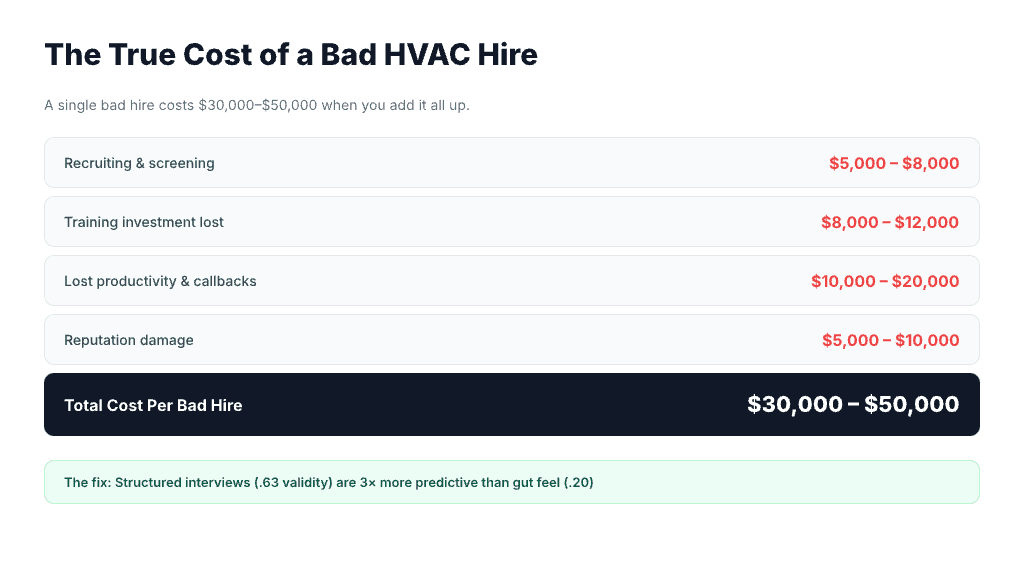
Structured interviews, where every candidate gets the same questions, scored against the same rubric, have a validity score of .63. That is more than twice as predictive of actual job performance.
With HVAC technician salaries ranging from $54,100 at the entry level to $90,800 for supervisors, a bad hire can easily cost you $30,000 to $50,000 when you factor in recruiting, training, lost productivity, and the hit to your profit margins.
The technician shortage is not slowing down. Approximately 42,500 positions are open annually, and roughly 40% of technicians leave their current employer due to a lack of career development, not money.
That means your interview process is also your first chance to show a candidate that your shop is different.
Here is the complete playbook.
Before diving into questions, here is the interview structure that top-performing HVAC companies use:
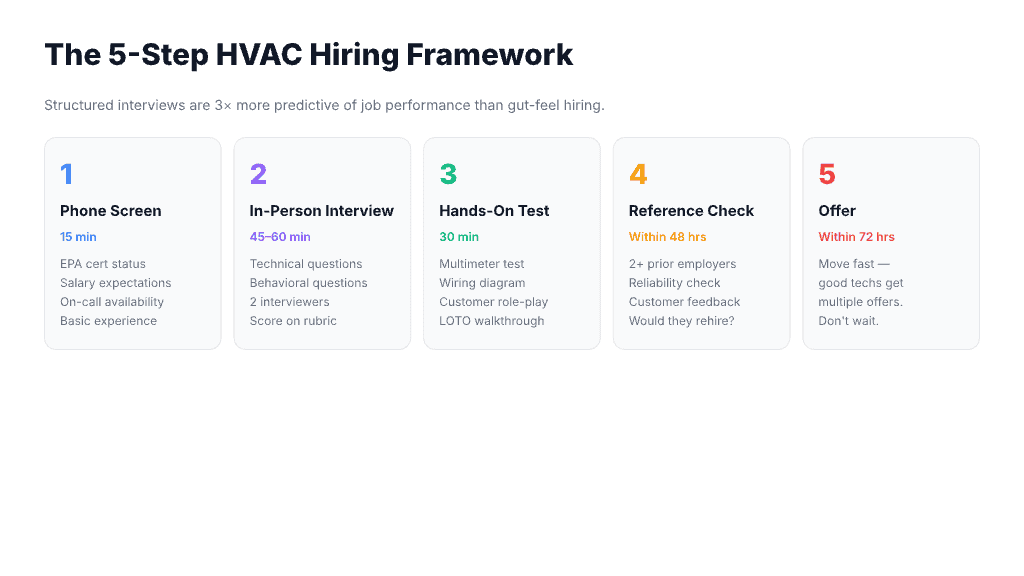
This filters out candidates who clearly are not a fit before you invest real time. Confirm EPA certification status, availability for on-call, salary expectations, and basic experience level.
If they cannot articulate why they want to work in HVAC or have zero relevant experience with no plan to get trained, stop here.
This is where you use the technical and behavioral questions below. Have at least two people in the room, the service manager and a senior technician, if possible.
One asks questions, the other scores on the rubric.
Hands-on testing is non-negotiable. More on this below.
Call at least two previous employers. Ask specifically about reliability, customer interactions, and whether they would rehire.
Move fast. Good technicians get multiple offers. If you wait a week to extend an offer, someone else already did.
These are the questions that separate technicians who actually understand systems from those who have been guessing their way through service calls.
For hiring managers, model answers are included so you know what to listen for, even if your background is not technical.
What a strong answer includes: Four components in order: compressor takes low-pressure gas and converts it to high-pressure gas. The condenser releases heat, and the gas becomes liquid. The expansion valve drops the pressure. The evaporator absorbs heat, and the liquid becomes a gas again. The cycle repeats.
Red flag: If a candidate with more than a year of experience cannot explain this clearly, that is a fundamental knowledge gap. This is HVAC 101.
Strong answer: Superheat is the temperature above the boiling point at the evaporator. It protects the compressor from liquid slugging. Subcooling is the temperature below the condensing point at the condenser. It ensures liquid refrigerant reaches the metering device. Both readings indicate whether the system has a proper refrigerant charge.
What to listen for: Candidates who can connect these measurements to diagnostic decisions, not just recite definitions.
Strong answer: Systematic approach starting simple, verify thermostat settings, check the air filter, confirm the breaker is on. Then move to the outdoor unit. Is the condenser fan running, is the compressor operating? Check refrigerant pressures. Inspect coils for dirt or ice. Verify airflow.
Red flag: A technician who jumps straight to “probably needs refrigerant” without checking the basics first. That approach costs your company money and frustrates customers.
Strong answer: Multiple methods depending on the situation, an electronic leak detector for pinpointing, a UV dye for slow leaks, soap bubbles for confirmation at specific joints, and a nitrogen pressure test for system-wide verification.
Common leak locations include Schrader valves, flare fittings, coil joints, and TXV connections.
Strong answer: Manual J load calculation considering square footage, insulation values, window type and orientation, climate zone, and occupancy. The candidate should specifically reject the “500 square feet per ton” rule of thumb, which leads to oversized systems, short cycling, humidity problems, and callbacks.
If you want deeper context on Manual J and why it matters, this ties directly into how to become an HVAC technician. Proper load calculations are a skill that separates trained professionals from handymen.
Strong answer: Sizing verification against the load calculation, gas line sizing to handle BTU requirements, PVC venting (high-efficiency units produce condensate that would destroy metal venting), condensate drain with trap, electrical connections, combustion air verification, startup procedures, and combustion analysis to confirm safe operation.
Strong answer: Measure airflow at each register, adjust dampers to distribute air according to the design, check static pressure in the ductwork, verify design CFM is being achieved, and measure temperature differential across the coil.
There are online free tools that would help with understanding air changes per hour.
Strong answer: Single-stage runs at full capacity or off: least efficient, most temperature swing. The two-stage system has high and low settings, better comfort, and better efficiency. Variable-speed modulates capacity continuously: best comfort, best efficiency, highest equipment cost. The candidate should be able to explain when each makes sense for different customers and budgets.
Strong answer: Lock-out/tag-out procedures, verify zero energy state before touching anything, proper PPE, meter testing to confirm power is actually off (not just trusting the breaker), and awareness of NEC requirements.
Red flag: Any hesitation or vagueness on electrical safety is a serious concern. This is life-and-death territory.
Strong answer: Understanding the difference between schematic and ladder diagrams. Ability to identify key components: contactors, relays, transformers, and capacitors. Can trace circuits through a diagram and understand standard color codes.
Practical tip for hiring managers: Hand them an actual wiring diagram during the interview. Their comfort level holding it tells you more than their verbal answer.
Strong answer: R-22 is fully phased out. R-410A is being phased down under the AIM Act. R-454B is the next-generation residential refrigerant. R-32 is gaining ground in heat pump applications.
Both R-454B and R-32 carry A2L classification (mildly flammable), which requires updated safety training and handling procedures.
Why this matters: A technician who is not tracking the HFC phasedown will be unable to service newer equipment within the next few years. This question reveals whether they invest in staying current.
Strong answer: Acid test the oil to confirm burnout. Install a filter-drier (often oversized) to capture contaminants. Triple evacuation to remove moisture and acid. Investigate the electrical cause of the burnout; do not just replace the compressor and walk away. Verify the oil charge in the new compressor.
Strong answer: A TXV (thermostatic expansion valve) modulates refrigerant flow based on superheat, adjusting to varying conditions. A piston is a fixed opening that provides a set amount of restriction. TXV provides better performance across a range of conditions but costs more. The candidate should know when each is appropriate.
Strong answer: Static pressure is resistance to airflow in the duct system, measured in inches of water column (iwc). High static pressure means restricted airflow, which reduces system efficiency, shortens equipment life, and causes comfort complaints. The target for most residential systems is around 0.5 iwc.
Strong answer: International Mechanical Code (IMC), International Residential Code (IRC), local amendments that may be more restrictive, EPA regulations for refrigerant handling, NFPA 54/IFGC for gas piping, NEC for electrical work, and permit requirements. The key is knowing that local codes take precedence and checking before starting work.
Strong answer: Using a combustion analyzer to measure CO, CO2, O2, and stack temperature, then calculating combustion efficiency. Compare readings to manufacturer specifications. This is performed during furnace startup, annual maintenance, and anytime a heat exchanger issue is suspected. Abnormal CO readings indicate potential heat exchanger cracks, a safety hazard.
Technical knowledge gets a technician through the service call. Behavioral skills determine whether customers request them by name or call to complain.
With 480,000+ skilled trade jobs unfilled, you can teach technical skills to a motivated person, but you cannot teach someone to care about the customer in their living room.
What this reveals: Conflict resolution ability. Listen for the candidate taking ownership rather than blaming the customer, dispatch, or someone else. Strong candidates describe specific actions they took, not just “I calmed them down.”
What this reveals: Problem-solving and communication skills. Did they improvise a temporary fix and communicate a return visit? Did they call the shop for support? Or did they just tell the customer, “I’ll have to come back” and leave?
What this reveals: Safety commitment when nobody is watching. The best answer describes a specific situation where cutting a corner would have been easy and tempting, but they chose the safe route anyway.
What this reveals: De-escalation skills. The answer should focus on acknowledging the customer’s frustration first, not launching into excuses. Explaining the situation comes after the customer feels heard. This is where great technicians separate from average ones.
What this reveals: Financial communication skills. Technicians represent your company’s pricing on-site. Strong candidates explain charges clearly, connect costs to value, and involve the office when needed. Weak candidates either cave on pricing or get confrontational.
Reassurance goes a long way. By sharing the process via documentation management software and letting them know what has been cooking.
What this reveals: Adaptability and learning approach. Did they research it, call a colleague, contact the manufacturer’s tech support? Or did they wing it and hope for the best? In 2026, with new equipment entering the market constantly, this scenario happens regularly.
What this reveals: Integrity and code compliance. The correct answer is always that they reported it, documented it, and informed the customer, even when that made the job more complicated or expensive.
What this reveals: Continuous learning mindset. Look for specific answers: manufacturer training, trade publications, YouTube channels from credible sources, NATE certification, and supply house seminars. Vague answers like “I just pick things up” suggest someone who has stopped growing.
What this reveals: Technical depth and persistence. The best stories involve systematic troubleshooting, not lucky guesses. Listen to how they describe the process of elimination.
What this reveals: Whether they care about the customer beyond the scope of the service call. Carbon monoxide from a water heater, exposed electrical, and a gas smell from a stove, great technicians mention these things even when it is not their job.
What this reveals: Teamwork and conflict management. Especially relevant for two-person install crews. Listen for mutual respect and willingness to find the right answer rather than win the argument.
What this reveals: Professional integrity and boundary-setting. The only acceptable answer is declining to violate code, explaining why the code exists (safety), and offering a compliant alternative. Any flexibility on this point is a disqualifier.
Not every hire needs ten years of experience. With the technician shortage projected to hit 225,000 vacant positions within five years, smart shops are hiring for attitude and training for skill. These questions help you evaluate candidates who are new to the trade.
1. Why Did You Choose HVAC as a Career?
Listen for genuine interest in the trade, not just “it pays well.” Candidates who mention liking hands-on work, solving problems, or helping people tend to stick around longer. Remember, 40% of technicians leave due to a lack of career development, so finding people who actually want to be here matters.
2. What Mechanical or Hands-On Experience Do You Have – Even Outside of HVAC?
Auto repair, plumbing, electrical work, and even building computers. Mechanical aptitude transfers across trades. Someone who rebuilt a transmission can learn to braze copper.
3. Are You Comfortable Working in Attics, Crawl Spaces, and Outdoor Weather Conditions?
This is not a trick question. Some people genuinely do not know what the physical environment looks like. Better to find out now than on their first 130-degree attic call in July.
4. This Job Involves Lifting Equipment, Climbing Ladders, and Working on Your Feet All Day. Are You Prepared for That?
Be direct about physical demands. Document that you asked, and the candidate confirmed. This protects both parties.
5. Can You Explain the Basic Refrigeration Cycle?
Even entry-level candidates who completed trade school or a vocational program should know this. If they cannot explain it at all, they may not have done any preparation for this career.
6. Are You Willing to Be On-Call?
On-call is a reality of HVAC work. Asking upfront avoids a conflict three months in.
7. Do You Have Your EPA 608 Certification, or What Is Your Plan to Get It?
Having it is great. Having a plan to get it is acceptable. Not knowing what it is? That is a red flag for someone claiming to want an HVAC career. For context on what certifications and licenses matter by state, see our HVAC license requirements guide.
Senior technicians and supervisors do more than fix equipment. They train the next generation, manage callbacks, and handle the jobs that stump everyone else. These questions go beyond technical knowledge.
1. How Do You Approach Training an Apprentice or Junior Technician?
The best senior technicians can teach. Listen for patience, structured mentoring (not just “watch and learn”), and genuine interest in developing others. With the average tech age at 43, your senior people need to be transferring knowledge now.
2. What Experience Do You Have With Building Automation Systems (BAS)?
For commercial work, BAS experience is increasingly non-negotiable. Even residential-focused seniors should have familiarity with smart thermostats, zoning controls, and integration with home automation.
3. Describe Your Process for Handling Warranty Callbacks
Callbacks cost money twice: the return trip and the reputation damage. Strong candidates describe a root-cause analysis approach: why did the original repair fail, what needs to change in the process, and how do they communicate with the customer to preserve trust?
4. Walk Me Through a Complex Multi-System Troubleshooting Scenario You’ve Solved
This is the senior-level version of “hardest repair.” Listen for interactions between systems, how the ductwork affects the equipment, how electrical issues masquerade as mechanical ones, and how building envelope problems create symptoms that look like equipment failure.
5. How Do You Approach Upselling Maintenance Agreements to Existing Customers?
This is not about being pushy. Strong candidates frame maintenance agreements as genuine value, catching problems before they become emergency calls, extending equipment life, and prioritizing scheduling. The best technicians sell maintenance agreements because they have seen what happens to systems without them.
This section is for technicians. The interview goes both ways. These questions help you evaluate whether this company deserves your skills, especially in 2026 when you have options.
1. What Field Service Management Software Do You Use?
A company running on paper tickets and whiteboards in 2026 is telling you something about how they invest in their operations. Modern shops use AI-powered scheduling software and AI dispatching software. If they are still doing things manually, ask why.
2. Do You Offer Certification Reimbursement?
NATE certification, manufacturer training, and EPA renewable, these cost money. Companies that invest in your credentials are investing in keeping you.
3. What Does the On-Call Rotation Look Like, and How Is It Compensated?
On-call is expected. On-call without fair compensation is exploitation. Get the specifics: how many nights per month, weekend frequency, and guaranteed minimum pay per call.
4. What Is the Average Tenure of Your Technicians?
If nobody sticks around longer than a year, that tells you everything you need to know. High turnover is the biggest red flag in HVAC hiring. Ask directly.
5. Is a Company Vehicle Provided, or Is There a Vehicle Allowance?
This affects your take-home pay significantly. A company truck with a fuel card is typically worth $8,000–$12,000 per year.
6. What Does Career Advancement Look Like Here?
Can you move to senior tech, lead, supervisor, or service manager? Or is the only path “keep running calls until you retire”? Remember that 40% turnover stat, lack of career development is the number one reason technicians leave.
7. Is There a Tool Allowance or Tool Replacement Program?
Your tools are your livelihood. Companies that expect you to fund thousands in specialty tools with no support are shifting business costs onto you.
8. How Is Dispatching Handled?
Efficient dispatching means less windshield time and more productive calls. Ask whether they use software or a whiteboard, whether routes are optimized, and whether you have input on your schedule.
9. What Benefits Are Offered – Health Insurance, Retirement, PTO?
Do not assume. Get specifics on what is offered, what the company pays versus what comes out of your check, and when benefits start.
10. What Is Your Callback Rate?
A company that tracks callbacks is a company that cares about quality. If they do not know their callback rate, they are not measuring what matters.
Here is where most HVAC companies fail the interview process. They ask decent questions but have no consistent way to evaluate answers.
Two managers interview the same candidate and walk away with completely different impressions because they were each listening for different things.
This scoring rubric fixes that. Rate every candidate on each category using a 1–5 scale. Compare scores across candidates. Make hiring decisions based on data, not gut feel.
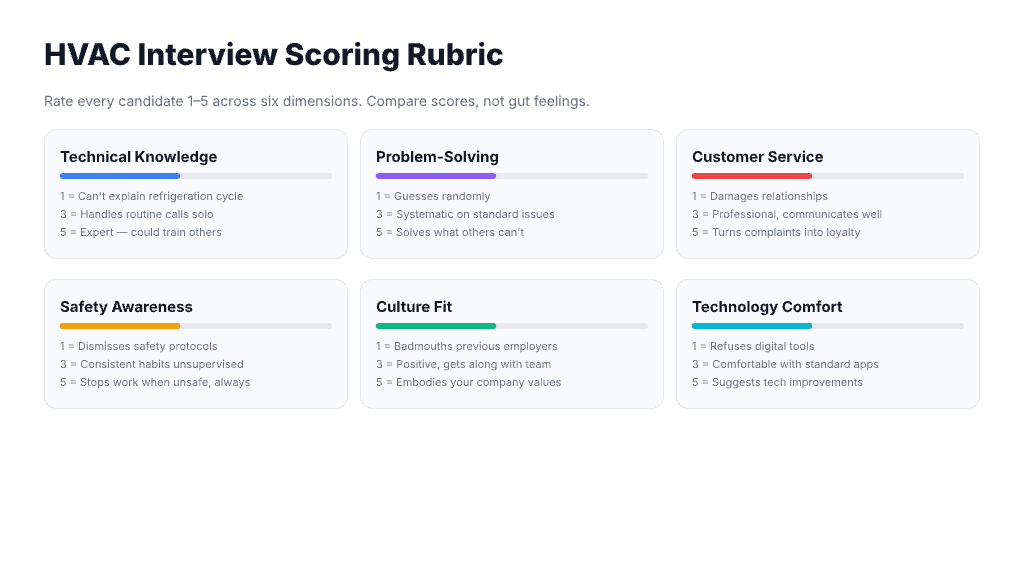
Technical Knowledge (1–5)
Problem-Solving (1–5)
Customer Service (1–5)
Safety Awareness (1–5)
Culture Fit (1–5)
Technology Comfort (1–5)
Print one rubric per candidate per interviewer. Each interviewer scores independently and does not compare notes during the interview. After all candidates are evaluated, compare total scores. Weight categories based on the role: entry-level hires can score lower on Technical Knowledge if they are strong on Culture Fit and Safety Awareness.
A minimum threshold of 3 across all categories is reasonable for mid-level hires. Senior candidates should average 4 or above.
Verbal interviews only tell you what a candidate knows in theory. A 30-minute practical assessment tells you what they can actually do.
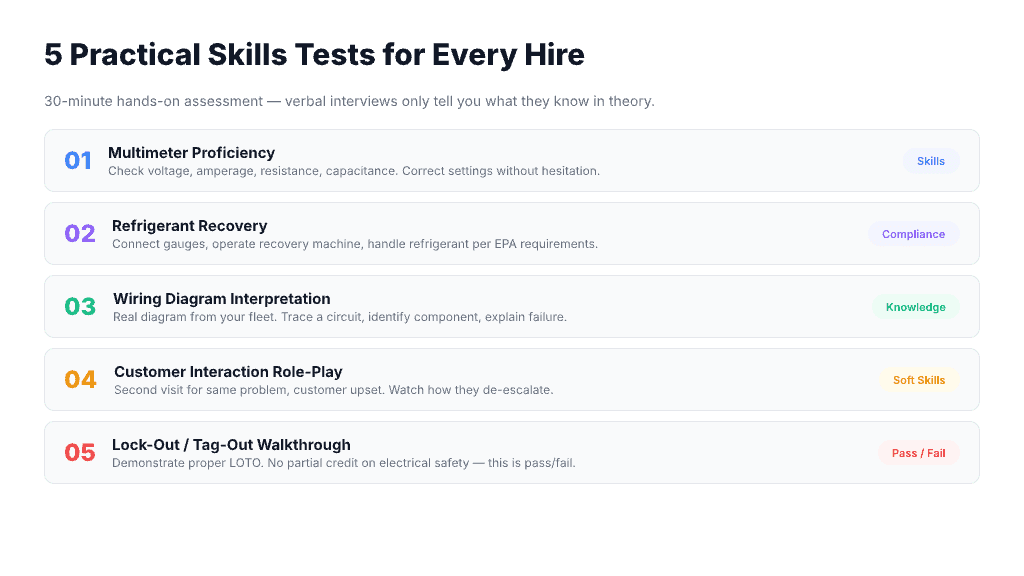
Multimeter Proficiency Test
Hand them a multimeter and ask them to check voltage, amperage, resistance, and capacitance on a piece of equipment. Watch their comfort level. Do they select the correct settings without hesitation? Do they observe electrical safety?
Refrigerant Recovery Demonstration
Set up a recovery scenario. Can they connect gauges properly, operate the recovery machine, and handle refrigerant according to EPA requirements? This is both a skills test and a compliance test.
Wiring Diagram Interpretation
Give them an actual wiring diagram from a unit you service. Ask them to trace a circuit, identify a specific component, and explain what would happen if that component failed. This separates technicians who understand electrical theory from those who just swap parts.
Customer Interaction Role-Play
Have someone play a frustrated homeowner. The scenario: it is the second visit for the same problem, and the customer is upset. Watch how the candidate listens, acknowledges the frustration, and communicates the plan. Technical skills mean nothing if the technician alienates customers. (For ready-made scripts your team can train with, see our HVAC phone scripts guide.)
Lock-Out/Tag-Out Walkthrough
Ask them to demonstrate proper LOTO procedure on a piece of equipment. This is pass/fail; either they do it correctly, or they do not. There is no partial credit for electrical safety.
Hiring the right person is half the job. Keeping them requires a structured onboarding plan. This is especially critical given the 40% turnover rate driven by a lack of career development. Show new hires from day one that you invest in your people.
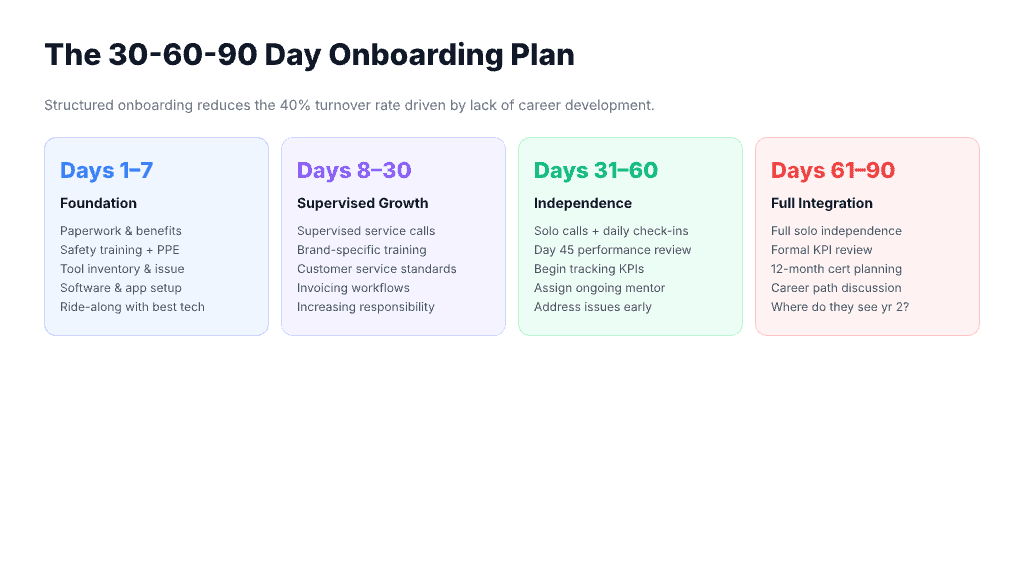
Companies that run a structured 30-60-90 onboarding plan see measurably lower turnover. Technicians who feel supported and see a path forward stay longer. Is it that straightforward?
Running a structured hiring process is only half the battle; you need to actually use it on every interview, with every candidate. We built a print-ready checklist that covers the full process: pre-interview prep, phone screen, in-person questions, practical assessment, red flags, and the 30-60-90 day onboarding plan.
Take it into every interview. Hand it to your service manager. Pin it in the break room.
Download the Free HVAC Hiring Checklist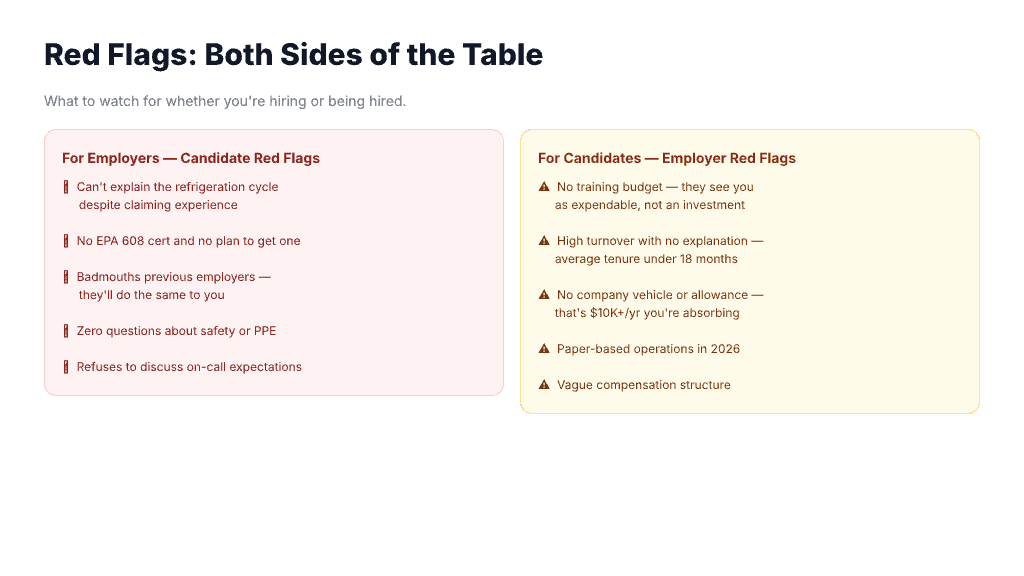
Cannot explain the refrigeration cycle. If someone claims experience and cannot walk through the basic four-step cycle, their resume may not be accurate.
No EPA 608 certification and no plan to get one. This is a legal requirement for handling refrigerants. Not having it is understandable for true entry-level candidates. Not having a plan to get it is a problem.
Badmouths previous employers. Every company has problems. A candidate who spends interview time trashing their last shop will trash yours too, and they will do it to your customers.
Asks zero questions about safety. A technician who does not ask about safety protocols, PPE, or how your company handles hazardous situations either does not care about safety or has never worked somewhere that did.
Refuses to discuss on-call expectations. On-call is part of HVAC. A candidate who will not engage with this topic is setting up a conflict that will surface within months.
No training budget. If the company will not invest in your growth, they see you as expendable. In a market with 110,000 open positions, you deserve better.
They cannot explain the high turnover. Ask about average tenure. If they dodge the question or the answer is under 18 months, there is a reason people leave.
No company vehicle and no vehicle allowance. Running your personal truck can easily run to $10,000+ per year in fuel, maintenance, and depreciation. A company that expects you to absorb that cost is underpaying you by that amount.
Paper-based operations in 2026. Companies still running on clipboards, paper invoices, and whiteboard scheduling are behind. And that inefficiency hits your productivity and earnings.
Modern HVAC operations use field service management tools like FieldCamp to handle scheduling, dispatching, invoicing, and customer management so technicians spend time on service calls instead of paperwork.
Vague compensation structure. “We’ll figure out your pay after 90 days,” or “it depends on how things go,” is not a compensation plan. Get specific numbers for base pay, overtime rates, on-call compensation, bonuses, and spiff programs before you accept.
Here is the condensed version for hiring managers who want to implement this immediately:
Before the interview:
During the phone screen (15 minutes):
During the in-person interview (45–60 minutes):
During the practical assessment (30 minutes):
After the interview:
Your Next HVAC Hire Is Already Interviewing Somewhere Else
With 110,000 unfilled positions and 42,500 new openings every year, the technicians you want are not sitting around waiting for your call. They are interviewing at two or three other shops this week.
The companies that win the hiring race are the ones with a real process — structured interviews, scoring rubrics, practical assessments, and an onboarding plan that shows new hires they made the right choice. Everything in this guide is designed to make your shop that company.
Start with the refrigeration cycle; it is the single best screening question for technical competence. Then ask about troubleshooting methodology (systematic vs. random), safety practices (specifically LOTO), and a behavioral question about handling angry customers. These four questions alone will tell you more about a candidate than 30 minutes of unstructured conversation.
Three stages work best: a 15-minute phone screen, a 45–60-minute in-person interview, and a 30-minute practical assessment. Some companies combine the in-person interview and practical test into one visit to respect the candidate’s time. Do not drag it past three stages; good technicians have other offers and will not wait through a five-round process.
Yes. A practical skills assessment is non-negotiable for any technician hire. Verbal interviews measure what someone knows in theory. Practical tests measure what they can actually do. At a minimum, have them demonstrate multimeter use, wiring diagram interpretation, and proper lockout/tagout procedure.
EPA 608 Universal is the baseline; it is legally required for anyone handling refrigerants. NATE certification demonstrates verified knowledge across specific system types. OSHA 10 or 30 shows formal safety training. For commercial roles, look for manufacturer-specific certifications on the brands you service. R-410A safety certification matters now, and A2L refrigerant training (R-454B, R-32) will be increasingly important in 2026 and beyond.
Focus on mechanical aptitude, attitude, physical readiness, and learning potential rather than technical knowledge. Ask about hands-on experience in any context — auto repair, construction, electrical work. Evaluate their understanding of the basic refrigeration cycle (trade school graduates should know this). Score heavily on culture fit, safety awareness, and technology comfort. The technical knowledge will come with training and experience.
The median HVAC technician salary is $59,810 per year nationally. Entry-level positions start around $54,100. Mid-level techs with 5+ years earn approximately $65,700. Senior technicians command around $77,200, and supervisors average $90,800. The full range runs from $39,130 to $91,020, depending on location, specialization, and experience. Top-paying states include Alaska ($85,000+), Massachusetts, and New Jersey. If your offer is below the median for your area, expect to lose candidates to competitors.
Run a structured 30-60-90-day onboarding program. Provide a clear career advancement path. Invest in ongoing training and certification. Pay competitively and be transparent about compensation. Use modern tools instead of paper-based systems. And most importantly, ask your existing technicians why they stay and why they have considered leaving. The 40% turnover rate in HVAC is driven primarily by lack of career development, not compensation.