
HVAC Maintenance Plan 2026 | Free Calculator + PDF
March 16, 2026 - 30 min read


March 16, 2026 - 30 min read

Table of Contents
| TL;DR: HVAC maintenance plans are annual service agreements, typically two tune-ups per year, that keep systems running safely, cut energy bills by 15–25%, and extend equipment life by 5–8 years. For homeowners, a $150–$250/year plan can prevent a single $300–$2,500 breakdown. For HVAC businesses, maintenance agreements are the fastest path to predictable recurring revenue, higher retention, and more repair work from customers who already trust you. |
A single skipped tune-up doesn’t seem like a big deal, until a cracked heat exchanger floods the house with carbon monoxide in January, or a seized compressor turns a $150 service call into a $2,500 replacement in July.
HVAC maintenance plans exist to prevent exactly those scenarios. For homeowners, they keep systems running safely, efficiently, and under warranty. For HVAC business owners, they’re the single most reliable source of recurring revenue you’ll ever build.
Whether you’re a homeowner deciding if a maintenance plan is worth the money or an HVAC contractor looking to create, price, and sell maintenance agreements, this guide covers both sides completely.
This guide is detailed, over 5,000 words covering costs, checklists, and business strategies. If you’d rather get a quick recommendation based on your specific situation, let AI break it down for you.
KEY HIGHLIGHTS
HVAC Dispatching Tips
An HVAC maintenance plan is a service agreement between a homeowner and an HVAC company that covers scheduled preventive maintenance visits, typically two per year. You get one tune-up in the spring to prepare the air conditioning for summer, and one in the fall to prepare the heating system for winter.
Most plans also include perks beyond the tune-ups themselves: priority scheduling during peak season, discounts on repairs (usually 10–20%), waived diagnostic fees, and sometimes parts coverage.
People use different names for these: HVAC service plans, maintenance agreements, preventive maintenance contracts, service level agreements, but they all describe the same thing: a commitment to keeping your HVAC system maintained in exchange for a flat annual or monthly fee.
Here’s how a maintenance plan differs from the other “protection” products homeowners encounter:
| Maintenance Plan | Home Warranty | Equipment Warranty | |
| What it covers | Scheduled tune-ups + discounts | Repair/replacement of covered systems | Defects in manufacturing |
| Who provides it | Your HVAC company | Third-party warranty company | Equipment manufacturer |
| Typical cost | $120–$300/year | $300–$600/year | Included with purchase |
| Prevents breakdowns? | Yes (proactive) | No (reactive) | No (reactive) |
| Repair discounts? | Yes (10–20%) | Covers repairs (with deductible) | Parts only (labor extra) |
| Requires maintenance? | — | Usually yes | Almost always yes |
For HVAC businesses, creating professional service agreements is easier when your invoicing supports recurring billing. Here’s a free HVAC invoice template you can use as a starting point.
The specific tasks vary by company, but a thorough preventive maintenance plan should cover everything below. This is what separates a real maintenance visit from a quick filter swap.
Before the cooling season, your technician should complete all 15 of these items:
Want to show customers what energy savings a higher-SEER system could deliver? Use our free SEER Energy Savings Calculator to show them the math.
Before heating season, the focus shifts to combustion safety and heat delivery:
HVAC businesses can digitize these checklists so technicians complete every item on a tablet in the field — no clipboards, no missed steps, and a digital record for every visit.
For homeowners: Keep a printed copy of your HVAC system records. When your technician arrives for a tune-up, you’ll know exactly what they should be checking, and you can ask informed questions about anything they skip.
For HVAC business owners: Load these items into your field service software as digital checklists. Standardized checklists ensure consistent service quality across all technicians, reduce callbacks, and give you documentation if a warranty claim or liability question ever comes up. You can also customize checklists per plan tier. Basic plans get the core 10 items, Premium plans get all 15/12.
We have covered this checklist in a PDF, so you can bookmark it.
Most residential plans fall between $120 and $400 per year, depending on what’s included. Here’s a typical breakdown:
| Plan Tier | Annual Cost | Monthly | What’s Included |
| Basic | $120–$150 | $10–$13 | 1 tune-up/year, filter replacement, 10% repair discount |
| Standard | $150–$250 | $13–$21 | 2 tune-ups/year (spring + fall), filter, 15% repair discount, priority scheduling |
| Premium | $250–$400 | $21–$34 | 2 tune-ups + 1 emergency visit, filter, 20% repair discount, priority scheduling, parts coverage on select components |
Several factors affect where you’ll land in these ranges:
Here’s the math that makes plans worthwhile: a standard plan costs roughly $150–$250/year. An average emergency HVAC repair runs $300–$600. A compressor replacement? $1,500–$2,500. A full system replacement? $5,000–$12,000.
Regular maintenance doesn’t just prevent those bills; it lowers your monthly energy costs, too. Well-maintained HVAC systems run 15–25% more efficiently than neglected ones. On a $200/month utility bill, that’s $360–$600/year in savings alone, often more than double the plan cost.
For HVAC businesses figuring out how to price labor into their plans profitably, our free labor cost calculator helps you dial in your actual per-visit cost so you’re not guessing.
Answer 3 quick questions to get your personalized estimate
1 tune-up/year, filter, 10% repair discount
Newer systems need minimal maintenance.
Yes, for most homeowners and for virtually every HVAC business.
Here’s the ROI math for homeowners. A standard plan costs $200/year. In return, you get:
The only scenario where a plan might not make sense: brand-new equipment still under a comprehensive manufacturer warranty with a homeowner who’s disciplined enough to schedule and pay for tune-ups independently. But even then, the repair discounts and priority scheduling usually justify the cost within the first year.
Need to estimate what an HVAC system replacement might cost? Our detailed HVAC pricing guide breaks down every cost category.
This is a simple formula HVAC professionals use to help homeowners decide between repairing and replacing their system:
Multiply the system’s age (in years) by the repair cost. If the result exceeds $5,000, replace the system instead of repairing it.
For example:
| Scenario | Calculation | Decision |
| 8-year-old system, $400 repair | 8 × $400 = $3,200 | ✅ Repair |
| 12-year-old system, $500 repair | 12 × $500 = $6,000 | ❌ Replace |
| 15-year-old system, $350 repair | 15 × $350 = $5,250 | ❌ Replace |
This is where maintenance plans tie in directly: regular preventive maintenance keeps repair costs low and extends system life, so you hit that $5,000 threshold far less often. A system that gets two tune-ups per year typically needs fewer major repairs and degrades more slowly, pushing the replacement timeline out by years.
HVAC businesses can use this rule as a powerful sales tool during service calls. When a customer’s calculation comes out borderline, showing them a maintenance plan that prevents future high-cost repairs is a natural close. Our free HVAC estimate template helps you present replacement quotes professionally when the math points toward replacement.
Everything above helps homeowners make smart decisions about HVAC maintenance plans. Everything below is for HVAC business owners on how to create, price, sell, and automate maintenance agreements to build predictable recurring revenue.
A maintenance plan that customers actually buy needs three things: clear value at every tier, pricing that’s profitable for you, and terms that are simple to understand.
Three tiers work best; it anchors the middle option as the obvious choice (the decoy effect in pricing psychology, and the reason nearly every SaaS company uses three-tier pricing). Here’s a proven framework:
| Basic | Standard | Premium | |
| Annual tune-ups | 1 (spring OR fall) | 2 (spring + fall) | 2 + 1 emergency visit |
| Filter replacements | 1/year | 2/year | 4/year (quarterly) |
| Repair discount | 10% | 15% | 20% |
| Priority scheduling | No | Yes (24-hour response) | Yes (4-hour response) |
| Diagnostic fee | Standard rate | Waived | Waived |
| Parts coverage | None | None | Select components up to $500/year |
| Plan transferability | No | Yes | Yes |
Some businesses add a free starter tier, a single annual filter change, and a system check as a lead magnet to get customers into the pipeline. Once someone’s on a free plan, upgrading them to Basic or Standard becomes a warm conversation instead of a cold sell.
Here’s the real math most HVAC businesses don’t do:
That looks thin — but the real profit comes from three places:
For premium plans with parts coverage, self-insure rather than buy third-party coverage. Most residential HVAC components under $500 fail rarely enough that your aggregate claims will be far below what you collect in premiums. On a base of 100 premium plans at $350/year, you’ll collect $35,000 and typically pay out $4,000–$6,000 in parts claims, a healthy margin.
To price plans accurately, you need to know your real per-job cost. The free HVAC profit margin calculator and HVAC labor rate calculator help you build a plan, pricing from actual data, not guesswork. For a deeper dive into job-level costing, see how AI-powered job costing works.
Your maintenance agreement needs to be crystal clear on these points:
Use professional invoicing software to manage agreement terms, recurring billing, and service history in one place. For adding contracts and attachments to your service agreements, see this setup guide.
Creating a great plan means nothing if your team can’t sell it. Here are seven strategies that actually move the needle:
1. Pitch at every service call. Your technicians are your best salespeople — they’ve just solved a problem, the customer trusts them, and the maintenance conversation is natural. After completing any repair, walk the customer through what you found, what could go wrong without regular maintenance, and how a plan prevents it. Role-play these conversations in team meetings until the pitch feels like advice, not a sales script. For tips on customer communication, see using ChatGPT for HVAC customer support.
2. Create seasonal urgency. “Sign up before summer and lock in this year’s rate” is more compelling than “Buy our maintenance plan whenever.” Time-limited pricing drives action because people fear losing a deal more than they desire saving money. Run spring and fall enrollment campaigns tied to your HVAC marketing strategy.
3. Bundle with new installations. Include the first year of a Standard plan free with every new system purchase. The customer gets immediate value, you’ve got 12 months to prove the plan’s worth before renewal, and your installation quote looks more competitive without lowering equipment prices.
4. Use the math on the spot. Show customers the cost comparison right there at their kitchen table: “$200/year for the plan versus the $1,800 you just paid for this compressor repair.” Pull up their service history on your mobile HVAC app and show them what they’ve spent in the last 2–3 years. When the numbers are on screen, the plan sells itself.
5. Automate follow-ups. Set up automatic email or text reminders when plans approach expiration. Customers who forget to renew aren’t rejecting your plan, they just got busy. An instant lead response workflow ensures no renewal or inquiry falls through the cracks.
6. Offer referral incentives. Give existing plan members a $25 credit for every new plan signup they refer. Happy customers sell better than any ad. Referral programs feed directly into your broader HVAC lead generation strategy.
7. Make signup effortless. If signing up requires printing a PDF, filling it out, and mailing it back, you’ve already lost. Online booking and digital agreement signing let customers commit in 60 seconds from their phone. For setting up your booking system, see our step-by-step online booking guide.
For the full playbook on growing your customer base, read how to grow your HVAC business.
Selling 50 maintenance plans is great. Managing 50 plans manually, tracking renewal dates in a spreadsheet, calling customers to schedule, and dispatching techs from a whiteboard is a nightmare that leads to missed renewals, forgotten follow-ups, and revenue leaking out everywhere.
Here’s what to automate and why:
Recurring job scheduling. Set up each plan member’s tune-ups as recurring jobs that auto-populate on your dispatch calendar. Spring AC tune-ups for all 50 plan members? Scheduled in seconds, not hours. FieldCamp’s AI scheduling handles this automatically — here’s a quick guide on scheduling jobs in FieldCamp.
Smart dispatching. AI dispatch assigns the right tech to each job based on location, certification, and availability — no manual matching required. For planning tune-up seasons weeks in advance, explore long-range scheduling strategies.
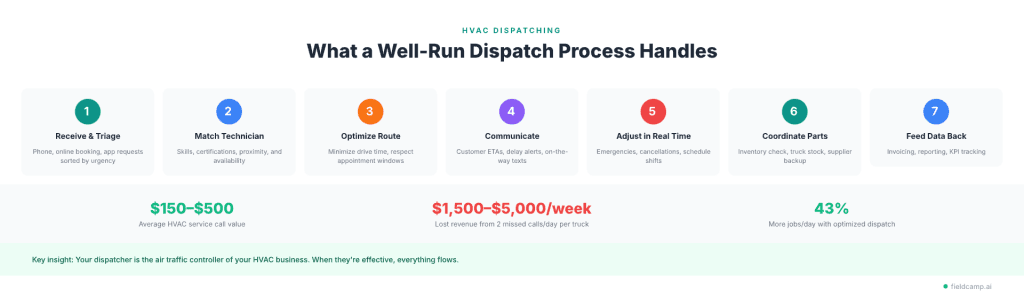
Route optimization. Group nearby plan members on the same day to minimize drive time. With 50 plan members scattered across a service area, optimized routing can save 1–2 hours per day in windshield time, which is an extra 2–3 tune-ups your techs can complete daily.
Automated billing. Plans should bill monthly or annually without anyone touching an invoice. Set up auto-deducting payments so revenue flows in predictably. For managing invoices at scale, see this invoice management guide.
Renewal reminders and no-show prevention. Automated workflows send renewal reminders 30, 14, and 3 days before expiration. For scheduled tune-up visits, no-show prevention automation sends confirmations so customers actually show up. Payment collection automation handles billing without manual follow-up.
CRM tracking. Your AI-powered CRM should flag every plan member’s status: active, expiring soon, or lapsed. When a tech arrives at a plan member’s home, instant customer history pulls up their full service record, past maintenance visits, open issues, plan tier, and expiration date, so nothing gets missed.
Work order management. Each tune-up visit generates a work order with checklist items pre-loaded per plan tier. Techs complete the digital checklist in the field, capture photos and notes, and the office sees results in real time. Track plan revenue and completion rates with reporting software.
Workflow automation. The entire maintenance plan lifecycle — from new signup to first scheduled visit to renewal reminder to payment collection- can be automated end-to-end with the AI workflow builder. No code required.
For a head-to-head comparison of scheduling tools, see our review of the best HVAC scheduling software.
Even well-designed plans fail when businesses make these common errors:
Underpricing to “be competitive.” Charging $99/year for two tune-ups that cost you $100 each to deliver isn’t a maintenance plan; it’s a charity program. Price for profitability first, then add value to justify the price.
Vague coverage terms. “Includes all necessary maintenance” is a lawsuit waiting to happen. Define every included service, every exclusion, and every limit in writing. Customers should never be surprised by what isn’t covered.
Not tracking plan member data. If you can’t instantly tell which customers are on plans, which plans are expiring this month, and which members haven’t had their fall tune-up yet, you’re losing money. This is where software pays for itself.
Letting techs skip checklist items. A 15-item checklist that gets shortened to 8 items because “the system seemed fine” destroys plan value and creates liability. Digital checklists with required fields solve this.
Ignoring the renewal. Selling a plan is step one. The real revenue is in years two through ten. Auto-renewal, proactive outreach 60 days before expiration, and a genuine thank-you call at renewal time are what keep members on board.
Maintenance plans are a rare business strategy that genuinely benefits everyone involved. Homeowners get reliable systems, lower bills, and peace of mind. HVAC businesses get recurring revenue, higher customer retention, and a pipeline of repair work from customers who already trust them.
The difference between an HVAC company stuck in seasonal feast-or-famine cycles and one that grows steadily year after year usually comes down to one thing: how many customers are on maintenance agreements.
Start with three tiers. Price for profitability, not just to cover your costs. Train your techs to sell at every visit. And automate everything — scheduling, dispatching, billing, renewals — so your plan program scales without drowning your office in admin work.
Right now, 3 out of 4 of your customers have zero reason to call you back
75% of homeowners who trusted you once will Google someone else when their AC dies, not because your work was bad, but because you gave them no reason to stay.
A maintenance plan fixes that.
FieldCamp’s AI scheduling and automated dispatching let you manage hundreds of agreements without adding office staff.
Twice per year at minimum, once in the spring for your cooling system and once in the fall for your heating system. Heat pumps that run year-round benefit from quarterly check-ins because they have both heating and cooling components under constant use. Commercial HVAC systems typically need monthly or quarterly maintenance, depending on operating hours and building occupancy. Skipping even one seasonal tune-up increases your chance of a mid-season breakdown significantly.
Some tasks are homeowner-friendly: replacing air filters every 1–3 months, clearing vegetation and debris from around the outdoor unit (maintain 2 feet of clearance), replacing thermostat batteries, keeping supply and return vents unobstructed, and gently hosing down the condenser coils. But anything involving refrigerant handling (requires EPA 608 certification), electrical components, gas connections, combustion analysis, or heat exchanger inspection requires a licensed HVAC technician. DIY attempts on these items risk personal injury, system damage, refrigerant release (an EPA violation), and voided manufacturer warranties.
The consequences compound over time. In year one, you’ll see 15–25% higher energy bills due to reduced efficiency. By years two and three, minor issues that a tune-up would have caught cascade into component failures costing $300–$600 each. By years five through seven without maintenance, you’re looking at a system lifespan of 10–12 years instead of 15–20, meaning you’ll replace the entire system 5–8 years earlier than necessary, a $7,000–$12,000 cost that proper maintenance would have delayed. You’ll also almost certainly void your manufacturer’s warranty, which typically requires proof of annual professional maintenance.
A maintenance plan is proactive — you pay your HVAC company for scheduled preventive service visits that keep your system running well. A home warranty is reactive — you pay a third-party company for insurance that covers repair or replacement costs when something breaks, usually with a $75–$125 service call deductible. Maintenance plans cost $120–$300/year; home warranties cost $300–$600/year. The two actually complement each other because most home warranties require proof of annual maintenance to approve claims. Having both gives you the best protection, but if you can only afford one, a maintenance plan prevents more problems than a warranty fixes.
Most plans allow cancellation with a 30-day written notice. Some companies prorate refunds based on services already delivered, if you’ve used one of your two tune-ups, you’ll get back roughly half the annual fee minus the retail value of the completed service. Check your agreement’s specific cancellation terms before signing. Reputable HVAC companies make cancellation straightforward because forcing unhappy customers to stay creates more problems than it solves. There’s rarely a penalty beyond forfeiting the remaining prepaid services.
Industry benchmarks suggest targeting 30–50% of your active customer base on maintenance plans. The industry average sits around 20–25%, so most companies have significant room to grow. If you have 500 active customers and 100 are on plans, that’s 20% — push toward 200–250 plan members by implementing the selling strategies above. Each plan adds $150–$300 in predictable annual revenue, and plan members generate 3–5x more repair revenue than non-plan customers because they call you first for everything. At 250 plans averaging $200/year, that’s $50,000 in guaranteed recurring revenue before a single repair call. Learn more about building your team to support growth in our HVAC technician salary guide and how to start an HVAC business.
Look for field service management software that supports recurring job scheduling, automated dispatching, CRM tracking with plan status flags, digital checklists, auto-billing, and renewal workflow automation. The key features to evaluate: can it auto-schedule recurring seasonal visits, can it track plan member status in the CRM, and can it automate renewal reminders and payment collection? If yes to all three, the software will pay for itself within the first quarter. For HVAC businesses evaluating their overall technology stack, our HVAC business valuation calculator helps you understand how recurring revenue from maintenance plans affects your company’s value.
Maintenance plans create a predictable workload — you know exactly how many tune-ups need to happen each spring and fall. Smart dispatching turns that predictable workload into optimized routes and balanced technician schedules. Instead of 50 plan members calling in randomly to book their tune-up, AI dispatching assigns all 50 visits across your team based on geography, technician skill, and availability, maximizing completed jobs per day while minimizing drive time. See our HVAC dispatching tips for more on optimizing your dispatch operations.
The pricing data, cost ranges, and technical specifications in this guide are compiled from the following sources:
All pricing reflects U.S. national averages as of 2026. Actual costs vary by region, system type, and provider. FieldCamp does not provide HVAC maintenance services; this guide is for educational purposes.