

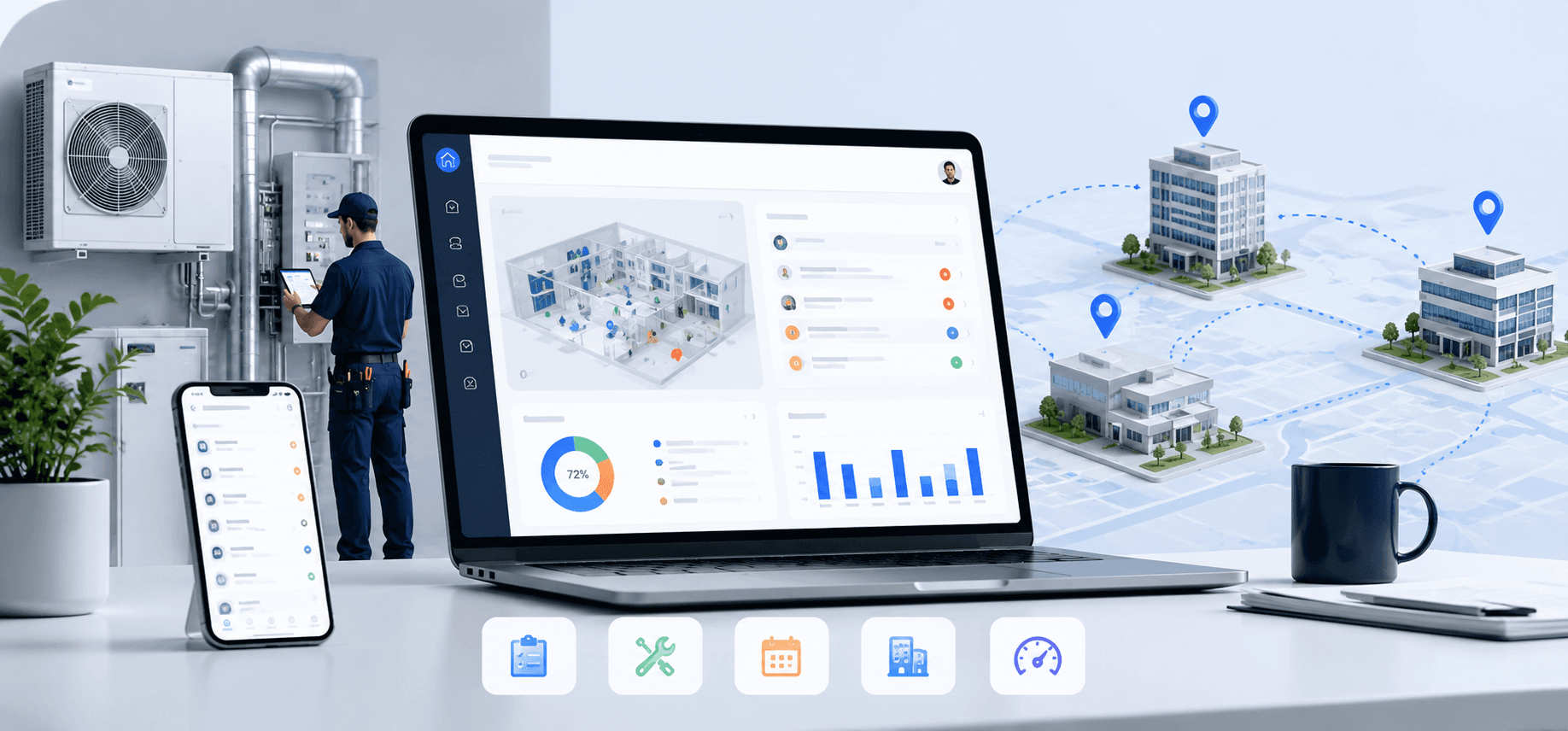
| TL;DR: Singapore integrated facilities management runs on multi-service coordination at the site level, monthly town council and MCST reporting, MOM work permit compliance across 500-plus ground staff, and sub-contractor visibility gaps that surface as client complaints. This guide evaluates eight FM software platforms against six SG-specific criteria: multi-service dispatch, MCST/town council report automation, MOM permit tracking, sub-contractor visibility, WhatsApp coordination, and EDG/PSG grant eligibility. FieldCamp and Genic Teams are the two most commonly shortlisted platforms in 2026 for operators managing 100 to 1,500 staff across commercial buildings, HDB estates, and hospital or school contracts. |
A town council manager calls an FM operations director at 10am. Block 123’s lobby is still showing a pest problem — the residents have been complaining since yesterday.
The FM company’s pest control team logged the monthly treatment as complete three days ago. The cleaning supervisor says her team swept the same lobby that morning. Nobody lied.
The pest record is in one system, the cleaning schedule is in another, and nobody cross-checked them against the actual site condition between visits. It is not a missed job — it is a multi-service coordination failure at site level, and it will happen again on Block 124 next week unless the software understands that cleaning and pest control are not independent work orders. They are two service lines at the same site, managed against the same client SLA.
This is the defining operational pressure in Singapore integrated FM — not scheduling, not invoicing, not individual job completion. It is coordination across service lines at a shared site where the client measures performance by the outcome, not by whether each individual team showed up.
An FM company operating 30 sites with cleaning, pest, M&E, and security at each of them is managing 120 simultaneous service streams, and every scheduling gap between those streams is a potential client complaint.
The second structural pressure is reporting volume. Singapore town council and MCST contracts require monthly service verification reports across every block, every service line, and every incident.
For an FM provider managing 15 HDB estates, that is 15 town council reports compiled and submitted every month. The Singapore FM industry is running this process manually — operations analysts pulling attendance logs, incident records, and service completions from multiple systems into a formatted document. The ICP research puts this at 20 to 40 hours per week across the ops team. That is a full headcount dedicated to a reporting function that software should handle automatically.
Want to see how FieldCamp handles multi-service coordination and automated MCST reporting before reading the full breakdown? Explore the documentation or book a walkthrough.
Eight platforms compared across multi-service dispatch, MCST/town council reporting, MOM permit compliance, sub-contractor visibility, and EDG/PSG eligibility. Let AI pull the short version for your service mix and contract portfolio.
KEY HIGHLIGHTS
Best Facilities Management Software in Singapore 2026
- Multi-service coordination failure is a client SLA event, not a scheduling oversight: when cleaning and pest control are deployed to the same site on the same day without cross-service visibility, the outcome gap — not the individual task completion — is what the town council or MCST measures against the contract.
- Town council and MCST monthly reporting consumes 20–40 hours per week across the FM ops team: this is not a reporting inconvenience — it is a full headcount cost that software with AI agent report compilation eliminates, not reduces.
- EDG grants (up to 50% of qualifying costs) are available for enterprise FM digital transformation, not just PSG: FM companies with 200-plus staff operating complex multi-service contracts should evaluate Enterprise Development Grant pathways alongside PSG — the grant ceiling is meaningfully higher.
Platform Overview: Singapore FM Software at a Glance
Before diving into each platform, here is how the eight options compare across the criteria that matter most to Singapore integrated FM operators. Use this table as your shortlisting filter.
| Platform | Multi-Service per Site | MCST/TC Reports | MOM Permits | Sub-contractor | EDG/PSG | |
|---|---|---|---|---|---|---|
| FieldCamp | Native (configurable) | AI agent automation | Custom structured | Configurable | Native | In evaluation |
| Genic Teams | Partial | Manual | Manual | None | Notification only | PSG ✅ |
| Cryotos | Partial (CMMS) | None | None | None | None | PSG ✅ |
| IBM Maximo | Native (EAM) | Custom build | None | Partial | None | None |
| Planon | Native (IWMS) | Custom build | None | Partial | None | None |
| ServiceMax | Partial | Custom build | None | Partial | None | None |
| UpKeep | Maintenance only | None | None | None | None | None |
| MaintainX | Maintenance only | None | None | None | None | None |
What Singapore FM Companies Actually Need from Software
Most software comparison guides for FM rank platforms by asset tracking depth or work order volume. For integrated FM operators in Singapore managing cleaning, pest, M&E, and security across HDB estates, commercial buildings, and hospital contracts simultaneously, those criteria are secondary. The primary filter is whether the platform understands how the Singapore FM operating model actually works.
1. Multi-service coordination at site level — not a per-service-line job board. A Singapore FM company deployed to a 30-storey commercial building is not running one service — it is running cleaning (daily), pest (monthly), M&E maintenance (quarterly), and security (continuous) at the same site. Each has its own frequency, compliance requirement, and ground staff deployment. Software that treats each of these as separate job types without a shared site record creates exactly the coordination gap the town council calls about. Multi-service per site means one unified record per building where every service line’s schedule, completion status, and incident log is visible simultaneously.
2. Town council and MCST monthly report automation. Singapore’s HDB town councils and MCST bodies require structured monthly service verification reports — attendance logs, service completion records, incident documentation, chemical usage for pest, and corrective action logs for maintenance. These are contractual obligations, not optional reporting. FM companies generating these manually are running a reporting operation inside their ops team. Software with AI agent-based report compilation — configured to the specific format each town council or MCST requires — eliminates this entirely. This single capability justifies software investment for most Singapore FM operators managing more than five government or residential contracts.
3. MOM work permit compliance across multi-service ground staff. Under MOM’s Work Pass framework, Singapore FM companies managing 500 to 1,500+ ground staff are operating with hundreds of Work Permit holders across cleaning, pest, M&E, and security service lines simultaneously. Permit categories, expiry dates, employer ties, and in some contracts, site-specific restrictions, determine legal deployment eligibility for every ground staff assignment. At scale, manual permit tracking is a compliance risk event waiting for an audit to surface it.
4. Sub-contractor visibility for FM primes. Singapore FM primes routinely subcontract specialty service lines — pest control to licensed NEA operators, ACMV to registered aircon servicing companies, specialist cleaning to certified contractors. The client holds the prime accountable for the sub’s performance. Software that gives the FM prime real-time sub-contractor job status, sign-off documentation, and incident records — without requiring the sub to use the same platform — closes the single biggest accountability gap in the Singapore FM model.
5. WhatsApp-native coordination for ground staff and supervisors. Singapore FM ground staff coordinate via WhatsApp. Shift confirmations, reliever deployment, site access instructions, incident escalations, and client notifications all travel through WhatsApp. Software that routes these through an in-app messenger or email creates a parallel communication stream that ground staff and supervisors will not adopt. For the full context on WhatsApp as a coordination channel for Singapore service operations, see the WhatsApp booking system guide for Singapore service companies.
6. EDG and PSG grant eligibility — for enterprise FM, EDG is the more relevant pathway. PSG (Productivity Solutions Grant) covers up to 50% of qualifying software costs for SMEs on the IMDA pre-approved list. For FM companies with 200-plus staff and complex multi-service contract portfolios, the Enterprise Development Grant (EDG) from Enterprise Singapore covers a broader scope of digital transformation initiatives — often at higher grant ceilings than PSG. See the PSG grant guide for Singapore field service software for the full application framework.
Best Facilities Management Software in Singapore: 2026 Picks
The eight platforms below represent the realistic shortlist for Singapore FM operators in 2026. The assessment covers what each platform genuinely handles in a Singapore FM context, where it stops fitting, and what questions to ask during evaluation. No sticker prices for FieldCamp — current SG tiers are on the Singapore pricing page. Competitor pricing is referenced at category level only.
1. FieldCamp — Best for Integrated Multi-Service FM with AI-Automated MCST and Town Council Reporting
For Singapore integrated FM operators — companies running cleaning, pest, M&E, and security simultaneously across dozens of commercial buildings, HDB estates, and government facilities — FieldCamp is the platform that has built its data model around the SG FM operating structure, not around a generic job-scheduling concept.
The core difference is how site records work. In most FSM tools, a site is an address attached to a job. In FieldCamp’s configurable data model, a site is a structured object with its own service lines, each with independent scheduling, compliance requirements, and ground staff assignments — all visible in a unified site record.
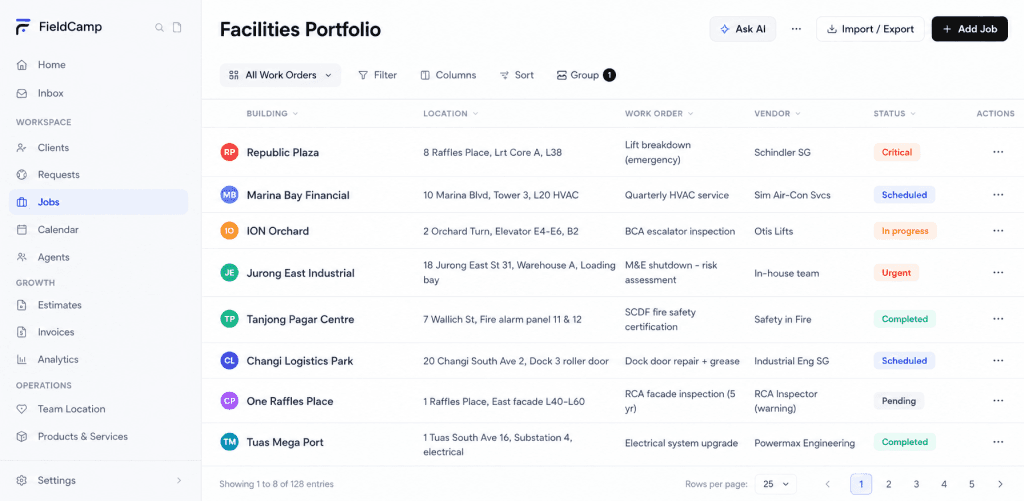
A building manager for a 40-storey Raffles Place tower can see the cleaning schedule, the monthly pest treatment status, the quarterly M&E PM log, and the security rotation in one view, with each line’s completion status and open incidents surfaced against the SLA that governs it.
Think of it this way: every other FSM tool gives you a job board and asks you to organise your FM operation around it. FieldCamp gives you the components to build the exact multi-service site model your contract portfolio requires — same reliability, your configuration, without a six-figure custom build.
“The software handles invoicing. But which tech goes where — that is still manual.”
— Field service ops lead (verified operator interview)
At FM scale — 30 sites, four service lines each — this is not an inconvenience. It is a daily operational failure that surfaces as client complaints, missed SLAs, and contract review conversations.
Strengths specific to Singapore FM operations:
- Multi-service site records with unified SLA visibility. Each site in FieldCamp carries all service lines — cleaning, pest, M&E, security, landscaping — with independent scheduling cadences, compliance field sets, and ground staff assignments. Cross-service coordination gaps (the pest team visited Block 123 but the cleaning supervisor was not notified of the rodent bait placement — now she has a safety incident) become visible before the client call rather than after.
- AI agent-automated MCST and town council monthly reports. AI agents configured to the specific report format each town council or MCST client requires compile attendance logs, service completion records, incident documentation, and corrective action summaries automatically on the reporting cycle. For FM operators managing 10 to 20 government or residential contracts, this eliminates the 20-to-40-hour weekly manual reporting load that currently sits on the ops team. Configured once; runs automatically every cycle without human intervention after setup.
- MOM work permit data as structured deployment constraint. Every ground staff profile stores Work Permit category, permit number, validity dates, employer tie, and approved service line categories. The AI Dispatcher checks permit eligibility before any deployment suggestion — a cleaner without a valid WP for security-adjacent site categories is not offered as a reliever for those shifts. Permit expiry alerts fire automatically before the breach, not during an MOM inspection. For the multi-permit complexity typical in SG FM (cleaners on WP, M&E techs on S Pass, supervisors on EP), configurable field sets per staff grade handle the full range without a parallel spreadsheet. For the detailed MOM compliance framework relevant to larger FM staff deployments, the HDB and condo maintenance software guide covers multi-site permit management in practice.
- Sub-contractor job records with prime visibility. When an FM prime subcontracts pest to a licensed NEA operator or ACMV to a registered aircon company, the sub’s job record, completion sign-off, and incident log are visible to the prime’s operations team in real time. The sub does not need to be on the FieldCamp platform — the prime creates and assigns the job record, and the sub updates it via a guest link or WhatsApp-delivered completion confirmation. Client complaints about sub performance no longer surface blind.
- WhatsApp Command Center for ground staff, supervisors, and site managers. Shift confirmations, reliever dispatch notices, site access instructions, incident escalations, and client SLA alerts travel via WhatsApp from a single registered FieldCamp business number. No app download required from your ground staff. No in-app messenger they will not check. Supervisors managing multiple sites across an HDB estate stay connected to the same coordination channel their ground staff already use.
- AI Dispatcher for multi-service, multi-site ground staff deployment. Zone-based deployment across Singapore’s North, South, East, West, and Central zones with transit-time estimates calibrated for MRT and bus — FM ground staff do not use company vehicles. The AI Dispatcher cross-checks permit category, site familiarity, service line certification, and availability before suggesting any deployment. For the helper-swap logic specific to cleaning ground staff within an FM portfolio, see the best cleaning company software guide for Singapore operators.
- SAP and Oracle integration pathway for enterprise FM. Singapore FM companies transitioning from or running alongside SAP / Oracle ERP can connect FieldCamp as the operational layer — job dispatch, site compliance, ground staff deployment — with financial data flowing to the ERP. This is the integration model enterprise FM primes with PE ownership or listed company reporting requirements use to avoid ripping out the existing ERP while gaining operational visibility the ERP was never designed to provide.
- EDG eligibility pathway alongside PSG. FieldCamp is currently in the IMDA evaluation process for PSG pre-approval listing. For enterprise FM operators eligible for EDG, contact the team for the current application framework — EDG covers a broader scope of digital transformation than PSG and is structured for the scale of investment most integrated FM operators require.
Best for: Singapore integrated FM companies with 100 to 1,500 ground staff, multi-service contract portfolios across HDB estates, commercial buildings, and government facilities, and the need to unify multi-service dispatch, MOM permit compliance, sub-contractor visibility, and town council/MCST reporting automation on one configurable platform.
Limitations: FieldCamp is not the right fit for a small single-service FM company (one service line, under 20 staff, no government contracts, no reporting obligations). The platform is built for the operational complexity of multi-service integration — operators without that complexity do not need it.
Verdict: The most capable platform on this list for Singapore integrated FM operators where multi-service site coordination, automated government client reporting, and MOM-compliant deployment at scale need to operate as a unified system rather than as separate tools stitched together with WhatsApp and weekly operations meetings.
Manage FM Operations the Singapore Way
Multi-service site coordination, AI-automated MCST and town council reporting, MOM work permit compliance, and WhatsApp-native ground staff dispatch — built for Singapore FM operators. See the full workflow live.
2. Genic Teams — Best for PSG Pre-Approval and SG-Built FM Scheduling
Genic Teams is Singapore’s most established locally-built FSM platform — IMDA-listed, PSG pre-approved, and with a customer base that includes Singapore FM and cleaning operators.
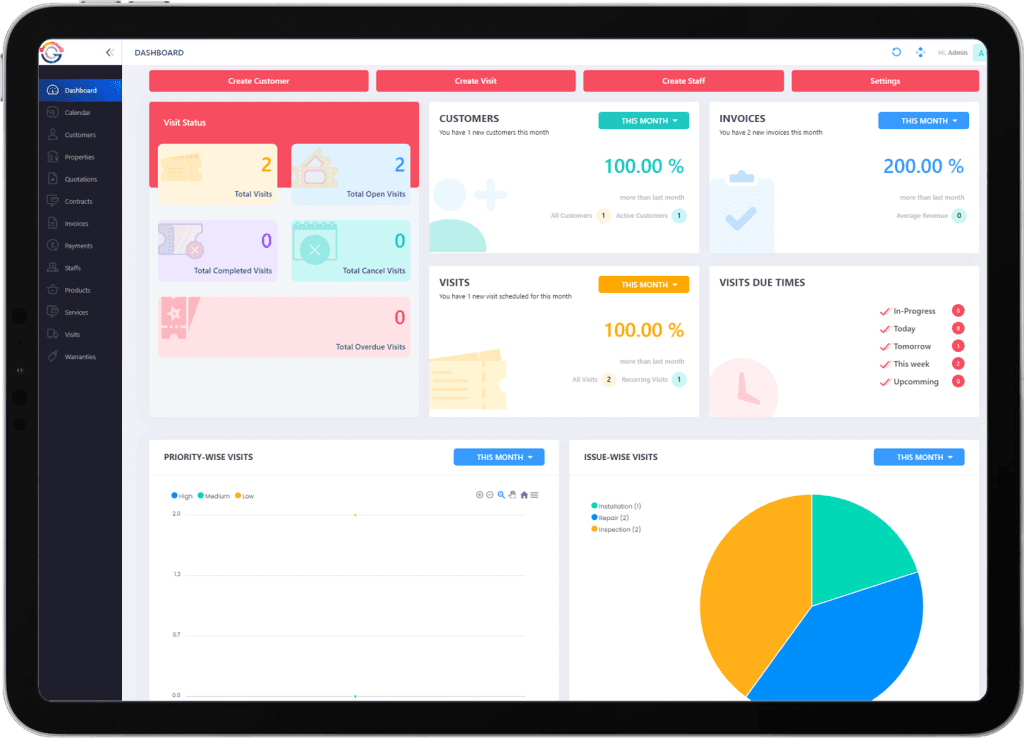
Strengths:
- PSG pre-approved. The clearest procurement pathway for FM companies whose finance teams require IMDA-listed vendor status before approving the software budget.
- SG-native scheduling with GST invoicing in SGD, local support on Singapore business hours, and familiarity with Singapore service industry workflows.
- Zone-based scheduling and mobile supervisor app — functional for single-service FM or cleaning-heavy FM operations.
- Reasonable deployment timeline for a basic scheduling and work order workflow.
Limitations:
- Multi-service per site is not a native data model. Genic Teams manages jobs, not site-level service portfolios — the coordination visibility between cleaning and pest at the same building requires manual cross-referencing.
- MCST and town council report automation does not exist — reports require manual assembly from the platform’s attendance and job completion exports.
- MOM work permit tracking is not a native structured field. Permit compliance runs on a parallel spreadsheet for most Genic Teams FM customers.
- Sub-contractor visibility is absent — no native model for FM prime visibility into sub-contractor job status or completion documentation.
- WhatsApp integration is outbound notification only, not a coordination channel.
- Scale ceiling: Genic Teams’ scheduling architecture handles single-service FM well and starts showing strain in operations above 200-plus ground staff across multiple service lines.
Best for: FM operators for whom PSG pre-approval is a hard procurement requirement, and who are primarily managing one or two service lines (cleaning-focused FM or maintenance-focused FM) without complex multi-service coordination, government client reporting automation, or sub-contractor management requirements.
Verdict: The right first choice when PSG status and local vendor familiarity drive the procurement decision. For integrated FM at scale, the multi-service coordination gap requires evaluation against FieldCamp before committing.
3. Cryotos — Best for CMMS-First FM Operators with M&E and Preventive Maintenance at the Core
Cryotos is a Singapore-based CMMS (Computerised Maintenance Management System) platform used by FM companies whose primary service line is M&E maintenance, asset management, and preventive maintenance scheduling, rather than cleaning or pest-led FM.
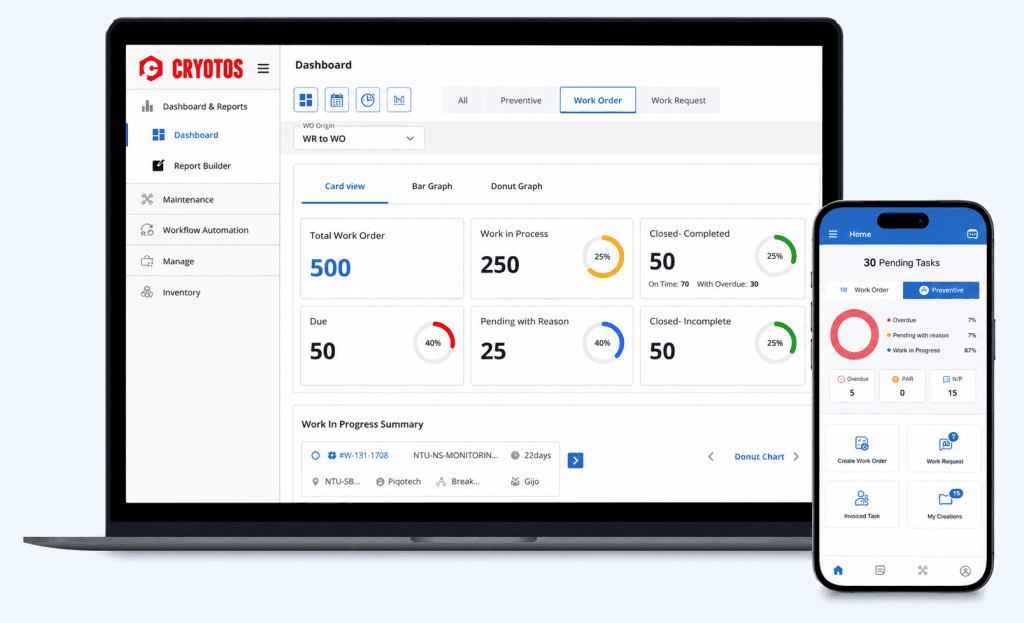
Strengths:
- Singapore-based with local support and a CMMS data model that maps well to M&E-heavy FM operations: asset registers, preventive maintenance schedules, work order management, and breakdown maintenance workflows.
- PSG pre-approved — relevant for FM companies whose digital transformation budget routes through PSG rather than EDG.
- Strong for scheduled preventive maintenance across a building asset portfolio — lifts, ACMV, fire suppression, plumbing.
- Mobile technician app for field engineers and M&E maintenance staff.
Limitations:
- Cryotos is a CMMS, not an integrated FM platform. It models assets and maintenance work orders — not multi-service coordination per site across cleaning, pest, and security simultaneously.
- No MCST or town council report automation for service delivery reporting (as distinct from maintenance records).
- No MOM work permit tracking or native WhatsApp coordination.
- No sub-contractor visibility beyond work order assignment.
- Not designed for the labour-intensive, ground-staff-heavy service delivery model that cleaning and pest-led FM requires — the scheduling architecture is optimised for technical maintenance, not daily shift-based deployment of hundreds of cleaners.
Best for: FM companies or property management organisations where M&E maintenance, asset management, and preventive maintenance scheduling are the primary software requirements — and where cleaning, pest, and soft FM services are either not in scope or managed separately.
Verdict: A strong CMMS for M&E-heavy FM; not a fit for integrated multi-service FM where cleaning, pest, and security coordination at the site level is the primary operational challenge.
4. IBM Maximo — Best for Enterprise FM with Complex Asset Management and ERP Integration Requirements
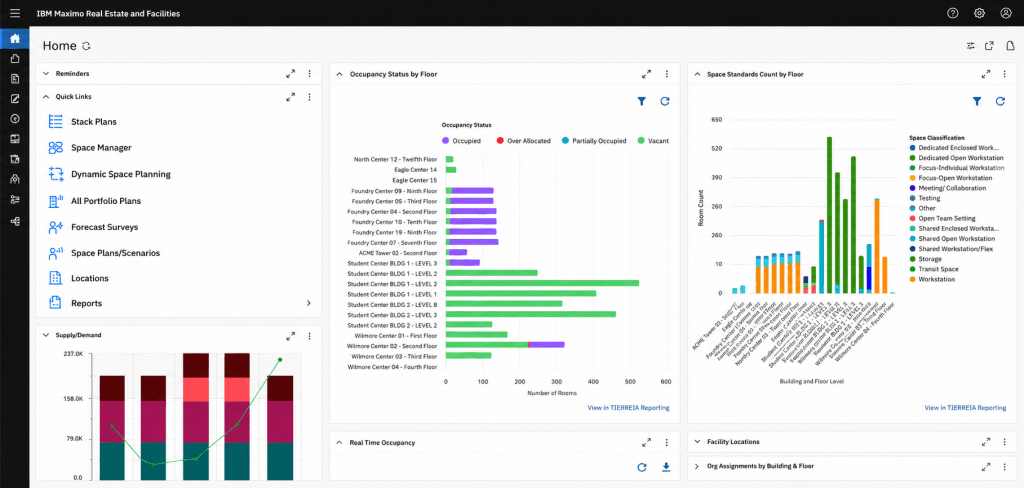
IBM Maximo is the global enterprise standard for asset management and maintenance in large-scale FM — used by Singapore government agencies, hospitals, transport operators (MRT, Changi Airport), and large commercial property managers.
Strengths:
- Enterprise-grade asset management with full lifecycle tracking — assets, preventive maintenance, work orders, materials, and contracts managed in a single ERP-adjacent platform.
- Deep integration with SAP and Oracle ERP systems — the standard integration model for Singapore’s listed FM companies and government-linked corporations.
- Powerful reporting and analytics for large asset portfolios — relevant for CAAS, LTA, HDB-scale operations.
- Decades of implementation experience in Singapore’s public sector and transport infrastructure.
- Handles multi-contractor, multi-service environments at the asset and work order level.
Limitations:
- Maximo is an asset management and maintenance platform, not a ground staff deployment and coordination platform. It models assets and work orders — not the daily shift-based deployment of 500 cleaners across 30 HDB estates.
- No native WhatsApp integration. Ground staff coordination requires a separate layer.
- No MOM work permit tracking as a structured deployment constraint.
- No MCST or town council service reporting automation for soft FM service delivery.
- Implementation cost and timeline are enterprise-grade: typical Singapore implementations run 12 to 24 months and require a specialist SI partner. Not appropriate for FM companies below 500 staff or SGD $20M revenue.
- Licensing is expensive by Singapore FM standards — the ROI calculation requires enterprise contract volumes to justify.
Best for: Singapore FM companies with 1,000-plus staff, large-scale hard FM and M&E asset portfolios (hospitals, transport hubs, government buildings), existing SAP or Oracle ERP infrastructure, and the budget and timeline for an enterprise implementation. Not appropriate for soft FM-led operations.
Verdict: The right choice when hard FM asset management at government or transport infrastructure scale is the core requirement and budget is enterprise-grade. Not a fit for the typical 100-500 staff integrated FM company managing HDB estates and commercial buildings.
5. Planon — Best for IWMS-Grade FM with Real Estate and Workplace Management Requirements
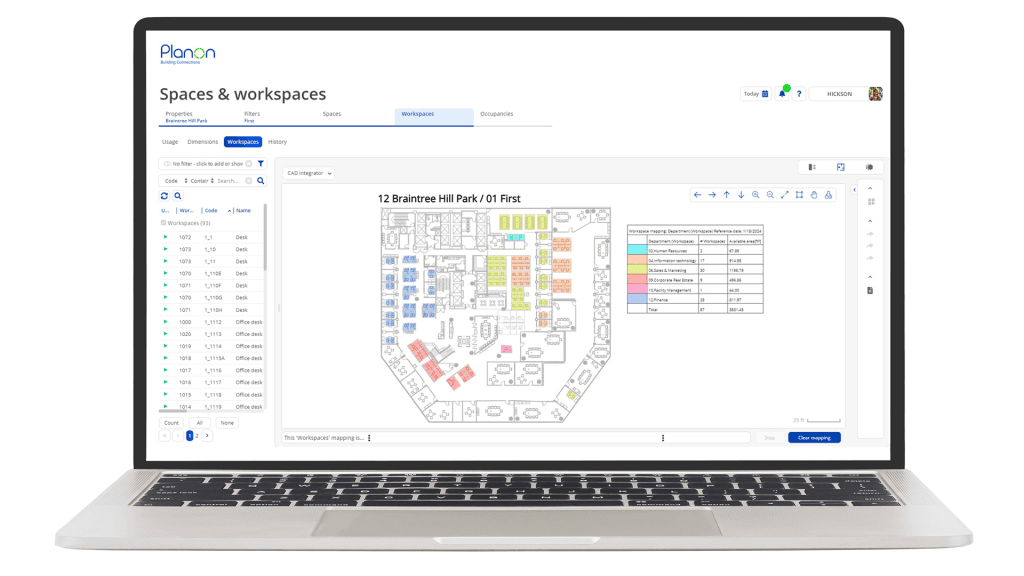
Planon is a Dutch enterprise IWMS (Integrated Workplace Management System) with a Singapore and Southeast Asia presence — used by large commercial property managers, corporate real estate teams, and integrated FM companies with workplace management and lease administration requirements alongside field service delivery.
Strengths:
- True IWMS scope: space management, lease management, real estate portfolio, sustainability reporting, and FM work order management in one platform — relevant for FM companies that also handle the property management layer for their clients.
- Strong reporting and dashboard tooling for FM KPI reporting at client portfolio level.
- Enterprise integration architecture with SAP and Oracle.
- Established Singapore customer base in commercial real estate and corporate FM.
Limitations:
- Planon is an IWMS and property management platform. It models real estate portfolios and workplace management — not the daily deployment of 500 ground staff across HDB estates.
- No native WhatsApp integration or MOM work permit tracking.
- No MCST or town council monthly service report automation for soft FM service delivery.
- Implementation complexity and cost are enterprise-grade — minimum 12-month implementation, significant configuration, specialist SI partner required.
- Not designed for cleaning, pest, or security service delivery scheduling at the ground staff level. The FM service delivery layer requires a separate platform in most Planon implementations.
Best for: Large commercial FM and corporate real estate operators in Singapore where space management, lease administration, and workplace management are primary requirements alongside M&E and hard FM — typically enterprise companies managing office buildings and corporate campuses rather than HDB estate or residential FM.
Verdict: Relevant for corporate real estate and commercial property FM at enterprise scale. Not a fit for HDB estate or residential FM operations, or for soft FM-led integrated FM companies.
6. ServiceMax (Salesforce Field Service) — Best for Enterprise FM with Salesforce CRM Integration
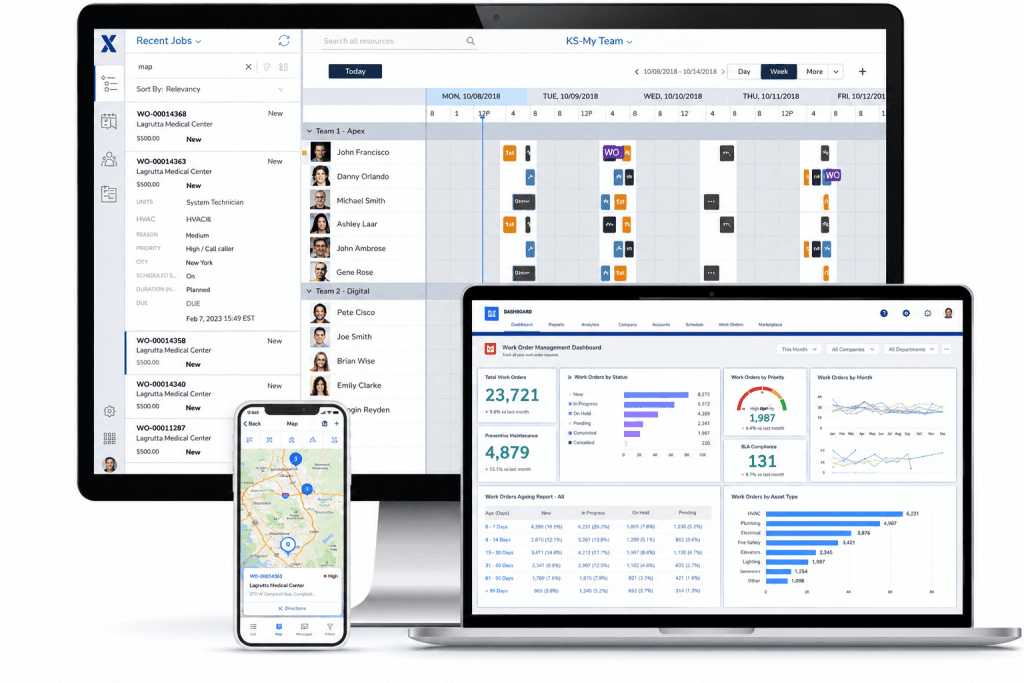
ServiceMax (now integrated with Salesforce Field Service) is an enterprise field service management platform built on the Salesforce platform — used by large FM companies that run their client management on Salesforce CRM and want a native FSM layer for field operations.
Strengths:
- Native Salesforce integration — if the FM company’s sales, account management, and client service functions run on Salesforce, ServiceMax provides the field dispatch layer without a separate integration build.
- Strong scheduling and work order management at enterprise volumes.
- Powerful analytics and reporting through the Salesforce ecosystem.
- Enterprise support model with Singapore-based partners.
Limitations:
- ServiceMax is built for technical field service (M&E, HVAC, equipment maintenance) — the scheduling model is optimised for skilled technician dispatch, not for the high-volume, daily, shift-based deployment of cleaning, pest, and security ground staff.
- No native WhatsApp integration or MOM work permit tracking.
- No MCST or town council monthly service report automation.
- Licensing cost is Salesforce enterprise pricing — significant for FM companies not already on the Salesforce platform.
- Not PSG or EDG eligible.
- Implementation complexity requires a Salesforce SI partner and significant configuration effort.
Best for: Enterprise FM companies already running Salesforce CRM who want a native field service layer for M&E and hard FM work order management — and who manage soft FM (cleaning, pest) through separate systems.
Verdict: A strong enterprise choice for Salesforce-native FM organisations managing hard FM and M&E at scale. Not a fit for soft FM-led integrated FM operations or companies not already in the Salesforce ecosystem.
7. UpKeep — Best for Mid-Market FM Operators Moving from Paper-Based Maintenance to Digital Work Orders
UpKeep is a US-based mobile-first CMMS used by mid-market facilities managers and FM operators moving from paper-based or spreadsheet-based maintenance management to digital work orders and preventive maintenance scheduling.
Strengths:
- Clean, mobile-first UX that has the lowest adoption friction of any CMMS on this list — maintenance technicians and FM supervisors can be operational within days.
- Strong preventive maintenance scheduling, asset tracking, and corrective maintenance work order flow.
- Reasonable per-seat pricing compared to enterprise CMMS — accessible for FM companies below SGD $20M revenue.
- Good API integration options for connecting to existing tools.
Limitations:
- UpKeep is a CMMS — it models assets and maintenance work orders, not multi-service site coordination or ground staff deployment at scale.
- No MCST or town council reporting, no WhatsApp integration, no MOM permit tracking, no sub-contractor visibility.
- USD pricing, no PSG or EDG eligibility.
- Not designed for the cleaning, pest, and security service delivery model that defines Singapore integrated FM.
- Support is US-based with no Singapore presence.
Best for: FM companies or building managers where the primary pain is moving from manual maintenance records to digital work orders and PM scheduling — typically single-building or small-portfolio property managers rather than multi-site integrated FM operators.
Verdict: A capable entry-level CMMS for maintenance management digitisation. Not a fit for integrated multi-service FM at Singapore scale.
8. MaintainX — Best for Operations Teams Replacing Paper Checklists with Digital Procedures
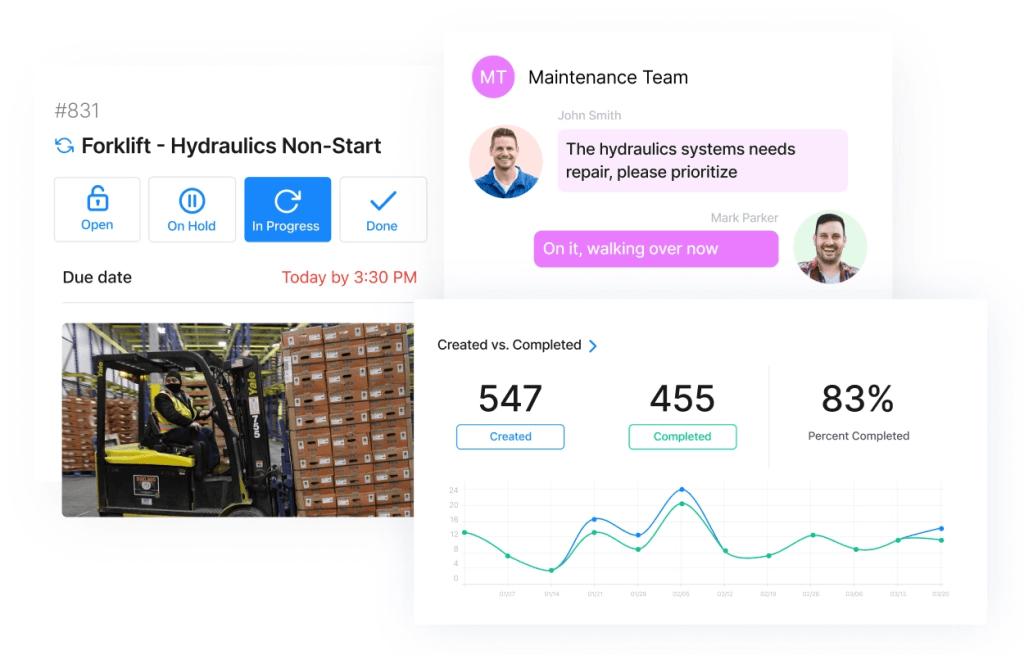
MaintainX is a modern, mobile-first work order and procedure management platform — positioned as a more intuitive alternative to legacy CMMS for operations teams replacing paper checklists and manual maintenance logs with digital workflows.
Strengths:
- The most intuitive onboarding experience of any maintenance platform on this list — digital procedures, work orders, and inspections can be live within a week.
- Strong procedure and checklist management — useful for FM operators standardising service delivery documentation across multiple sites.
- Clean mobile app that frontline supervisors and technicians actually use without training investment.
- Growing APAC presence with Singapore customers in manufacturing and facilities.
Limitations:
- MaintainX is a work order and procedure platform — it does not model multi-service site coordination, ground staff shift deployment, or integrated FM service delivery.
- No MCST or town council reporting, no WhatsApp integration, no MOM work permit tracking.
- USD pricing, no PSG or EDG eligibility.
- Not designed for the scale of ground staff deployment (100-1,500 staff) that characterises Singapore integrated FM operations.
Best for: FM operations teams with 10 to 50 staff where the primary pain is replacing paper-based checklists and manual maintenance logs with digital procedures — typically single-site or small-portfolio property managers, not multi-site FM operators.
Verdict: A useful operational procedure tool for small FM teams. Not a fit for integrated multi-service FM at Singapore contract scale.
How to Choose: Decision Framework for Singapore FM Operators in 2026
Work through these four questions before requesting demos. They will eliminate half the platforms on this list before you invest evaluation time in them.
What is your primary service model — integrated multi-service, M&E-heavy, or cleaning-led? If you are running cleaning, pest, M&E, and security simultaneously at the same sites, only FieldCamp and Planon model multi-service coordination at the site level natively — and Planon is built for corporate real estate, not HDB estate or soft FM. IBM Maximo handles asset-heavy hard FM at enterprise scale. Cryotos and UpKeep handle M&E and maintenance. If your primary pain is multi-service coordination, the shortlist is FieldCamp.
Do you hold town council or MCST contracts that require monthly service verification reports? If yes, this is a hard filter. Among the platforms reviewed here, FieldCamp is the one that has built AI agent-automated report compilation against a configured government client format. All other platforms require manual assembly. For FM companies managing five or more such contracts, this single requirement often determines the software decision before any other criterion is evaluated.
What is your staff scale and MOM permit complexity? If you are managing 200-plus Work Permit holders across multiple service lines, permit-aware deployment enforcement at the scheduling layer is a compliance requirement, not a preference. FieldCamp is the platform on this list that has built MOM permit compliance as a structured deployment constraint for a Singapore operator. All others require a parallel system or spreadsheet.
Is PSG or EDG the relevant grant pathway, and is it a hard procurement requirement? Genic Teams and Cryotos are PSG pre-approved. FieldCamp is in the IMDA evaluation pipeline. For FM operators with 200-plus staff eligible for EDG, the grant pathway evaluation should happen alongside the platform shortlist — EDG can cover a broader scope of the implementation investment than PSG. See the PSG grant guide for Singapore field service software and contact Enterprise Singapore directly for EDG eligibility confirmation before building timelines into your procurement plan.
“Revenue has been increasing almost double every year and we have the pain of not having a software to manage the jobs. So everything is very manual and things get very messy.”
— Andy, Founder, Commercestar (Singapore)
The operational pattern Andy describes applies at every scale in Singapore FM — from a 30-staff cleaning FM company to a 1,000-staff integrated FM prime. The tools that got the business to its current size are the same tools creating the ceiling on the next phase of growth. For Singapore FM companies comparing specific software transitions, the best cleaning company software guide and the HDB and condo maintenance contract management guide cover the two most adjacent buying decisions for FM operators evaluating their full technology stack.
Ready to unify your Singapore FM operations?
See how FieldCamp handles multi-service site coordination, AI-automated MCST and town council reporting, MOM permit compliance, and WhatsApp-native ground staff dispatch — in a single configurable platform built for Singapore FM operators.