
BRCGS pest control audit requirements for service providers come from clause 4.14 of the BRCGS Food Safety Standard Issue 9. The standard requires a documented, preventive, risk-based pest management programme covering the whole site, delivered by a competent pest control contractor or trained in-house staff. The contractor produces the evidence, and the site keeps it in a pest control file held on site and acts on every recommendation.
BRCGS grew out of the British Retail Consortium’s Global Standards and now uses the name BRCGS on its own. Issue 9 of the Food Safety Standard was published in August 2022 and has been the audited issue since February 2023. Pest management sits at clause 4.14, split into twelve sub-clauses, 4.14.1 to 4.14.12. The standard itself is sold by BRCGS, so the clause descriptions on this page are summaries, not the official wording.
What does a BRCGS audit expect from your pest control firm?
- A documented programme: Preventive, risk-based and covering the whole site.
- The pest control file: Held on site, filled mostly with your reports and records.
- Proven competence: Certificates and training records, on paper or on screen.
- Frequency and trends: Risk sets the visit frequency; an in-depth assessment and trend analysis are required.
- Clear duties: Contractor and site responsibilities must be defined.
Key facts
- No fixed frequency: the site’s risk assessment sets it (4.14.2).
- In-depth assessment: by a pest management expert at least once a year (4.14.10).
- Paper or electronic: both are accepted for the records.
- Supplier approval: clause 3.5.3 requires sites to approve and monitor service suppliers, pest control included.
The BRCGS pest control audit checklist, clause by clause
Use this checklist a month before the audit to walk the pest control file against each sub-clause of 4.14. Every line names the evidence an auditor expects to see. Download the pest control audit checklist, BRCGS-ready (PDF) to print it with space to note where each item is held and whether it’s OK or needs action.
| Clause (summary) | What the auditor checks | Evidence to have ready |
|---|---|---|
| 4.14.1 Pest activity is no contamination risk | Any infestation is recorded and managed | Visit reports and sightings log showing activity and the action taken |
| 4.14.2 Competent contractor or trained staff, risk-based frequency | Who does the work, how often and why | Contract and service scope, company and technician competence, risk assessment setting the visit frequency, reviewed after building or process changes or a significant pest issue |
| 4.14.3 In-house pest management (if used) | Trained staff, resources and locked pesticide storage | Training records, access to specialist advice, pesticide store |
| 4.14.4 Documentation and records | The file holds the minimum records | Up-to-date plan of the full site with every device, device and bait identification, defined site and contractor responsibilities, product details and emergency action, observed activity, treatments |
| 4.14.5 Rodent bait stations and devices | Located and maintained to prevent contamination; toxic bait secured and kept out of open-product areas except for an active infestation | Bait point list matching the site plan; records of any missing stations, reviewed and investigated |
| 4.14.6 Insect monitoring devices | Insect-killing devices and traps sited correctly and working | Device list and service records |
| 4.14.7 Birds | Birds kept out of buildings and away from loading areas | Bird proofing in place, recommendations and actions |
| 4.14.8 Infestation response | Immediate action to identify at-risk product | Incident record and non-conforming product records |
| 4.14.9 Recommendations and actions | Proofing and hygiene recommendations are carried out in good time by the site | Recommendations log with dates raised and completed |
| 4.14.10 In-depth assessment | Done by a pest management expert at least once a year, or more often on risk | The latest documented assessment and its recommendations |
| 4.14.11 Trend analysis | Results analysed at least annually or after an infestation, including trap and monitor results | The trend analysis and what changed because of it |
| 4.14.12 Staff awareness | Staff know the signs of pests and who to report them to | Training or toolbox talk records, sightings log |
What BRCGS clause 4.14 expects from a pest control service provider
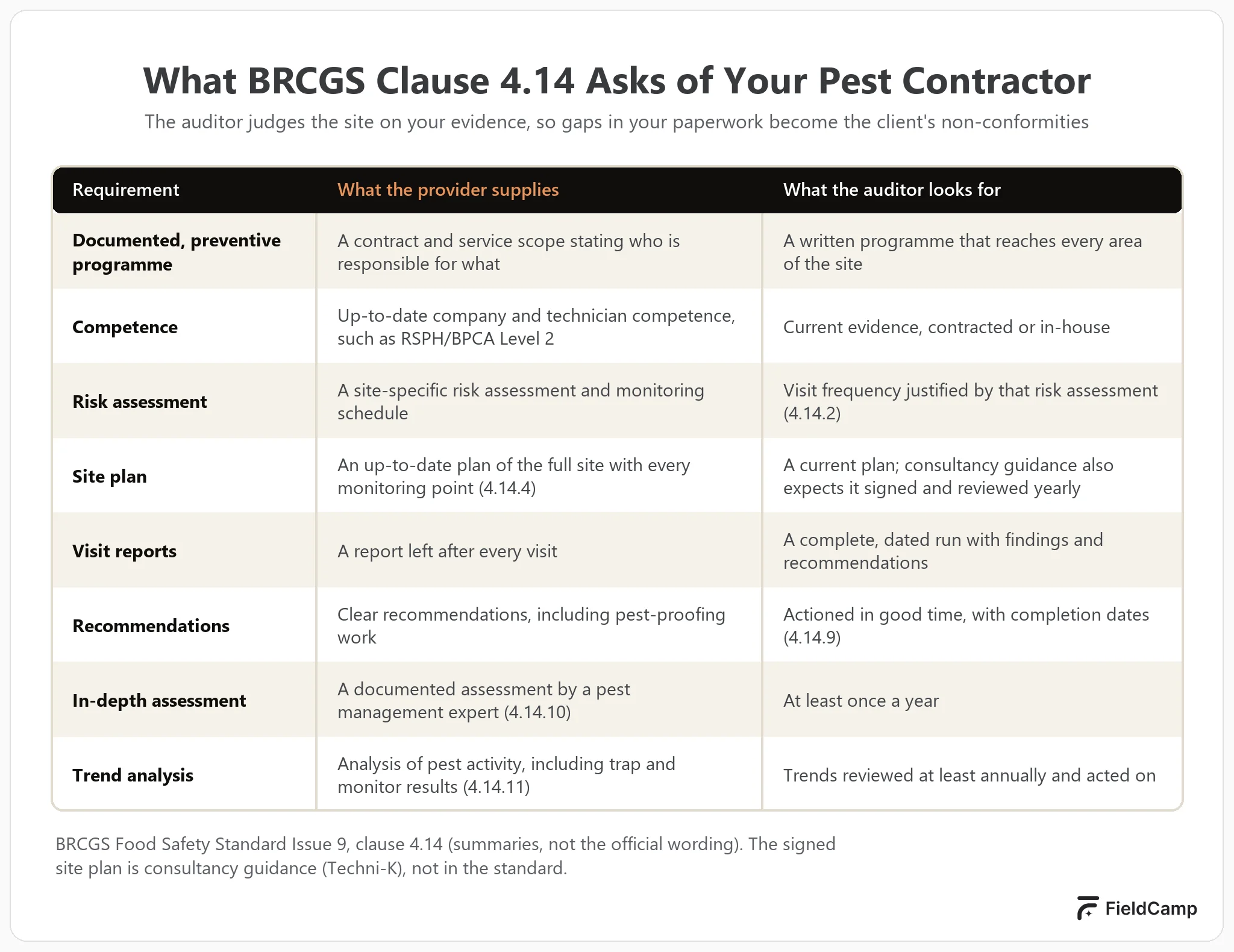
A pest control service provider working on a BRCGS site must supply evidence that the programme is documented, preventive, competently delivered and reviewed. The auditor judges the site on that evidence, so gaps in your paperwork become the client’s non-conformities.
| Requirement | What the service provider supplies | What the auditor looks for |
|---|---|---|
| Documented, preventive programme covering the whole site | A contract and service scope that states who is responsible for what | A written programme that reaches every area of the site |
| Competence | Up-to-date evidence of company and technician competence, such as RSPH/BPCA Level 2 | Current competence evidence, whether the work is contracted or done in-house |
| Risk assessment | A site-specific risk assessment and monitoring schedule | Visit frequency justified by that risk assessment (4.14.2) |
| Site plan | An up-to-date plan of the full site showing every monitoring point and its location (4.14.4) | A current plan; consultancy guidance also expects it signed by the site and the pest controller and reviewed at least annually |
| Visit reports | A report left after every visit | A complete, dated run of reports with findings and recommendations |
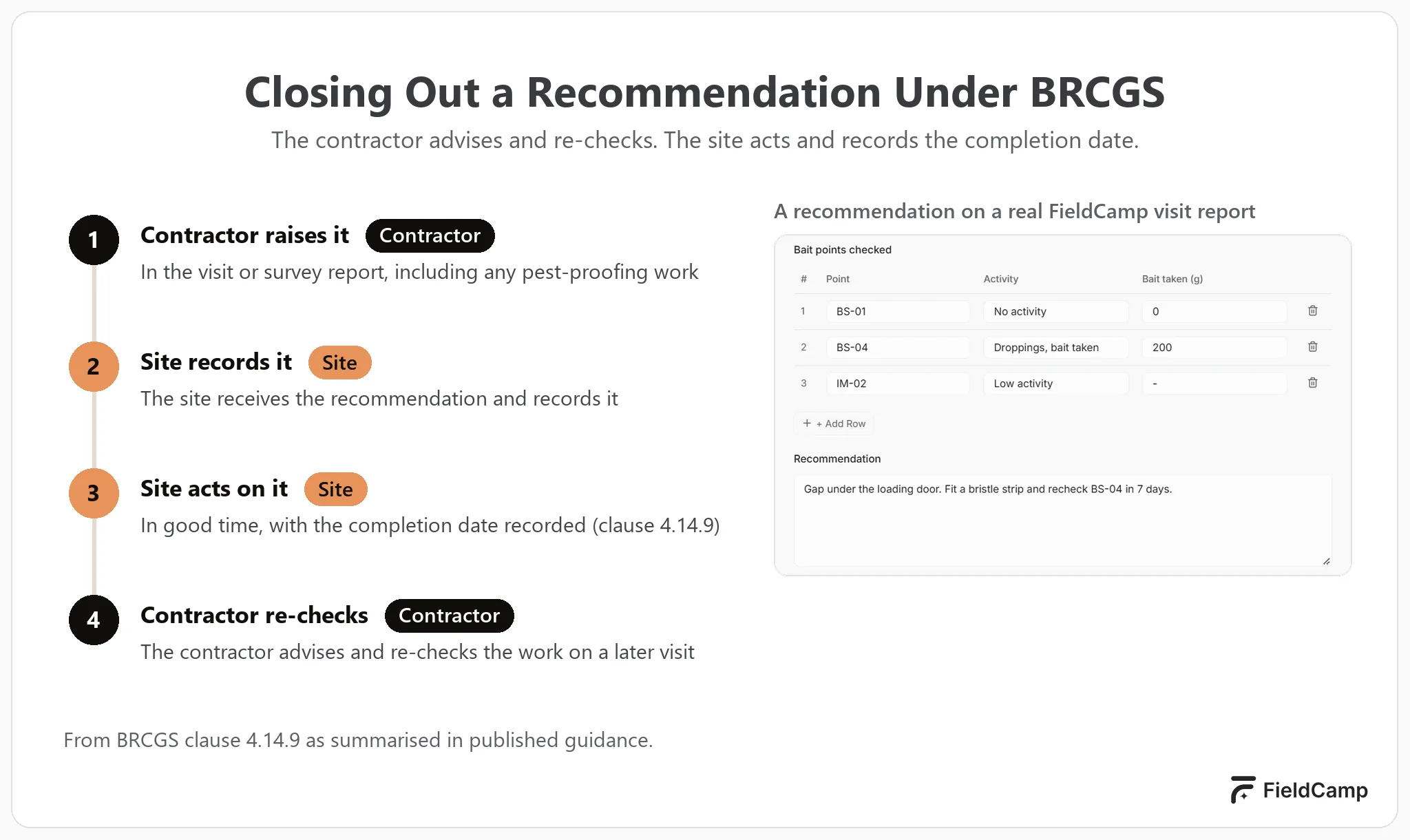
| Recommendations and corrective actions | Clear recommendations, including pest-proofing work | Recommendations actioned by the site in good time, with completion dates (clause 4.14.9) |
| In-depth assessment | A documented assessment by a pest management expert (4.14.10) | An assessment at least once a year |
| Trend analysis | Analysis of pest activity over time, including trap and monitor results (4.14.11) | Evidence that trends were reviewed at least annually and acted on |
What goes in a BRCGS pest control file?
A BRCGS pest control file is the site’s evidence pack for clause 4.14, held on site, with most of its contents supplied by the pest control service provider. Issue 9 allows the records to be on paper or on an electronic system (4.14.4). Auditors expect to find:
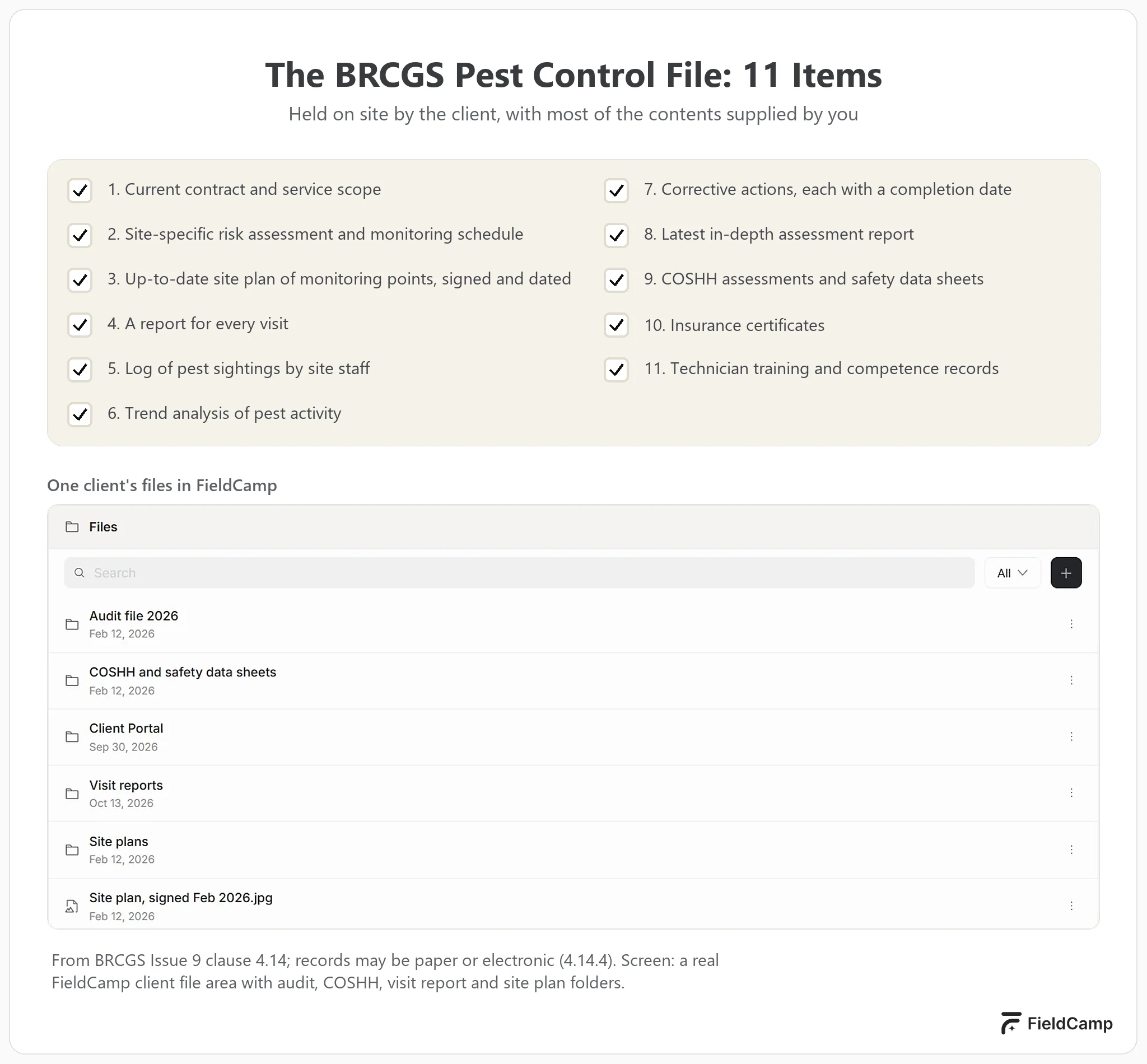
- The current contract and service scope, with responsibilities set out
- The site-specific risk assessment and monitoring schedule
- The up-to-date site plan of monitoring points, signed and dated
- A report for every visit
- A log of pest sightings reported by site staff
- Trend analysis of pest activity
- Corrective actions, each with a completion date
- The latest in-depth assessment report
- COSHH assessments and product safety data sheets
- Insurance certificates
- Training and competence records for technicians
Retention periods and the wider records a pest control company keeps sit in FieldCamp’s guide to pest control company record keeping requirements. This page sticks to what a BRCGS auditor opens the file to check.
Walk the file a month before the audit
The BRCGS-ready audit checklist lists each requirement, the evidence and where it is held, with an OK or action column and sign-off.
Technician and contractor competence
BRCGS requires the site to use either a competent pest control contractor or suitably trained in-house staff (4.14.2). A service provider has to prove that competence on paper, not just claim it.
Where a contractor is used, published guidance such as Techni-K’s summary of the pest management programme expects:
- A defined service scope and documented responsibilities for each party
- Competence evidence for the company and each technician, kept up to date
- Technicians trained to at least RSPH/BPCA Level 2, the industry minimum
- A report left on site after each visit
- A review meeting with the site at least once a year
- COSHH assessments for every product used
Since 1 January 2026, anyone buying or using professional rodenticides also needs a certificate from a CRRU UK approved course within the past five years, or an older certificate plus membership of an approved CPD scheme, under the CRRU UK Code of Best Practice. Keep a copy for each technician with the rest of the competence evidence.
Many sites and contractors describe the approach as integrated pest management (IPM). That means a documented, risk-assessed programme where prevention and proofing come before treatment. BPCA published guidance for its members on the earlier Issue 8, but it sits in the members’ area, so check any clause wording against the current standard before you put it in a contract.
Visit frequency, in-depth assessments and trend analysis
BRCGS does not fix one visit frequency for every site. The site’s risk assessment sets it (4.14.2), and the pest control service provider must be able to show why the chosen frequency fits the risk.
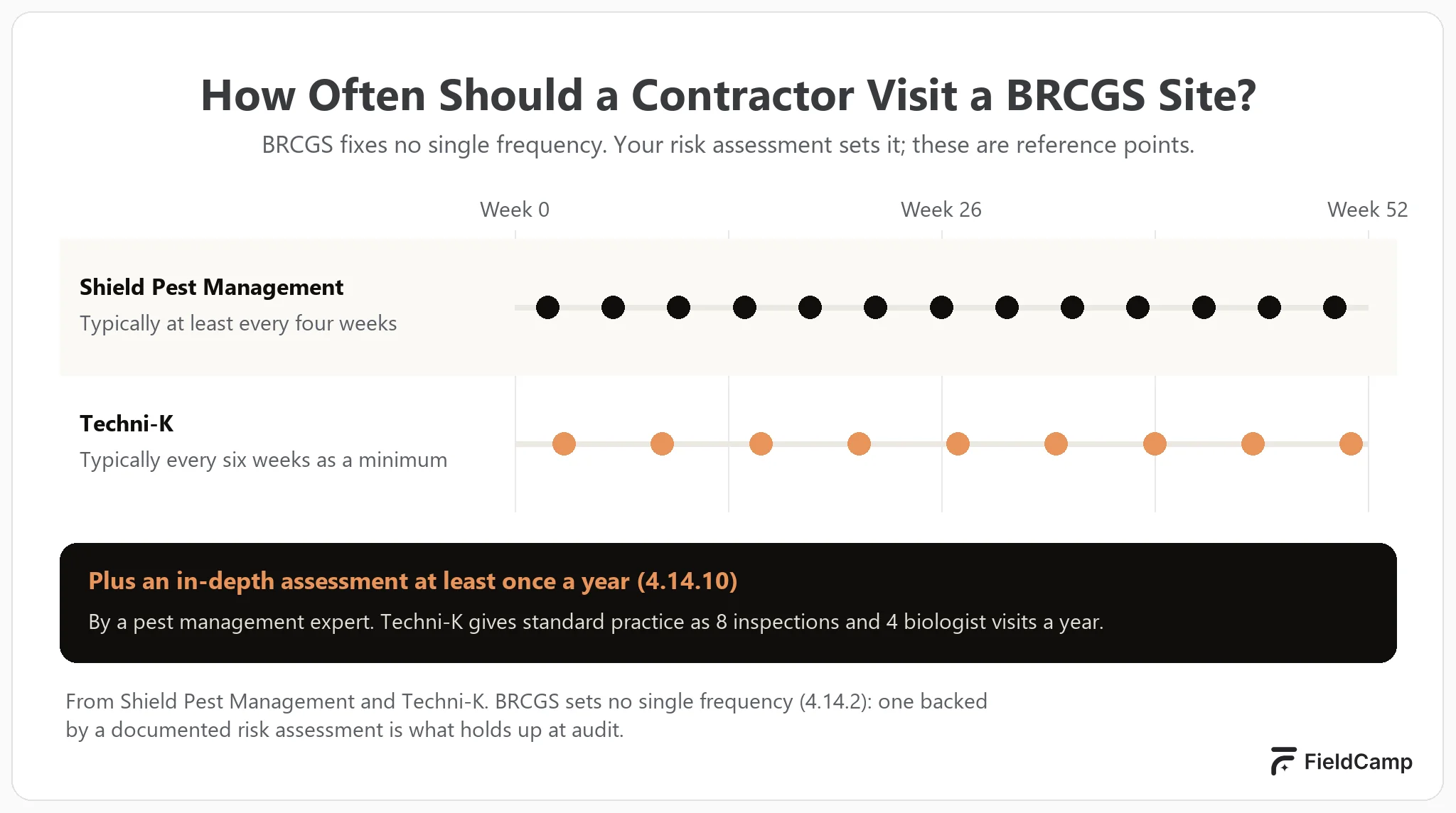
How often should a pest control contractor visit a BRCGS site?
Published figures differ by source:
- Shield Pest Management’s guidance says typically at least every four weeks.
- Techni-K says typically every six weeks as a minimum, with a 12-month schedule of inspections in place.
- Techni-K also gives standard contract practice as eight inspections and four biologist visits a year.
Treat these as reference points rather than rules. A frequency backed by a documented risk assessment is what holds up at audit.
What is the annual in-depth assessment?
BRCGS expects a documented, in-depth pest management assessment by a pest management expert at least once a year, or more often where the risk calls for it (4.14.10). Issue 8 called it a survey; Issue 9 calls it an assessment. It must include an in-depth inspection of the site, equipment and facilities, review the measures in place and recommend changes. Some contractors schedule field biologist inspections twice a year, as Shield Pest Management’s FAQ states. That goes beyond the BRCGS minimum rather than replacing it.
Who handles trend analysis?
Trend analysis means showing how pest activity changes over time and what was done about it. Issue 9 asks for inspection results, including those from trapping and monitoring devices, to be analysed at least once a year or after an infestation, and used to improve the programme (4.14.11). Device-level catch trending and auditor-facing dashboards are usually the job of dedicated pest-monitoring and reporting tools. Many contractors run one of these for the trending and keep their visits, reports and invoices in a separate field service system.
Preparing for a client or third-party audit: what auditors ask the pest contractor for
A client or third-party audit checks the pest contractor as a supplier of services as well as the pest control file. BRCGS clause 3.5.3 requires food sites to approve and monitor their service suppliers, with pest control named first, to hold a contract that sets out what the service covers, and to review the supplier’s performance on a documented basis. Retailer audits, AIB International’s Consolidated Standards, where integrated pest management is one of five scored categories, and SALSA audits for smaller producers ask for much the same evidence. SALSA audits move to new issues of its standards from 1 September 2026.
Two to four weeks before the audit, expect the site’s technical manager to ask you for:
- Approval documents: insurance certificates, trade association membership (BPCA or NPTA), and the signed contract and service scope.
- People: training certificates for every technician who visits, including RSPH/BPCA Level 2 and CRRU UK certificates for rodenticide users, and the field biologist’s qualifications.
- Products: an up-to-date product list with COSHH assessments and safety data sheets, matching what the visit reports say was used.
- The site plan: current, with every device numbered and matching the bait point list, plus any missing or moved stations explained.
- A complete run of reports: every routine visit and call-out since the last audit, with no gaps against the agreed frequency.
- Recommendations: the log of proofing and hygiene recommendations, showing which are closed and which are still open with the site.
- The latest in-depth assessment and trend analysis, with the actions that came from them.
- The risk assessment, showing it was reviewed after any building change, process change or significant pest issue.
On the day, the auditor may walk the site with the plan, open bait stations at random and ask staff what they would do if they saw a pest (4.14.12). Outside certified schemes, Environmental Health Officers check pest control against food hygiene law, and the FSA’s guidance on setting up food business premises names pest control as part of good food hygiene.
Who does what under clause 4.14: contractor or site
Clause 4.14.4 asks for “clearly defined responsibilities for the site management and the contractor”, but the standard does not allocate each duty. The split below is a reading of the Issue 9 clause text. Your contract scope decides it for each site.
| Duty | Contractor | Site | Clause |
|---|---|---|---|
| Use a competent pest management organisation or trained staff | Provides competence evidence | Selects, approves and monitors the provider | 4.14.2, 3.5.3 |
| Set visit frequency by risk assessment | Carries out and documents the risk assessment | Tells the contractor about building or process changes so it can be reviewed | 4.14.2 |
| Record and manage any infestation | Treats it and records it | Keeps product safe and acts at once to identify product at risk | 4.14.1, 4.14.8 |
| Keep the documentation and site plan current | Supplies the plan, device list, product details and visit records | Holds the file on site and confirms the plan at review | 4.14.4 |
| Place and maintain bait stations and monitors | Sites, services and secures them | Reports missing or moved stations; investigates with the contractor | 4.14.5 |
| Keep insect devices and bird proofing working | Services the devices in scope and advises on proofing | Maintains its own devices and carries out proofing work | 4.14.6, 4.14.7 |
| Raise recommendations, including proofing | Raises them in visit and assessment reports | Receives and records them | 4.14.9 |
| Action recommendations in good time and keep records | Advises and re-checks | Acts on them and records completion | 4.14.9 |
| Commission the in-depth assessment | Carries it out, through a pest management expert | Makes sure it happens at least yearly | 4.14.10 |
| Analyse trends | Usually prepares the analysis | Reviews it and uses it to improve the programme | 4.14.11 |
| Train staff to spot and report pests | May provide awareness training | Makes sure staff know and report to a named manager | 4.14.12 |
Keeping the evidence on one record
For a pest control service provider, BRCGS evidence breaks down when the visit report, the client’s documents and the contract billing live in different places. FieldCamp keeps them on one record. See how this fits a whole UK pest firm in pest control software for UK firms.
- Inspection reports as custom job forms. Job forms built in your own wording capture findings, actions, recommendations, products, quantities, photos and the site manager’s signature, so every visit produces a report in the same shape. The technician emails it from site; it arrives in the email body with a link to view and print, not as a PDF.
- Site documents on the site. The risk assessment, COSHH sheets and the signed site plan sit in the site’s files, ready to pull into the audit file.
- Bait points and recommendations as records. Each bait point is a record on the site, with its number, type and location, and each recommendation can be tracked as a record marked Open or Done, using custom objects. Findings kept as records can be exported to CSV, so the trend analysis can be charted in a spreadsheet.
- Commercial clients modelled properly. The client, the site and the bill payer can each be separate records, and the Bill-To client carries from estimate to job to invoice.
- A client tracking page. Documents you share appear in the client’s customer portal, alongside their visits and invoices, and each visit report also opens from its email link.
- Accounts and payments. Invoices sync with Xero, QuickBooks and Wave, and card payments run through Stripe.
- Alongside monitoring tools. FieldCamp does not draw floor plans, scan barcodes or produce catch-data trend graphs, and it holds no BRCGS certification or endorsement. Its public REST API and webhooks let it sit alongside the monitoring tool that does that work.
To see how this fits your commercial contracts, book a demo.
Frequently asked questions
Why does BRCGS want a preventive, risk-based pest programme rather than just treatment?
Why does BRCGS want a preventive, risk-based pest programme rather than just treatment?
Clause 4.14 asks for a documented, preventive, risk-based programme across the whole site, not treatment alone. Under integrated pest management (IPM), prevention and proofing come before treatment. The site-specific risk assessment also lets the provider justify the visit frequency and monitoring schedule.
Why do a pest control provider’s records affect the client’s audit result?
Why do a pest control provider’s records affect the client’s audit result?
The auditor judges the site on the evidence in its pest control file, and most of that evidence comes from the pest control provider. Gaps in the provider’s paperwork therefore become the client’s non-conformities. Dated visit reports, current competence evidence and clear recommendations keep the file complete.
Does FieldCamp do pest control trend analysis?
Does FieldCamp do pest control trend analysis?
Not as graphs. FieldCamp doesn’t draw trend charts, and answers on a visit form can’t be exported. Keep findings in a records list you set up (point, date, activity), export it to CSV and chart it in a spreadsheet, or run a dedicated pest-monitoring tool for device-level trending alongside FieldCamp through its public REST API and webhooks.
How should a proofing recommendation be handled between contractor and site?
How should a proofing recommendation be handled between contractor and site?
The contractor raises the recommendation, including any pest-proofing work, in the visit or assessment report. The site receives and records it, then acts on it in good time and records the completion date (clause 4.14.9). The contractor advises and re-checks.
What COSHH paperwork should a pest control contractor supply for a BRCGS site?
What COSHH paperwork should a pest control contractor supply for a BRCGS site?
Published guidance expects COSHH assessments for every product the contractor uses. The pest control file should also hold product safety data sheets, and clause 4.14.4 asks for product details, including instructions for effective use and what to do in an emergency. Keeping them with the technicians’ training records and the insurance certificates puts the safety evidence in one place for the auditor.
What qualifications do pest control technicians need for BRC sites?
What qualifications do pest control technicians need for BRC sites?
BRCGS asks for a competent contractor rather than naming a qualification. The industry minimum for a technician is the RSPH/BPCA Level 2 Award in Pest Management, and anyone using professional rodenticides now also needs a CRRU UK approved certificate. The person carrying out the in-depth assessment should be a pest management expert, such as a qualified field biologist.
How often should pest control trend analysis be done for BRCGS?
How often should pest control trend analysis be done for BRCGS?
At least once a year, and again after any infestation (clause 4.14.11). Many sites review trends more often, for example quarterly, so problem areas show up before the annual review. The analysis should include results from trapping and monitoring devices and lead to changes in the programme.
Can BRCGS pest control records be kept electronically?
Can BRCGS pest control records be kept electronically?
Yes. Clause 4.14.4 says records may be on paper or controlled on an electronic system, such as an online reporting system. Whatever you use, the auditor must be able to see the full set of records, including the site plan, device list, products used, observed activity and treatments.
What happens if a bait station goes missing on a BRCGS site?
What happens if a bait station goes missing on a BRCGS site?
It must be recorded, reviewed and investigated (clause 4.14.5). Note it on the visit report, check the site plan and replace or re-site the station, and agree with the site whether the loss points to a wider problem, such as damage from forklifts or cleaning.
How should a pest control contractor prepare for a client’s BRC audit?
How should a pest control contractor prepare for a client’s BRC audit?
Check the file against each sub-clause of 4.14 a few weeks before the audit date, using a checklist like the one above. Send the site’s technical manager your current insurance, competence certificates, product list and COSHH assessments, and close or explain any open recommendations. Make sure the site plan matches the bait points on the ground.
What does an AIB or SALSA audit ask about pest control?
What does an AIB or SALSA audit ask about pest control?
Both look for a documented, preventive pest programme run by a competent contractor, with records to prove it. AIB International scores integrated pest management as one of five categories in its Consolidated Standards. SALSA is aimed at smaller UK food and drink producers, and from 1 September 2026 its audits use the new issues of its standards, so check the current issue for the exact wording.
Get the BRCGS pest control audit checklist
Clause 4.14 checklist, contractor documents, site plan check, trend review and sign-off on printable A4 pages. No call required.
We’ll email you the PDF. See our privacy policy for how we handle your email.
See an audit file built from your visits
Bring one BRCGS site and see its visit reports, recommendations and site documents held on one record for the auditor.


