

Free Auto Detailing Invoice Template
About this template
Detailing a car takes precision. Billing for it shouldn’t take the same amount of effort. FieldCamp’s free auto detailing invoice template lets you document every service, from a basic exterior wash to a full ceramic coating application, in a clean, professional format that clients actually understand.
Fill in your client details, break down interior and exterior services, add material costs for products like wax, polish, and coating, and generate a car detailing receipt that looks as sharp as the finish you just put on. Whether you’re running a fixed shop or a mobile detailing operation working out of a van, this template adapts to how you work.
Key Features
- Mobile-ready layout for on-site invoicing
- Service package breakdowns with detailing invoice
- Auto tax calculation based on service location
- Before/after photo attachments to show results
,
|
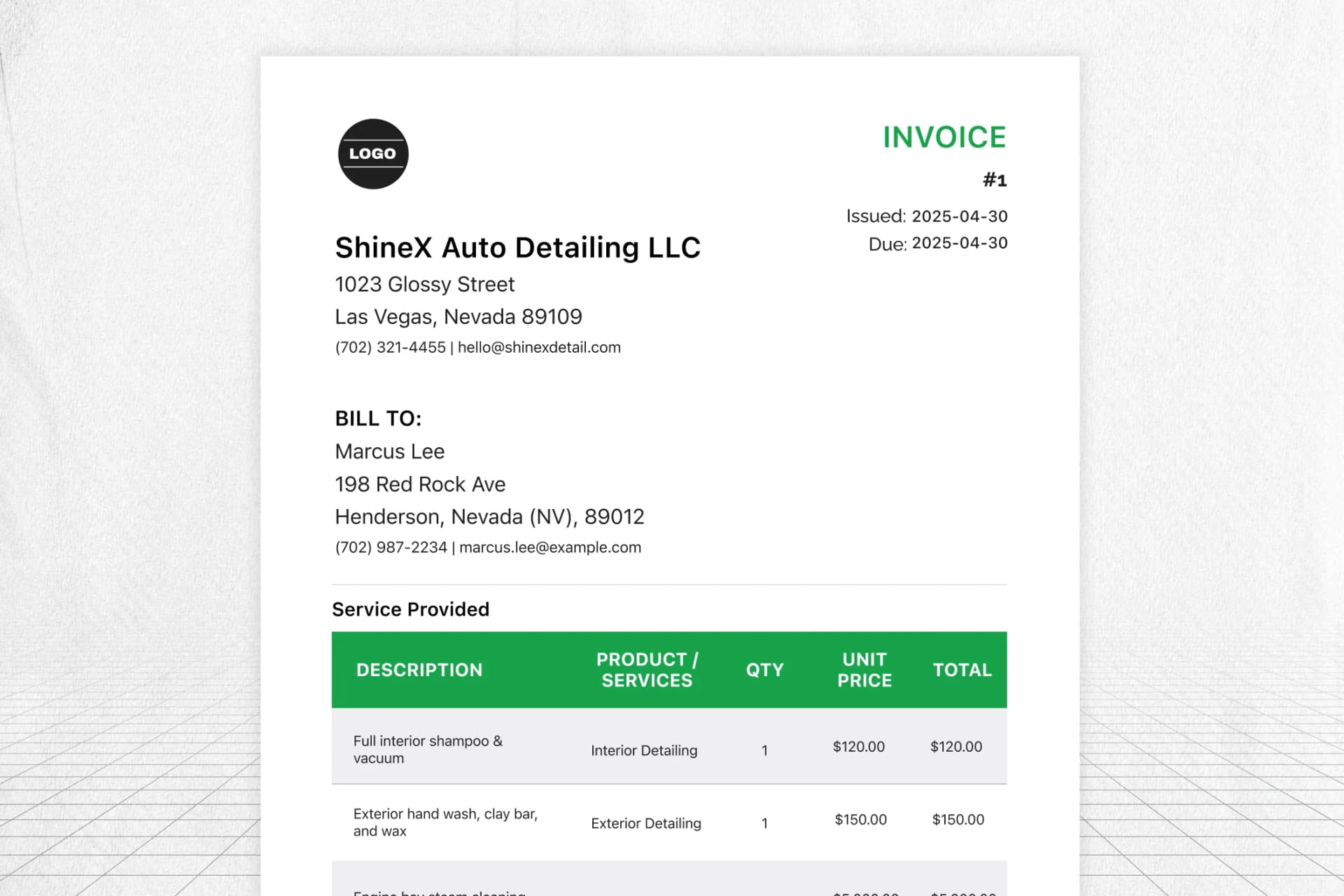
INVOICE
#1
Issued: 2026-03-05
Due: 2026-03-05
BILL TO:
Services Provided
| DESCRIPTION | PRODUCT / SERVICE | QTY | UNIT PRICE | TOTAL |
|---|---|---|---|---|
| Vacuum carpets, seats, and the trunk area | Full Interior Detail | 1 | $85.00 | $85.00 |
| Hand wash, clay bar treatment, premium wax | Exterior Wash & Wax | 1 | $125.00 | $125.00 |
| Polish and compound to remove swirl marks | Paint Correction | 1 | $175.00 | $175.00 |
How to Create an Auto Detailing Invoice?
Putting together a detailing invoice is straightforward once you have the right format. Here’s how to do it in six steps:
- Add your business details: Enter your company name, phone number, email, and address. Upload your logo so every invoice carries your brand. If you’re a mobile detailer, include your service area or city so the client knows exactly who they’re paying.
- Select your service packages: Choose the services you performed: interior detail, exterior wash and wax, full detail package, ceramic coating, paint correction, or any combination. Having predefined packages speeds up the process and keeps pricing consistent.
- Itemize individual services: Break down the specifics within each package. Vacuuming, steam cleaning, leather conditioning, clay bar treatment, machine polishing, and hand wax application. List each service with its cost. Clients appreciate knowing what they’re paying for, and it reduces questions after the fact.
- Add material costs separately: Products like ceramic coating, paint sealant, wheel cleaner, interior protectant, and microfiber towels have a cost. List the major materials used on the job, so the client sees the full picture, not just a flat number.
- Set clear payment terms: Specify when payment is due, what methods you accept (cash, card, Venmo, Zelle), and any deposit requirements for large jobs like full corrections or ceramic applications. Putting this on the invoice eliminates the awkward conversation later.
- Review and send: Double-check your line items, totals, and client information. Download the PDF and email it to the client, or hand them a printed copy on-site.
If you’re creating invoices regularly and want to stop rebuilding the same template every time, FieldCamp lets you create, send, and track invoices from one dashboard. Here’s how it works: Creating and Managing Invoices in FieldCamp.
What Should a Car Detailing Invoice Include?
Every car detailing invoice should answer one question for the client: What exactly am I paying for? Here’s the full checklist:
- Your business information: Company name, phone, email, website, and business address. If you’re licensed or insured, include that too. It builds trust, especially with first-time clients.
- Client details: Customer name, phone number, email, and the vehicle make, model, year, and color. Including vehicle details makes the invoice specific and professional.
- Invoice number and date: A unique identifier for every invoice. You’ll need this for your own bookkeeping and for handling any disputes.
- Vehicle condition notes: Document the vehicle’s condition before you start. This protects you if a client claims damage and adds context to your pricing (a neglected interior costs more to detail than a well-maintained one).
- Detailed service descriptions: Don’t write “detailing – $200.” Write “Full interior detail: vacuum, steam clean seats and carpets, leather conditioning, dashboard and console wipe-down, window cleaning, air freshener.” The more specific, the fewer payment disputes.
- Materials used: Ceramic coating brand and type, polish grade, wax product, and interior protectant. Clients who care about their cars want to know what products touched the paint.
- Labor charges: Time spent on the job and your rate. For complex work like multi-stage paint correction, breaking labor out separately helps justify higher pricing. If you’re unsure what to charge per hour, FieldCamp’s labor cost calculator can help you figure out the right number.
- Taxes and fees: Sales tax, mobile service fee, environmental disposal fee, whatever applies. Show each one separately.
- Total amount due: Big, bold, and clear.
- Payment terms: Due date, accepted payment methods, and any late payment policy.
Auto Detailing Price List Template
Knowing what to charge is half the battle. Whether you’re setting up your first price list or updating rates for the year, here’s a reference guide for standard auto detailing services in 2026.
Standard Auto Detailing Pricing by Service
| Service | Sedan / Coupe | SUV / Truck | Full-Size Van |
| Basic Exterior Wash | $25 – $50 | $35 – $65 | $45 – $80 |
| Interior Vacuum & Wipe | $50 – $75 | $65 – $100 | $80 – $120 |
| Full Interior Detail | $150 – $250 | $200 – $325 | $250 – $400 |
| Full Exterior Detail | $150 – $300 | $200 – $375 | $250 – $450 |
| Complete Detail (Int + Ext) | $250 – $450 | $325 – $550 | $400 – $700 |
| Ceramic Coating (Full Vehicle) | $500 – $1,500 | $700 – $2,000 | $900 – $2,500 |
| Single-Stage Paint Correction | $300 – $500 | $400 – $650 | $500 – $800 |
| Multi-Stage Paint Correction | $500 – $1,000 | $650 – $1,300 | $800 – $1,600 |
| Headlight Restoration | $50 – $100 | $50 – $100 | $50 – $100 |
| Engine Bay Cleaning | $50 – $100 | $60 – $125 | $75 – $150 |
| Odor Removal / Ozone Treatment | $75 – $150 | $100 – $200 | $125 – $250 |
Prices vary based on vehicle condition, your local market, and the products you use. A car that hasn’t been detailed in three years will cost more than a monthly maintenance client, price accordingly.
How to Set Your Detailing Rates
Your pricing needs to cover more than just your time. Here’s what should factor into every service price:
- Product costs: Ceramic coatings, polishes, waxes, interior chemicals, towels, and applicators. These add up, especially on premium jobs.
- Labor time: A full interior detail takes 2–4 hours, depending on condition. A multi-stage paint correction can take 6–10 hours. Know your time investment before setting a flat price.
- Overhead: Rent (if you have a shop), insurance, equipment wear, vehicle expenses (for mobile operations), water, and electricity.
- Profit margin: After covering costs, what’s left? If the answer is “not much,” your pricing needs work. Use a profit margin calculator to see exactly where your numbers land on each service.
If you’re building a price list from scratch and want to make sure your rates are sustainable, FieldCamp’s service price calculator walks you through the math: labor, materials, overhead, and your target margin, so you’re not guessing.
Mobile Detailing Invoice: What’s Different
Mobile detailing is one of the fastest-growing segments in the car care industry, and invoicing for it isn’t quite the same as billing from a fixed shop location. When you’re driving to the client’s driveway, office parking lot, or dealership, your invoice needs to account for things a shop-based detailer never thinks about.
What to Add on a Mobile Detailing Invoice
- Travel/service call fee: Most mobile detailers charge a flat travel fee ($25–$75, depending on distance) or a per-mile rate. List this as its own line item so the client understands it’s separate from the detailing work.
- Service location address: Include the exact address where the work was performed. This matters for your records, mileage tracking, and any insurance or tax purposes.
- Parking or access notes: If you had to pay for parking or needed special access (gated community, underground garage), note it on the invoice along with any associated fee.
- Equipment and water usage: Mobile detailers bring everything: water tanks, generators, pressure washers, and extraction machines. If you factor equipment usage into your pricing, a brief note on the invoice helps justify the cost.
- Appointment time and duration: Mobile clients often schedule around their day. Documenting the time slot and duration keeps both sides aligned, especially for recurring appointments.
Recurring Mobile Clients
If you’ve built a base of clients who book monthly or bi-weekly details, manually invoicing each one every cycle gets old fast. This is where automated billing makes a real difference.
FieldCamp lets you set up recurring invoices and automatic payment collection for repeat clients, so the invoice goes out and payment comes in without you touching anything. Here’s how to set that up: Auto-Deducting Payments for Invoices & Recurring Jobs.
Customizing Your Car Wash and Detailing Invoice
A generic invoice gets the job done. A customized one gets you remembered and referred. Here’s how to make this template work specifically for your detailing business:
- Brand it: Add your logo, use your brand colors if your invoicing tool supports it, and make sure your business name and contact details are front and center. First impressions matter, even on paperwork.
- Structure services into packages: Instead of listing 15 individual line items, group them into packages your clients already recognize: Basic Wash, Full Detail, Premium Restoration, Ceramic Protection. Then break down what’s included within each package.
- Include material details: Detailing clients’ care about products. If you used a specific ceramic coating brand or a premium carnauba wax, note it on the invoice. It reinforces the value and gives them something to talk about when they refer you.
- Add vehicle-specific information: Make, model, year, color, VIN (for high-end or fleet work). This turns a simple receipt into a proper service record that the client can reference.
- Set up mobile logistics: If you’re a mobile detailer, include your service radius, travel fee structure, and any minimum booking requirements right on the template so clients know the terms before they even book.
- Add before/after photos: If your invoicing platform supports it, attach photos. A side-by-side of a swirl-marked hood versus a freshly corrected one speaks louder than any line item.
For shops and mobile operations handling volume, FieldCamp’s invoicing software lets you build reusable templates, auto-populate client details, and send branded invoices without starting from scratch each time.
Auto Detailing, Auto Billing
Automate totals, apply taxes, and send invoices that reflect your professionalism. Create invoices that showcase your services, justify pricing, and speed up cash flow. Perfect for mobile detailers and shop owners alike.
Frequently Asked Questions
How do I price auto detailing services on my invoice?
Base your pricing on three things: vehicle size, vehicle condition, and service complexity. A basic exterior wash on a sedan is a different job than a full paint correction on a neglected SUV. Set your rates by service tier and adjust up for larger vehicles. List each service as a separate line item on the invoice so the client sees exactly what drives the total.
What should a car detailing invoice include?
At minimum: your business name and contact info, client name and vehicle details (make, model, year, color), a unique invoice number, the date, itemized service descriptions with individual pricing, material costs, labor charges, applicable taxes, total amount due, and payment terms. The more specific your service descriptions, the fewer questions you’ll get after sending it.
Can I include additional charges like travel fees and premium supplies?
Yes, and you should. Mobile detailing businesses should itemize travel fees, mileage charges, and premium supply costs as separate line items. If you used a $100 ceramic coating on the job, that’s not something to bury in a flat rate. Breaking out additional charges keeps pricing transparent and helps clients understand why a premium service costs more than a basic wash.
How can I customize the invoice template for my detailing business?
Add your company logo, brand colors, and full contact information. Modify the service categories to match what you actually offer: paint protection, engine detailing, odor removal, ceramic coating, and interior restoration. You can also add custom fields for vehicle information, package descriptions, and notes about products used.
Are there free auto detailing invoice tools available?
Yes. FieldCamp’s auto detailing invoice template is completely free to use without an account, trial, or strings. Fill in your details, customize the line items, and download a professional PDF. If you need more advanced features like recurring invoices, payment tracking, and client management, FieldCamp’s full platform handles that too.
When should I send a detailing invoice?
Send it immediately after completing the service. The work is fresh in the client’s mind, they can see the results right in front of them, and you’re more likely to get prompt payment. For mobile detailers, email the invoice before you’ve even packed up your equipment. For larger jobs with deposits, send a partial invoice upfront and the final balance upon completion.
How do I send invoices to detailing clients?
Email is the standard; send a PDF attachment with your invoice and a brief message thanking them for their business. For on-site mobile work, you can also print a copy and hand it over. If a client prefers text or a payment link, platforms like FieldCamp let you share invoices via a direct link the client can view and pay from their phone.
Does the template calculate taxes automatically?
Yes. Set your local tax rate in the template, and it applies automatically to the subtotal. You don’t need to calculate tax manually for each invoice; just make sure the rate is correct for your service area, and the template does the rest.
How can I make my detailing invoice stand out from competitors?
Three things make the biggest difference: include before/after photos of the actual vehicle you worked on, list the specific product brands you used (clients notice this), and write service descriptions that are detailed enough to show the scope of work. A line item that says “Full interior detail: deep vacuum, steam extraction, leather conditioning, UV protectant, window cleaning, air purification” tells a completely different story than “Interior – $200.”
What are the most common auto detailing invoice mistakes?
Vague service descriptions top the list, writing “detailing” with a flat price instead of breaking down what was included. Other common mistakes: forgetting to include vehicle information, leaving off payment terms (so the client doesn’t know when to pay), not itemizing materials separately from labor, and skipping the tax line. These small omissions lead to payment delays and disputes that eat into your time and cash flow.