

Free Electrical Invoice Template
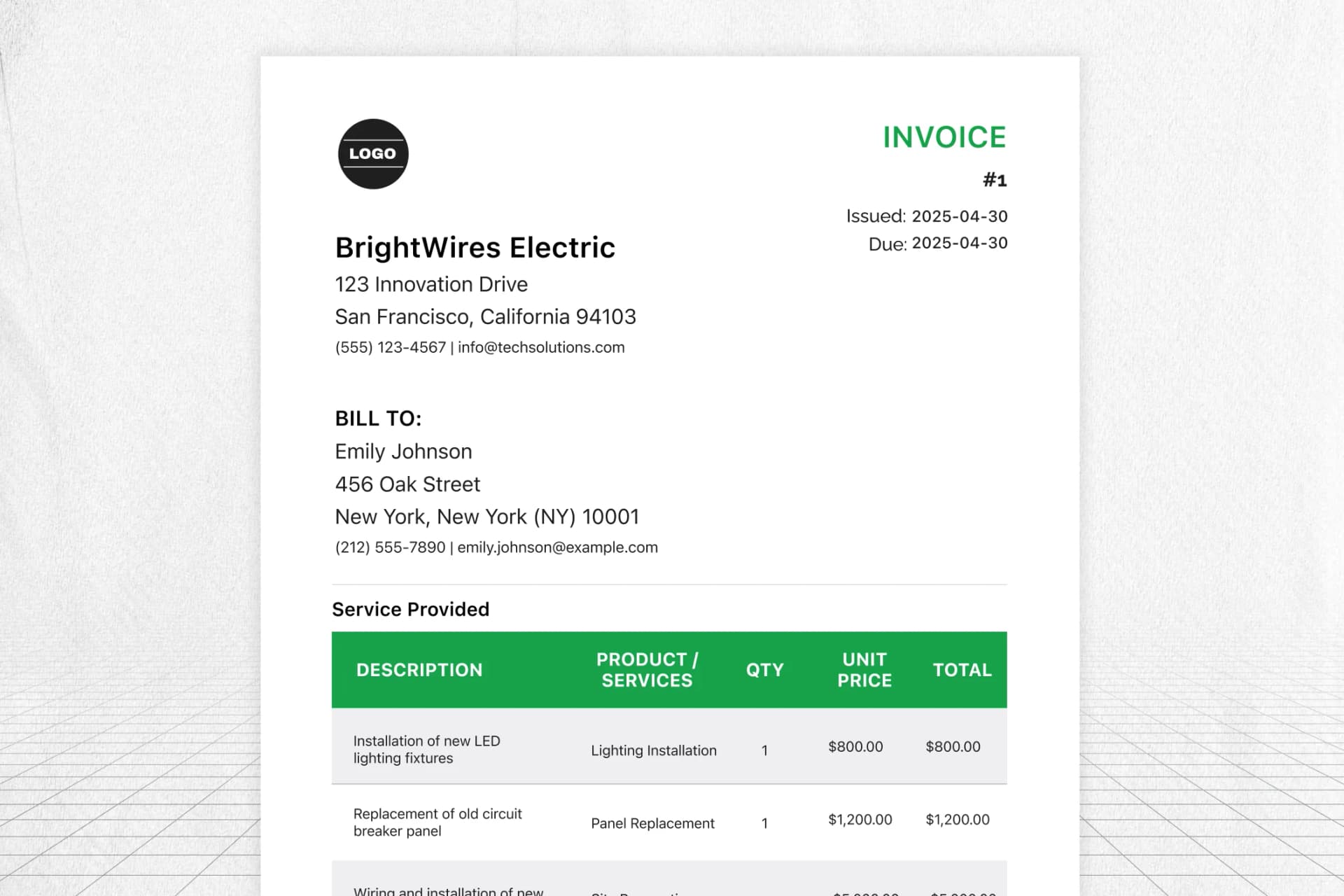
About this template
Electrical work is precise. Your invoicing should be too. FieldCamp’s free electrical invoice template is built specifically for electricians and electrical contractors, not retrofitted from a generic billing form. Add itemized services, materials with markup, permit fees, inspection charges, tax rates, and payment terms. Then download a clean, professional PDF ready to send to your client.
Whether you just finished a panel upgrade, a full rewire, or a quick outlet install, this template covers every line item an electrical job demands, including fields most generic templates forget entirely.
Key Features
- Invoice number for easy tracking and organization
- Customizable template for electrical job details
- Mobile-friendly for sending invoices on the go
- Detailed list of products and services provided
,
|
INVOICE
#1
Issued: 2026-03-24
Due: 2026-03-24
BILL TO:
Services Provided
| DESCRIPTION | PRODUCT / SERVICE | QTY | UNIT PRICE | TOTAL |
|---|---|---|---|---|
| Performed safety and code compliance checks | Inspection Fees | 1 | $50.00 | $50.00 |
| Used parts to fix wiring and components | Electrical Repair Materials | 1 | $100.00 | $100.00 |
| Completed repair and installation tasks | Labor for Electrical Work | 1 | $75.00 | $75.00 |
What Should an Electrical Invoice Include?
A professional electrician’s invoice isn’t just a payment request. It’s a record of the work performed, the codes followed, and the terms agreed upon. Incomplete invoices lead to payment disputes, callback confusion, and lost revenue.
Here’s what every electrical invoice should contain:
Business and Client Information
Start with the basics: your company name, license number, address, phone, and email. Then add your client’s name, property address, and contact details. If you’re working under a general contractor, include both the GC’s details and the property owner’s info. This keeps the paper trail clean if questions come up months later.
Invoice Number and Dates
Every invoice needs a unique number for tracking. Include the date the invoice was issued, the date the work was completed, and the payment due date. Sequential invoice numbers also make tax season significantly less painful; your bookkeeper will thank you.
Itemized Services with Descriptions
Don’t lump everything into a single “electrical work” line. Break it down. Your client should see exactly what they’re paying for:
- Panel upgrades and breaker replacements
- Circuit installation (new or rerouted)
- Outlet and switch installation
- Lighting fixture installation or replacement
- Troubleshooting and diagnostic fees
- Emergency or after-hours service surcharges
Each line item should include a brief description, the quantity (hours or units), the unit rate, and the total. This level of detail builds trust and reduces “why is this so expensive?” phone calls.
Permit Fees and Inspection Charges
Electrical work almost always involves permits. If you pulled a permit on behalf of your client, it should appear as its own line item, not buried inside labor costs. The same goes for inspection fees. Separating these charges shows transparency and protects you if the client later questions the bill.
Common permit-related line items include:
- Electrical permit fee (municipal)
- Rough-in inspection fee
- Final inspection fee
- Re-inspection fees (if applicable)
Materials and Markup
Materials are a significant portion of most electrical jobs. List each material used, wire gauge and length, breakers, panels, boxes, connectors, fixtures, along with the unit cost and quantity. Most electrical contractors apply a standard markup of 15% to 30% on materials to cover procurement time, transportation, and inventory carrying costs. Be upfront about this. Clients respect transparency over discovering hidden margins later.
If you want to calculate your exact labor and material costs before invoicing, FieldCamp’s labor cost calculator can help you dial in accurate numbers before sending anything to the client.
NEC Code References
This is where an electrician’s invoice separates itself from every other trade. Referencing the applicable National Electrical Code (NEC) articles on your invoice adds a layer of professionalism and legal protection that most competitors’ templates completely ignore.
For example:
- NEC Article 210 — Branch circuit work (outlet additions, circuit extensions)
- NEC Article 230 — Service entrance upgrades or replacements
- NEC Article 240 — Overcurrent protection (breaker replacements, panel work)
- NEC Article 250 — Grounding and bonding work
- NEC Article 300 — General wiring methods
- NEC Article 680 — Swimming pool and hot tub electrical installations
You don’t need to cite every article on every invoice. But when you reference the specific code that governed the work, it tells the client and any future inspector that the job was done by a licensed professional who follows code. It also protects you in liability situations.
Tax Calculations
Apply the correct sales tax rate for your jurisdiction. Tax rules for electrical work vary by state and sometimes by municipality. In most states, labor for new construction is taxable, while repair labor may be exempt. Materials are almost always taxable. When in doubt, consult your accountant, but your invoice should clearly show the tax percentage and the calculated amount.
Payment Terms
Spell out exactly when and how you expect to be paid. Common terms for electrical contractors include:
- Net 15 or Net 30 — payment due within 15 or 30 days
- Due upon completion — for smaller residential jobs
- 50/50 split — 50% deposit before work begins, balance due on completion
- Progress billing — for larger commercial or multi-phase projects
Include accepted payment methods (check, bank transfer, credit card, online payment) and any late payment penalties. A 1.5% monthly late fee is standard in the trades.
Warranty Terms
Every electrician should include warranty language on their invoices. This protects both you and the client. Standard warranty terms in the electrical trade include:
- 1-year labor warranty — covers workmanship defects
- Manufacturer warranty pass-through — for fixtures, panels, and equipment
- Exclusions — damage from power surges, flooding, or unauthorized modifications
Even a two-line warranty statement on your invoice is better than nothing. It sets expectations and prevents disputes down the road.
How to Fill Out This Electrical Invoice Template?
This template is designed so you can go from a completed job to a sent invoice in under five minutes. Here’s how to use it step by step.
Step 1: Enter Your Business Details
Select your country, then fill in your company name, address, phone number, and email. If you have a contractor license number, include it in your business details; it reinforces credibility.
Step 2: Set Invoice Number and Dates
The template auto-generates today’s date. Add your unique invoice number, the work completion date, and the payment due date based on your terms.
Step 3: Add Client Information
Enter your client’s name, address, and contact details. For commercial jobs, include the company name and the point-of-contact’s name.
Step 4: Build Your Line Items
This is where the template shines. Add each service as a separate line item:
- Description of the work performed
- Quantity (hours, units, or flat rate)
- Unit cost
- The template auto-calculates each line total
Click “Add Line Item” for each additional service, material, permit fee, or charge. Don’t combine unrelated charges; granularity is your friend.
Step 5: Apply Discounts and Tax
If you’re offering a discount (repeat customer, referral, bundle pricing), enter the percentage. Then set your applicable tax rate. The template calculates the final total automatically.
Step 6: Generate and Download
Hit “Generate Free Invoice,” and you’ll get a professional PDF with your company details, itemized charges, tax calculations, and totals. formatted and ready to send.
Need to send an estimate before the job starts? Use FieldCamp’s free electrical estimate template to quote the job, then come back here to invoice once the work is done.
Common Electrical Invoice Line Items and What to Charge
Knowing what to put on your invoice is one thing. Knowing what to charge is another. Here’s a breakdown of typical electrical services and the line items that should appear on your invoices.
Residential Electrical Services
| Service | Typical Line Item Description | Common Price Range |
|---|---|---|
| Outlet installation | Upgrade the main service panel to 200A, including new breakers and labeling per NEC 408 | $150 – $300 per outlet |
| Panel upgrade (100A to 200A) | Install a GFCI-protected outlet per NEC 210.8 | $1,500 – $3,000 |
| Ceiling fan installation | Install a ceiling fan with a new switch and wiring | $150 – $350 |
| Whole-house rewire | Complete rewire of [sq ft] residence, including new panel, all circuits, and final inspection | $8,000 – $15,000+ |
| GFCI outlet installation | Install a new 120V duplex outlet, including wiring from the nearest junction | $130 – $300 |
| Smoke detector installation (hardwired) | Install interconnected hardwired smoke detectors per NEC 760 | $150 – $300 per unit |
| EV charger installation | Install Level 2 EV charging station with dedicated 240V/50A circuit | Install a new 120V duplex outlet, including wiring from nearest junction |
For guidance on the right rates to include, our service pricing guide covers what professionals typically charge.
Commercial Electrical Services
| Service | Typical Line Item Description | Common Price Range |
|---|---|---|
| Commercial lighting retrofit | Install a standby generator with an automatic transfer switch per NEC 702 | $50 – $200 per fixture |
| Generator installation | Install a standby generator with an automatic transfer switch per NEC 702 | $5,000 – $15,000+ |
| Fire alarm system wiring | Install fire alarm circuits and connections per NEC 760 and local fire code | Varies by system size |
| Data/low-voltage cabling | Install Cat6 cabling runs with termination and testing | $150 – $300 per drop |
These prices are based on 2025–2026 averages sourced from industry pricing databases, including Angi, HomeGuide, HomeAdvisor, and Fixr. Actual costs vary by region, complexity, and local market conditions. The point is that each service should be its own line item on the invoice, not grouped under a vague “electrical work” umbrella.
For guidance on the right rates to include, our How to Charge for Travel Time covers what professionals typically charge.
Materials Markup: How to Price It Right
Materials markup is one of the most misunderstood parts of electrical invoicing. Some electricians eat the markup to “stay competitive.” Others bury it in labor rates. Both approaches cause problems.
Here’s the straightforward way to handle it:
- List materials at your cost on the invoice (what you paid the supplier)
- Add a separate “Materials Handling” line item at 15%–30% of material cost
- Or apply markup per-item so each material shows its retail/marked-up price
The industry standard markup for electrical materials sits between 20% and 25%. This covers:
- Time spent sourcing and ordering materials
- Fuel and vehicle costs for pickup
- Restocking and inventory management
- Waste and leftover materials from the job
Whichever method you choose, be consistent across all your invoices. If a client ever compares two of your invoices and sees different markup structures, it erodes trust quickly.
Why Use FieldCamp’s Electrical Invoice Template?
There are dozens of invoice templates online. Most of them are generic fillable PDFs that could be used for landscaping, plumbing, or selling handmade candles. They weren’t built with electrical work in mind.
This template was designed specifically for electricians and electrical contractors. That means:
- Line items pre-populated with common electrical services: inspection fees, repair materials, and labor are already there as starting points
- Tax calculations built in: enter your rate, and the math is done for you
- Discount fields, for repeat customers, referral pricing, or negotiated rates
- Clean, professional PDF output, your client sees a properly formatted invoice, not a thrown-together spreadsheet
- No sign-up required: fill it out and download, no email gates, no trial traps
- Mobile-friendly: fill it out on your phone between jobs
And when a free template isn’t enough anymore, when you’re managing multiple crews, juggling dozens of open jobs, and chasing payments across spreadsheets, FieldCamp’s electrician software handles estimates, invoicing, scheduling, dispatching, and CRM in one platform.
But that’s for when you’re ready. The template is here for right now.
From Estimates to Invoices: Streamline Your Entire Billing Workflow
Most electrical jobs follow a predictable billing path: estimate first, then invoice after completion. If you’re using separate tools (or worse, paper) for each step, you’re doubling your admin work.
Here’s how a clean workflow looks:
- Quote the job using an electrical estimate template
- Complete the work and document what was done
- Invoice the client using this template, matching line items to the original estimate
- Follow up on payment if the due date passes
When the volume picks up, and it will, you’ll want a system that connects these steps automatically. FieldCamp converts approved estimates into invoices with one click, sends automated payment reminders, and tracks everything in one place.
You can see exactly how invoice creation and management works or learn how to add contracts, terms, and attachments to your invoices in the documentation.
For electricians evaluating tools to manage their entire operation, not just invoicing, this roundup of the best electrician apps covers what’s available and how they compare.
The Longer Your Invoice Takes to Send, the Longer You Wait to Get Paid.
FieldCamp fires off invoices the moment a job wraps, with every line item, permit fee, and tax calculation already done. Your client pays. You move on.
Frequently Asked Questions
What are the best practices for creating electrician invoices?
Use a clean, professional layout and include every detail the client needs to process payment without questions. That means your business info, client info, a unique invoice number, itemized services with descriptions, materials listed separately, permit and inspection fees broken out, applicable taxes, payment terms, and warranty language. Reference NEC codes where applicable; it demonstrates professionalism and provides a record of code-compliant work. Use invoicing software to automate numbering, tax calculations, and payment reminders so nothing falls through the cracks.
When should electricians send invoices to customers?
Send the invoice as soon as the job is complete, ideally the same day. For larger projects with progress billing, send invoices at each agreed milestone (rough-in complete, final inspection passed, etc.). The faster an invoice goes out, the faster you get paid. Delayed invoicing signals disorganization to clients and pushes your cash flow further out. If you’re running multiple jobs per day, use a mobile-friendly template or invoicing app to generate invoices on-site before you leave the property.
Do electricians typically invoice for their work?
Yes. Every licensed electrical contractor should invoice for every job, no matter how small. Invoices serve as legal documentation of the work performed, the price agreed upon, and the payment terms. They’re also critical for tax reporting, warranty claims, and resolving disputes. Even for small residential repairs, a professional invoice protects your business and builds client confidence.
What’s the difference between an electrical estimate and an invoice?
An estimate is a projection of costs sent before work begins. An invoice is a bill for work already completed. Estimates help clients approve the job scope and budget. Invoices request payment for delivered work. The line items should closely match. If your invoice deviates significantly from the estimate, include a note explaining what changed and why (additional work discovered, material price changes, client-requested additions).
How do I handle change orders on an electrical invoice?
When the scope of work changes mid-job, a homeowner wants additional outlets, an inspector requires a panel upgrade, document the change order separately, and add it as a distinct section or line item group on your invoice. Label it clearly (e.g., “Change Order #1, Additional circuit added per client request on [date]”). This keeps the original scope clean and gives the client a clear paper trail for any additions.
Should I include my electrical license number on invoices?
Absolutely. Including your state electrical license number on every invoice signals legitimacy, satisfies many state and local requirements, and gives clients confidence that a licensed professional performed the work. In some jurisdictions, it’s legally required. Even where it’s not, it’s a trust signal that distinguishes you from unlicensed operators.
Can I send electrical invoices directly from FieldCamp?
Yes. FieldCamp’s electrician software lets you create, customize, and send invoices directly to clients, complete with itemized services, tax calculations, payment terms, and automated reminders. Clients can view and pay online. No printing, no mailing, no chasing.