
How to Charge for Window Cleaning: Pricing Guide + Formulas (2026)
January 13, 2026 - 19 min read


January 13, 2026 - 19 min read

Table of Contents
| TL;DR Window cleaning pricing comes down to knowing your costs, understanding your market, and choosing the right pricing model for each job type. Most US window cleaners charge $4 to $15 per window for residential work or $0.50 to $2.50 per square foot for commercial jobs. The average residential job runs $150 to $350, while commercial contracts range from $150 to $650 depending on size and frequency. |
KEY HIGHLIGHTS
Pricing Window Cleaning for Profit
Running a successful window cleaning business takes more than a squeegee and a bucket. One of the biggest challenges professional window washers face is pricing their services accurately. Undercharge, and you lose profit. Overcharge, and you risk losing clients. You’re not alone—many window washers struggle to strike the right balance.
According to IBISWorld’s 2024 report, the U.S. window cleaning industry is growing steadily, with increased demand from both residential and commercial sectors.
In fact, the window cleaning revenues in the U.S. are expected to reach $2.9 billion in 2024 and $3.2 billion by 2029 as more homeowners and businesses prioritize curb appeal and cleanliness. This growth presents a major opportunity—if you can price price window cleaning jobs right.
Whether you’re just starting your learning on how to start a cleaning business or quoting for a suburban home or a high-rise office building, understanding the right pricing model is essential.
In the detailed service pricing guide like one drafted below for you, we’ll break down proven methods used by professionals, along with real-world examples to help you quote with confidence.
Use our free window cleaning pricing calculator to generate accurate estimates in seconds. Let’s help you stay profitable—and competitive—every step of the way.
| Pricing Model | Typical Range | Best For |
| Per window | $4-$15 | Residential jobs |
| Per pane | $4-$8 | Detailed residential pricing |
| Per hour | $40-$75 | Simple jobs, time-based work |
| Per square foot | $0.50-$2.50 | Commercial buildings |
| Flat rate | $150-$350 | Standard home cleanings |
There are more than 35,000 businesses offering window cleaning services in the U.S., so smart pricing is a key way to stand out and stay profitable. (Source: IBISWorld)
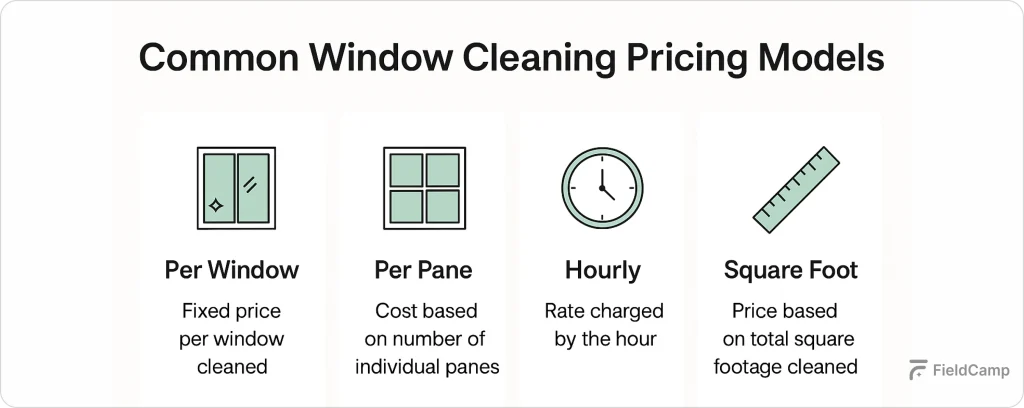
The short answer: residential window cleaning typically costs $10 to $15 per window or $4 to $8 per pane. Commercial rates run $0.50 to $2.50 per square foot. Your actual rate depends on your costs, local market, and job complexity.
Thumbtack data shows a national average cost of $283 for window cleaning, with most customers paying between $266 and $300 for a standard job and average hourly rates near $50 per hour. (Source: Thumbtack)
Residential jobs:
Commercial jobs:
Post-construction cleaning:
Cleaning the windows of a 1,500-square-foot house typically costs about $260, with most jobs ranging from $150 to $370 in the U.S. Use this as your baseline when quoting similar homes. (Source: Fixr)
If you also offer pressure washing services, bundling window cleaning with exterior cleaning can increase your average ticket significantly.
Stop guessing. Use this formula to price every job based on your actual costs plus profit margin.
Total Cost = Labor Cost + Material Cost + Overhead Cost
Labor cost: Hours to complete the job multiplied by your hourly rate. Learn more about how much to charge per hour for service businesses.
Material cost: Cleaning supplies, replacement squeegees, towels, and any specialty products needed for the job.
Overhead cost: Insurance, vehicle expenses, marketing, software, and administrative costs divided across your jobs. Use a labor cost calculator to get accurate numbers.
Total Price = Total Cost + (Profit Margin x Total Cost)
Example calculation:
One national analysis found the average residential window cleaning job in the U.S. costs around $220, with most projects ranging from $150 to $302. (Source: HomeGuide)
Most profitable window cleaning businesses aim for 20% to 35% net profit margins. If you are just starting out, aim for at least 20%. As you build efficiency and reputation, push toward 30% or higher.
For a complete walkthrough on setting up your pricing in FieldCamp, see our getting started guide.
Run Your Window Cleaning Business on Autopilot
From job scheduling and route planning to checklists and invoicing, FieldCamp keeps every window cleaning job organized and on time.
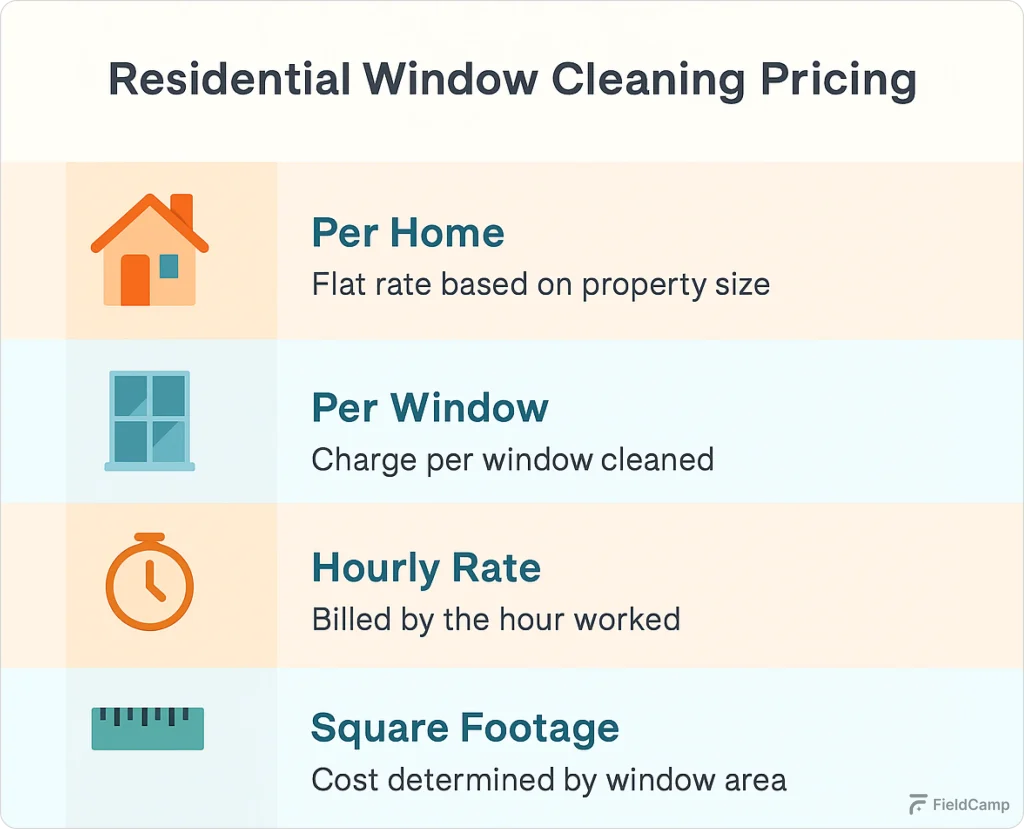
Residential pricing works best on a per-window or per-pane basis. Charging per pane is more precise and fair, as you will not be penalized for working efficiently, and clients will not worry about slow work.
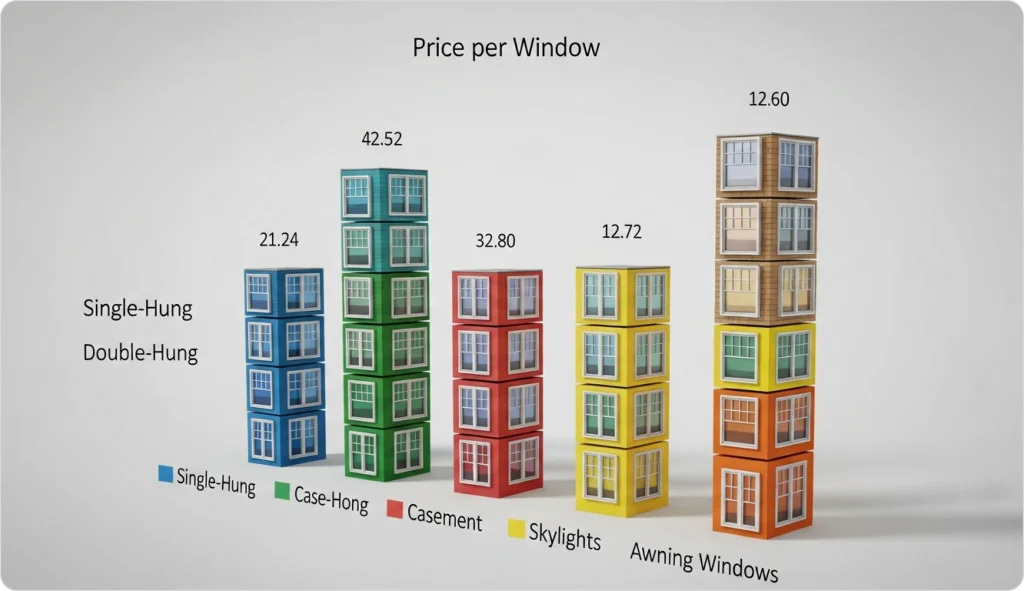
Typical U.S. pricing works out to $4 to $15 per window, with factors like size, height, and style driving the final rate. (Source: Angi)
| Window Type | Price Per Pane | Price Per Window |
| Single-hung (most common) | $4-$8 | $8-$16 |
| Double-hung | $4-$8 | $8-$16 |
| Sliding | $4-$5 | $8-$10 |
| Casement | $4-$15 | $15-$30 |
| Skylight | – | $25-$35 |
| Sunburst | – | $30-$40 |
| Storm windows | – | $30-$40 |
| French doors | – | $6 (half) / $12 (full) |
For example, washing a basic double-hung window often costs about $8, while a large picture window with eight panes can reach $40, or roughly $5 per pane. (Source: Fixr)
| Home Size (sq ft) | Estimated Windows | Average Price |
| 1,000 | 10 | $180 |
| 1,500 | 15 | $250 |
| 2,400 | 24 | $350 |
| 3,200 | 32 | $450 |
| 4,200 | 42 | $570 |
Add-on services like screen, shutter, or mineral deposit cleaning typically run from $2.50 up to $30 per item, which can significantly increase job totals. (Source: HomeGuide)
| Service | Price Range |
| Screen cleaning | $0.50-$8 per screen |
| Sills and tracks | $2-$4 per window |
| Hard water stain removal | $10-$30 per window |
| Shutter cleaning | $21-$26 per shutter |
| Dust removal | $1-$2 per window |
Build add-ons into your quotes. When you notice dirty walkways during an estimate, offer pressure washing. Bundle window cleaning with gutter cleaning and offer 10% off the package. This increases your average ticket size without extra travel.
Learn how to create professional estimates quickly in our estimates documentation.
Commercial window cleaning requires different thinking. Jobs are often priced by square foot rather than per window, and recurring contracts are where the real profit lives.
Another 2026 guide reports that residential window cleaning jobs usually range from $150 to $350, while commercial projects often fall between $150 and $650 depending on size and frequency. (Source: HomeAdvisor)
| Building Type | Price Per Sq Ft | Typical Job Range |
| Small storefront (<1,000 sq ft) | $0.15-$0.25 | $150-$250 |
| Office building (1,000-5,000 sq ft) | $0.10-$0.20 | $250-$450 |
| Large commercial (5,000-10,000 sq ft) | $0.08-$0.15 | $350-$550 |
| High-rise | $0.15-$0.30 | $500+ |
| Frequency | Price Adjustment |
| Weekly | Full rate |
| Bi-weekly | 5-10% discount |
| Monthly | 10-15% discount |
| Quarterly | 15-20% discount |
Warning:
Commercial clients often pay on net 30 to net 90 terms. You need enough cash flow to cover payroll while waiting for payment. Factor this into your pricing or require deposits for large contracts.
Learn more about service pricing strategies that work across different field service industries.
Use our free estimate generator to quickly generate per window quotes that include your labor costs and profit margins.
Both models work. The right choice depends on your business stage and job type.
Pros:
Cons:
Best for: Residential work, repeat customers, standardized services
Pros:
Cons:
Best for: Post-construction cleaning, first-time deep cleans, commercial jobs with unknown scope
Angi notes that many pros charge $4 to $8 per window or $10 to $15 per hour, with experienced companies and those carrying strong insurance often billing at the higher end of that range. (Source: Angi)
Many successful window cleaners use a hybrid model: base price per window plus hourly adjustments for complexity. Quote a per-window rate for standard cleaning, then add time-based charges for extras like hard water removal or construction debris.
Start with $10 per window for standard residential work. Track your time on your first 10 to 20 jobs. If you are completing jobs in less than an hour and the client is happy, your pricing is in the right range. Adjust based on your actual costs and local market.
Create a standardized price sheet that every team member uses. Include base rates per window type, add-on prices, and minimum job charges. Use field service software to store your pricing rules so quotes are consistent whether you are quoting or your newest employee is.
With AI dispatching for small teams, you can ensure the right technician gets assigned to the right job based on skills, location, and availability.
Build in complexity modifiers:
Customers expect fast responses. If you are taking 24 to 48 hours to quote, you are losing jobs to faster competitors. Use software that lets you generate quotes from your phone immediately after an on-site visit, or set up online booking with instant pricing.
Learn how to automate your quoting process in our workflow builder documentation.
Price Every Window Cleaning Job With Confidence
FieldCamp helps you create consistent quotes, track job profitability, and make sure every technician follows the same pricing rules.
Every job has fixed costs: driving to the site, setting up equipment, and the administrative work of scheduling and invoicing. Your minimum charge should cover these costs plus profit.
Fixed costs per job:
Add your profit margin (25%):
Round up for simplicity:
Most window cleaners set minimums between $75 and $150. Do not take jobs below your minimum unless they are in the same neighborhood as other scheduled work. Using multi-stop route planning with AI helps you cluster jobs in the same area to maximize efficiency.
For new customers: Simply update your price sheet. No explanation needed.
For existing customers:
How often: Review pricing annually at minimum. Adjust for inflation and rising costs.
1. Research the property: Use Google Maps or satellite view to estimate size and window count before arriving.
2. Confirm scope: Ask about interior vs exterior only, screens, tracks, and any special requirements.
3. Check condition: Ask when windows were last cleaned. Long gaps mean more work.
1. Count everything: Walk the entire property. Do not miss basement windows, transoms, or garage door glass.
2. Note complexity: Flag high windows, difficult access, or heavy soiling.
3. Look for upsells: Dirty gutters? Stained siding? Offer a package deal.
4. Quote on the spot: Customers prefer immediate answers. Use a mobile app to generate quotes in front of them. Get a free window cleaning estimate template to get started.
1. Follow up: If you do not hear back in 3 days, send a friendly reminder.
2. Track outcomes: Note which quotes you win and lose. Look for patterns.
3. Ask for feedback: When you lose a bid, politely ask why. Was it price? Timing? Competition?
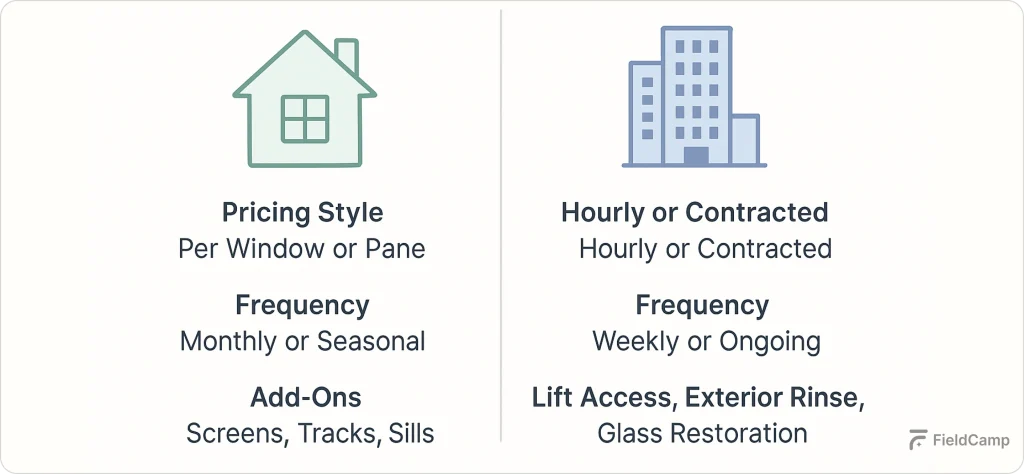
| Factor | Residential | Commercial |
| Pricing model | Per window or per pane | Per square foot |
| Payment timing | Immediate or net 7 | Net 30 to net 90 |
| Job frequency | 1-2x per year | Weekly to monthly |
| Contract length | One-time or informal | Formal contracts |
| Decision maker | Homeowner | Property manager or owner |
| Price sensitivity | High | Moderate |
| Relationship building | Personal | Professional |
Commercial contracts provide predictable, recurring revenue. A $200 monthly storefront contract generates $2,400 per year from one relationship. Build 20 similar accounts and you have $48,000 in stable annual revenue before adding residential work.
Exterior window cleaning is a large and growing segment: globally, exterior window cleaning generated about $6.8 billion in 2024 and is forecast to reach $10.0 billion by 2030, growing around 6.8% annually. (Source: Grand View Research)
The trade-off: longer payment terms require better cash flow management, and winning contracts often requires professional proposals and references. Learn about field service invoicing to get paid faster.
For step-by-step instructions on creating and managing invoices, check our invoicing documentation.
Window cleaning pricing isn’t about guessing—it’s about knowing your costs and applying clear, repeatable formulas. When you price based on labor, overhead, and job complexity, every job stays profitable and predictable.
The most successful window cleaners use simple pricing rules, standardize quotes, and rely on recurring commercial contracts to stabilize revenue. With the right field service software, you can automate estimates, keep pricing consistent across your team, optimize routes, and track which jobs actually make money.
If you want faster quotes, better margins, and fewer pricing mistakes, it starts with the right system.
Book a demo and see how FieldCamp helps window cleaning businesses price smarter and scale with confidence.
Per window pricing is usually better for residential work because it rewards efficiency and gives customers predictable pricing. Hourly rates work better for post-construction cleaning or jobs with unknown complexity. Many cleaners use a hybrid approach with per-window base rates and hourly adjustments for extras.
Window cleaners in the US typically charge $40 to $75 per hour for residential work. Commercial rates can be higher, especially for high-rise work where specialized equipment and safety measures are required. Hourly rates should cover your labor, overhead, and profit margin.
Use this formula: Total Price = (Labor Cost + Material Cost + Overhead Cost) x (1 + Profit Margin). First calculate your total cost to complete the job, then add your desired profit margin (20-35% is typical). Track your actual job times to refine your estimates over time.
Yes. AI-powered field service software can apply your pricing rules consistently, generate professional quotes in seconds, and track which quotes convert to jobs. This eliminates manual calculations and ensures every quote reflects your actual costs and profit goals. Learn more about how to get started with AI dispatch.
Building height, window accessibility, cleaning frequency, and total square footage are the primary factors. Commercial window cleaning service rates range from $5-$15 per window for standard buildings to $100-$170 per hour for high-rise work.
Review pricing annually or when costs increase significantly (fuel, insurance, wages). Track your profit margins monthly and adjust if they fall below your target 15-25% range. Market research every 6 months helps maintain competitive positioning.
Focus on value rather than just price. Highlight your insurance, professional training, satisfaction guarantee, and time savings for the client. Offer service packages or payment plans when appropriate, but avoid competing solely on price.